Aguilar Elena, Sousa Daniel, Uhrin Amy V, Gudino-Elizondo Napoleon, Biggs Trent
Department of Geography, San Diego State University, San Diego, CA, 92182, USA.
National Oceanic and Atmospheric Administration, National Ocean Service, Office of Response and Restoration, Marine Debris Division, Silver Spring, MD, 20910, USA.
Environ Monit Assess. 2025 Jun 25;197(7):802. doi: 10.1007/s10661-025-14125-z.
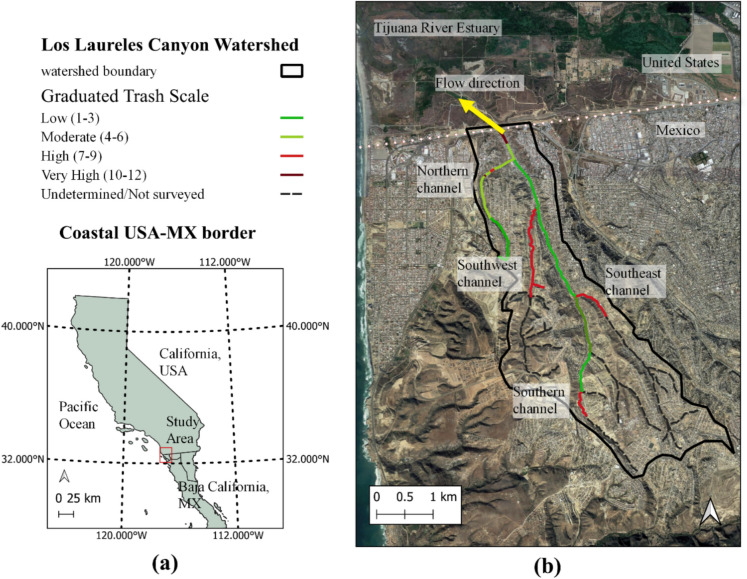
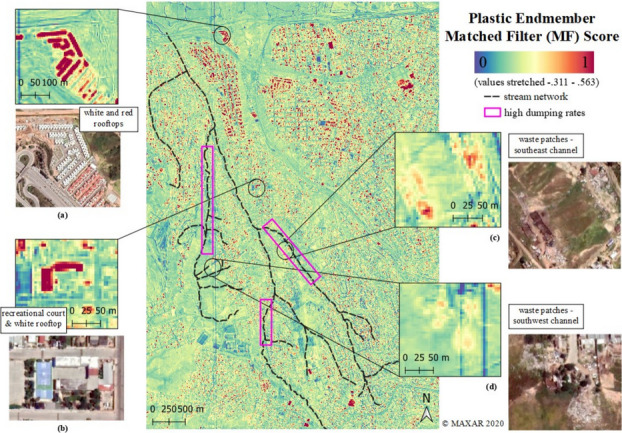
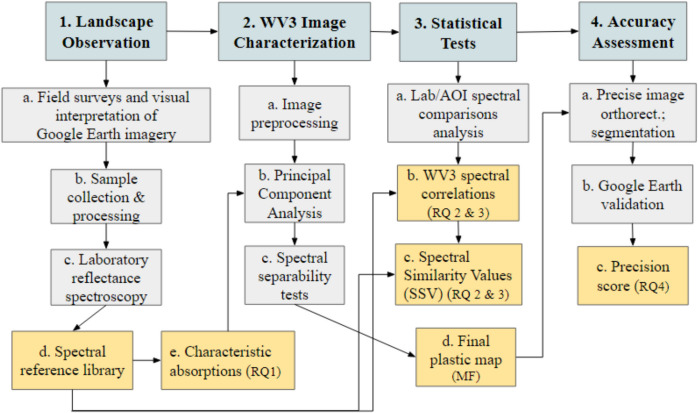
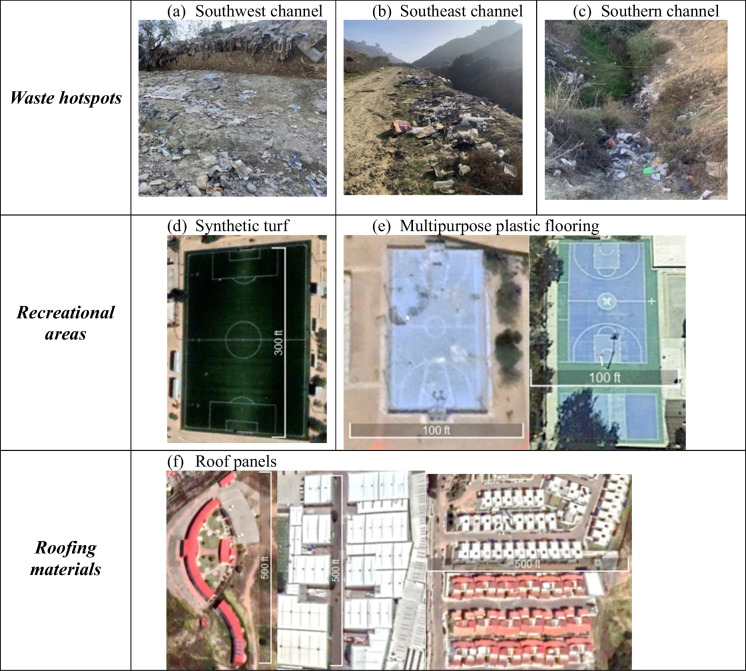
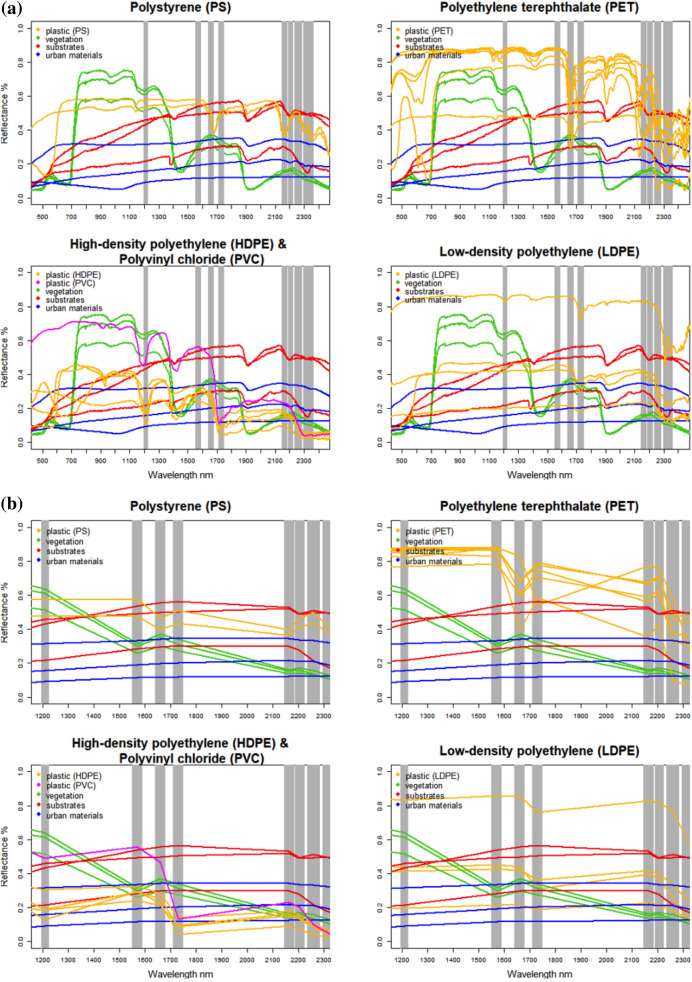
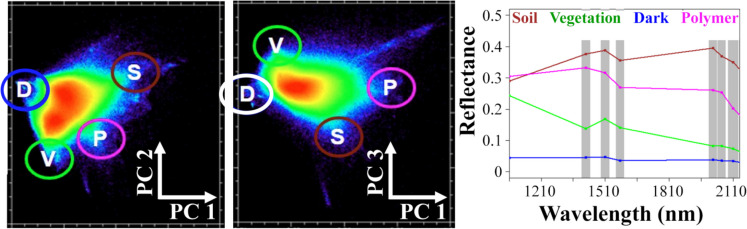
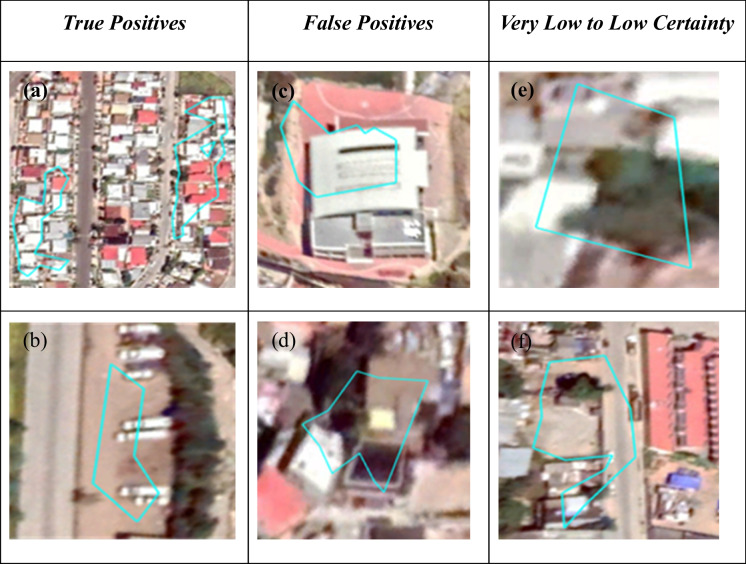
The presence and abundance of synthetic polymers can be used to map mismanaged waste, housing quality, and other development indicators. For various common urban plastic polymers, spectral absorption features in the shortwave infrared (SWIR) wavelengths can be captured using laboratory reflectance spectroscopy. In addition, SWIR bands of the WorldView-3 (WV3) satellite sensor are known to capture absorptions specific to these polymers. The ≈4-m ground sampling distance of WV3 offers the potential to spatially resolve urban aggregations of polymer-based debris and differentiate these from natural and other anthropogenic materials. Synthesizing field work, laboratory reflectance spectroscopy, and satellite image analysis, we mapped suspected polymer-based materials in a complex urban watershed on the coastal US-Mexico border. Field surveys identified several large (80-150 m) unmanaged waste aggregations in stream channels. 1024-band laboratory reflectance spectra of field-collected macroplastics (25-1000 mm) showed consistent absorption features that were often preserved when convolved to the 8-band spectral response function of the WV3 SWIR sensor. Laboratory spectra for high- and low-density polyethylene, polyethylene terephthalate, and polyvinyl chloride correlated closely (r = 0.95; p < 0.01) and had high spectral similarity with an independently derived endmember selected from a bounding apex of the spectral feature space of a WV3 image of the area. Matched filtering identified areas corresponding to infrastructure inferred to be of polymer-based or -coated materials as well as waste aggregations. Mapping precision scores ranged from 0.92 to 0.95. Our study suggests that some common plastic polymers may be distinguishable in this study area using a generalized WV3 SWIR image endmember.
合成聚合物的存在和丰度可用于绘制管理不善的垃圾、住房质量及其他发展指标。对于各种常见的城市塑料聚合物,可利用实验室反射光谱法捕捉短波红外(SWIR)波长下的光谱吸收特征。此外,已知WorldView-3(WV3)卫星传感器的SWIR波段能捕捉这些聚合物特有的吸收。WV3约4米的地面采样距离有潜力在空间上分辨基于聚合物的碎片的城市聚集情况,并将其与天然材料和其他人为材料区分开来。综合实地调查、实验室反射光谱法和卫星图像分析,我们绘制了美国-墨西哥边境沿海一个复杂城市流域中疑似基于聚合物的材料分布图。实地调查在河道中发现了几处大型(80 - 150米)未管理的垃圾聚集点。对实地采集的大型塑料(25 - 1000毫米)进行的1024波段实验室反射光谱显示出一致的吸收特征,当卷积到WV3 SWIR传感器的8波段光谱响应函数时,这些特征通常得以保留。高密度和低密度聚乙烯、聚对苯二甲酸乙二酯及聚氯乙烯的实验室光谱相关性密切(r = 0.95;p < 0.01),并且与从该区域WV3图像光谱特征空间的边界顶点独立推导得出的端元具有很高的光谱相似性。匹配滤波识别出了与推断为基于聚合物或涂覆聚合物材料的基础设施以及垃圾聚集点相对应的区域。测绘精度得分在0.92至0.95之间。我们的研究表明,在本研究区域,使用广义的WV3 SWIR图像端元可能可以区分一些常见的塑料聚合物。