Jia Ledong, Li Shengting, Zhang Chao, Zeng Lijun, Shen Shulin, Yin Nengwen, Zhao Huiyan, Tang Zhanglin, Qu Cunmin, Li Jiana, Chen Zhiyou
Integrative Science Center of Germplasm Creation in Western China (CHONGQING) Science City and Southwest University, College of Agronomy and Biotechnology, Southwest University, Chongqing 400715, China.
Guizhou Rapeseed Research Institute, Guizhou Academy of Agricultural Sciences, Guiyang 550006, China.
Biology (Basel). 2025 Jun 13;14(6):693. doi: 10.3390/biology14060693.
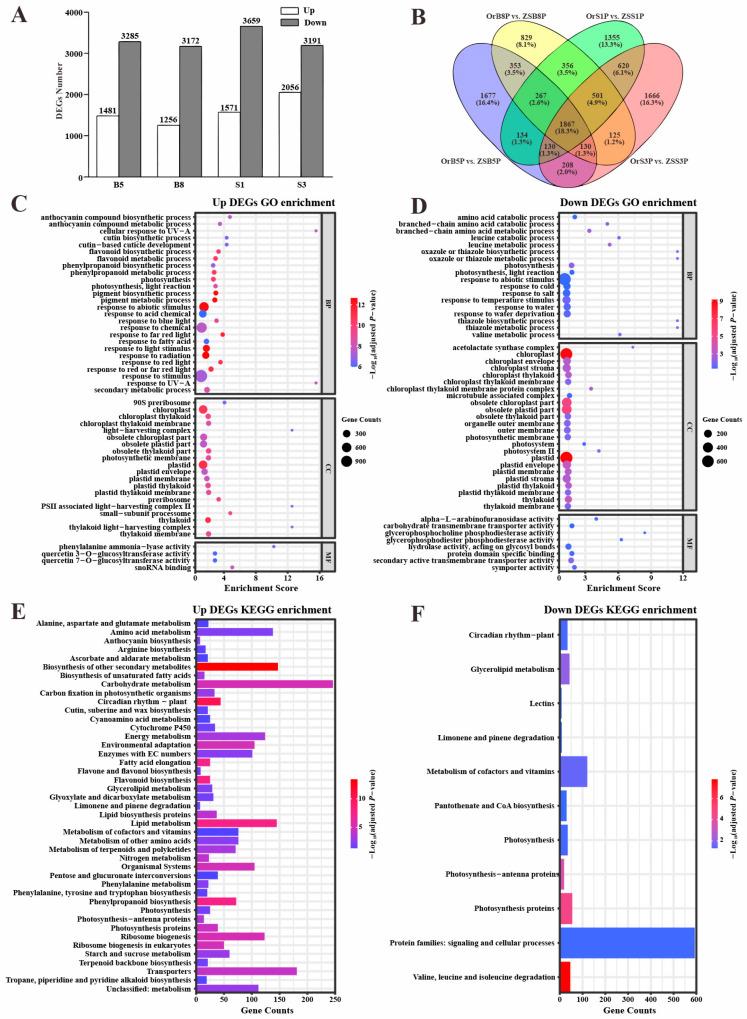
Rapeseed ( L.) has been cultivated as an ornamental plant in recent years. However, the metabolic and regulatory processes involved in pigment accumulation in. flowers are poorly understood. To address this knowledge gap, we conducted a multi-omics analysis of the orange-red-flowered 'OrP' and the yellow-flowered 'ZS11' rapeseed cultivars. The total anthocyanin content of 'OrP' petals was 5.420-fold and 3.345-fold higher than 'ZS11' petals at the S2 and S4 developmental stages, respectively. The red coloration of 'OrP' flowers resulted primarily from the presence of anthocyanin pigment derivatives. The up-regulated differentially expressed genes (DEGs) of four stages in 'OrP' were found to be significantly enriched in phenylpropanoid, flavonoid, and anthocyanin metabolism-associated GO and KEGG terms. Weighted Gene Co-expression Network Analysis (WGCNA) revealed that 51 DEGs were linked to anthocyanin metabolism, including several structural genes such as , , , , , , , and the transcription factor (TF) genes , , , , , , and . Furthermore, we found that three main factors affecting the relative content of anthocyanins in petals were likely responsible for the fading of 'OrP' petals, namely the significantly down-regulated expression of genes (, , , and ) related to anthocyanin biosynthesis, the significantly up-regulated expression of genes (, and ) related to anthocyanin degradation or the negative regulation of anthocyanin biosynthesis, and the rapidly increasing petals area.
近年来,油菜(L.)已被作为观赏植物进行栽培。然而,人们对花朵色素积累所涉及的代谢和调控过程了解甚少。为了填补这一知识空白,我们对橙红色花朵的‘OrP’和黄色花朵的‘ZS11’油菜品种进行了多组学分析。在S2和S4发育阶段,‘OrP’花瓣的总花青素含量分别比‘ZS11’花瓣高5.420倍和3.345倍。‘OrP’花朵的红色主要源于花青素色素衍生物的存在。发现‘OrP’四个阶段上调的差异表达基因(DEGs)在苯丙烷、类黄酮和花青素代谢相关的GO和KEGG术语中显著富集。加权基因共表达网络分析(WGCNA)显示,51个DEGs与花青素代谢相关,包括几个结构基因,如 、 、 、 、 、 、 以及转录因子(TF)基因 、 、 、 、 、 、 。此外,我们发现影响花瓣中花青素相对含量的三个主要因素可能是导致‘OrP’花瓣褪色的原因,即与花青素生物合成相关的基因( 、 、 、 和 )表达显著下调,与花青素降解或花青素生物合成负调控相关的基因( 、 和 )表达显著上调,以及花瓣面积迅速增加。