Boudrag Sabrina, Arendt Elke K, Segura Godoy Celia, Sahin Aylin W, Nyhan Laura, Cashman Kevin D, Zannini Emanuele
School of Food and Nutritional Sciences, University College Cork, College Road, T12 YN60 Cork, Ireland.
APC Microbiome Ireland, Biosciences Building, University College Cork, T12 YT20 Cork, Ireland.
Foods. 2025 Jun 11;14(12):2055. doi: 10.3390/foods14122055.
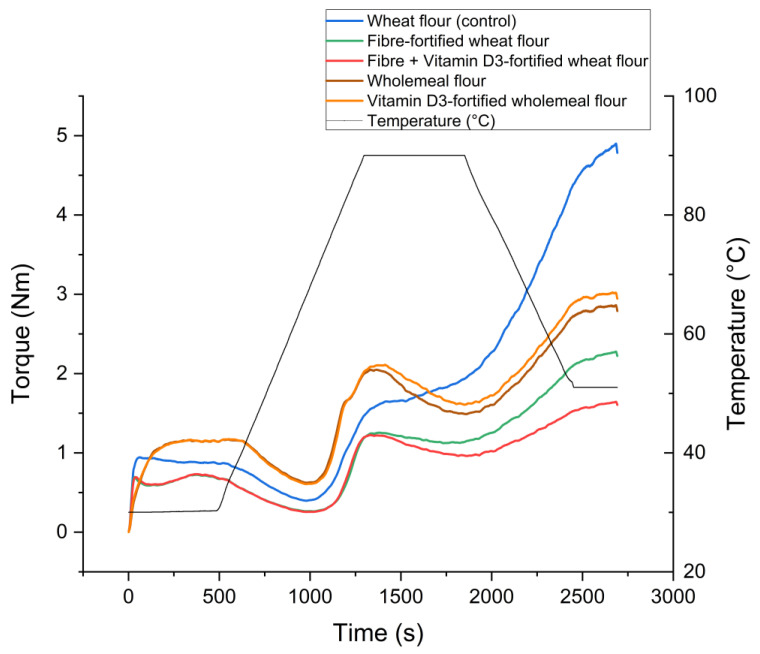
Inadequate vitamin D and dietary fibre intake are growing public health concerns in Western countries, especially in regions with limited sunlight and diets rich in processed foods. Bakery products, widely consumed, offer a promising opportunity for nutritional fortification. This study explored the possibility of fortifying white wheat bread-a staple food but low in fibre-with vitamin D and various dietary fibres (oat fibre, pectin, cellulose, and beta-glucan). The goal was to enhance its nutritional profile while maintaining desirable bread qualities. Using Response Surface Methodology (RSM), an empirical model, optimised the fibre combination. A range of dough and bread analyses were conducted-including assessments of gluten structure, starch pasting, fermentation activity, crumb hardness, specific volume, and colourimetry. The results showed fibre addition weakened the gluten network and altered starch properties (reduced peak, final and breakdown viscosities)-reducing loaf volume (4.2 ± 0.4 mL/g vs. 4.8 ± 0.1 mL/g for the control)-though to a lesser extent than in wholemeal bread (2.4 ± 0.1 mL/g), while vitamin D inclusion had a minimal impact (4.0 ± 0.4 mL/g for white bread, 2.1 ± 0.0 mL/g for wholemeal bread). The study identified an optimal mix of soluble and insoluble fibres with vitamin D that preserved the texture, crumb structure, and appearance of standard white bread. The final product offered fibre levels (Total Dietary Fibre, TDF = 10.72 ± 0.31 g/100 g bread, vs. 3.81 ± 0.06 g/100 g for the control) comparable to those of wholemeal bread (TDF = 9.54 ± 0.67 g/100 g), with improved texture and volume. This approach presents an effective strategy to enhance staple foods, potentially improving public health through better nutrient intake without compromising consumer acceptance.
在西方国家,维生素D和膳食纤维摄入不足正日益引起公众健康关注,尤其是在阳光有限且饮食富含加工食品的地区。广泛消费的烘焙食品为营养强化提供了一个有前景的机会。本研究探索了用维生素D和各种膳食纤维(燕麦纤维、果胶、纤维素和β-葡聚糖)强化白小麦面包(一种主食但纤维含量低)的可能性。目标是在保持理想面包品质的同时提高其营养成分。使用响应面法(RSM),一种经验模型,优化了纤维组合。进行了一系列面团和面包分析,包括对面筋结构、淀粉糊化、发酵活性、面包心硬度、比容和比色法的评估。结果表明,添加纤维会削弱面筋网络并改变淀粉特性(降低峰值、最终和破损粘度),从而降低面包体积(对照组为4.8±0.1 mL/g,添加纤维后为4.2±0.4 mL/g),不过程度小于全麦面包(2.4±0.1 mL/g),而添加维生素D的影响最小(白面包为4.0±0.4 mL/g,全麦面包为2.1±0.0 mL/g)。该研究确定了一种维生素D与可溶性和不溶性纤维的最佳组合,该组合保留了标准白面包的质地、面包心结构和外观。最终产品的纤维含量(总膳食纤维,TDF = 10.72±0.31 g/100 g面包,对照组为3.81±0.06 g/100 g)与全麦面包(TDF = 9.54±0.67 g/100 g)相当,且质地和体积有所改善。这种方法提出了一种强化主食的有效策略,有可能通过更好的营养摄入改善公众健康,同时不影响消费者的接受度。