Jiménez-Sierra Lucia, López-de-Andres Ana, Hernández-Barrera Valentín, Jiménez-Garcia Rodrigo, Carabantes-Alarcon David, Bodas-Pinedo Andrés, Labajo-Gonzalez Elena, Zamorano-León José J
Department of Public Health and Maternal & Child Health, Faculty of Medicine, Universidad Complutense de Madrid, IdISSC, 28040 Madrid, Spain.
Department of Public Health and Maternal & Child Health, Faculty of Pharmacy, Universidad Complutense de Madrid, IdISSC, 28040 Madrid, Spain.
J Clin Med. 2025 Jun 8;14(12):4053. doi: 10.3390/jcm14124053.
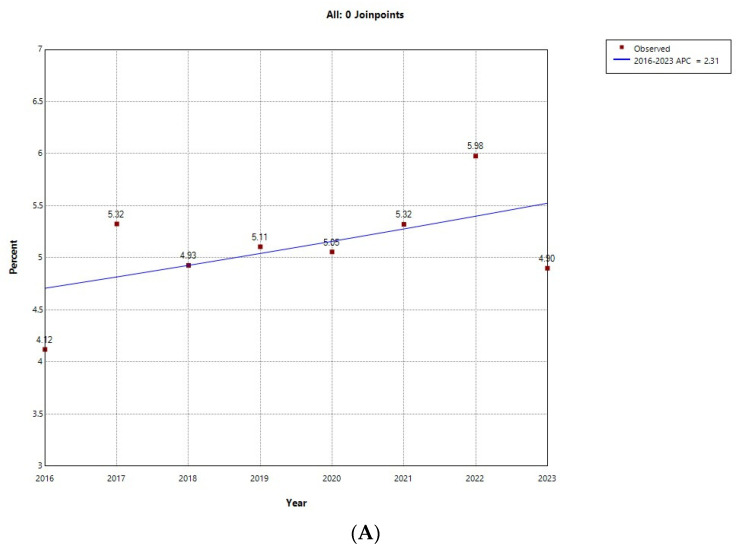
We aim to describe and analyze the clinical characteristics and hospital outcomes of alcohol-related hospital admissions (ARHAs) among adolescents and young adults (12 to 35 years) with type 1 diabetes (T1D) in Spain from 2016 to 2023. We also aim to determine factors associated with admission to the intensive care unit (ICU). : A descriptive observational study was carried out based on the Spanish Hospital Discharge Database (SHDD). ICD-10 codes were used to identify ARHAs in T1D patients. Joinpoint regression was used to analyze the time trend, and multivariable logistic regression was conducted to identify predictors of ICU admission. : We recorded 39,091 discharges with T1D (52.59% females); of these, 1274 (3.26% prevalence) were identified as ARHAs (74.10% males vs. 25.90% females). Joinpoint regression showed a significant increase among females and stable prevalence in males. Females with T1D and ARHAs were younger than males, and more frequently had diabetic ketoacidosis (DKA), mental disorders, and external causes of morbidity and mortality, whereas greater drug use was detected among males. Overall, 20.80% of ARHAs required ICU admission. Predictors of ICU admission included DKA, drug use, hypoglycemia, and female sex (OR: 1.39; 95% CI: 1.02-1.90). : The frequency of ARHAs in young people with T1D in Spain rose between 2016 and 2023, mainly owing to the increase in the percentage of females requiring ARHA. DKA and drug and tobacco consumption were very common in ARHAs. Admission to the ICU is frequent, increases over time, and is associated with female sex, DKA, hypoglycemia, and drug use.
我们旨在描述和分析2016年至2023年西班牙12至35岁1型糖尿病(T1D)青少年及青年成人中酒精相关住院(ARHA)的临床特征及住院结局。我们还旨在确定与入住重症监护病房(ICU)相关的因素。:基于西班牙医院出院数据库(SHDD)开展了一项描述性观察性研究。使用国际疾病分类第十版(ICD - 10)编码识别T1D患者中的ARHA。采用Joinpoint回归分析时间趋势,并进行多变量逻辑回归以确定ICU入住的预测因素。:我们记录了39091例T1D患者出院情况(女性占52.59%);其中,1274例(患病率3.26%)被确定为ARHA(男性占74.10%,女性占25.90%)。Joinpoint回归显示女性患病率显著上升,男性患病率稳定。患有T1D和ARHA的女性比男性更年轻,更常出现糖尿病酮症酸中毒(DKA)、精神障碍以及发病和死亡的外部原因,而男性药物使用情况更普遍。总体而言,20.80%的ARHA患者需要入住ICU。ICU入住的预测因素包括DKA、药物使用、低血糖和女性性别(比值比:1.39;95%置信区间:1.02 - 1.90)。:西班牙T1D青少年及青年成人中ARHA的频率在2016年至2023年期间有所上升,主要是由于需要ARHA的女性比例增加。DKA以及药物和烟草消费在ARHA中非常常见。入住ICU很常见,且随时间增加,与女性性别、DKA、低血糖和药物使用有关。