Lee Sungjae, Kim Heungjo, Lee Hongjae, Hahn Jongsung, Chang Min Jung
Department of Pharmacy and Yonsei Institute of Pharmaceutical Sciences, Yonsei University, Incheon 21983, Republic of Korea.
Department of Pharmaceutical Medicine and Regulatory Science, Yonsei University, Incheon 21983, Republic of Korea.
J Clin Med. 2025 Jun 9;14(12):4077. doi: 10.3390/jcm14124077.
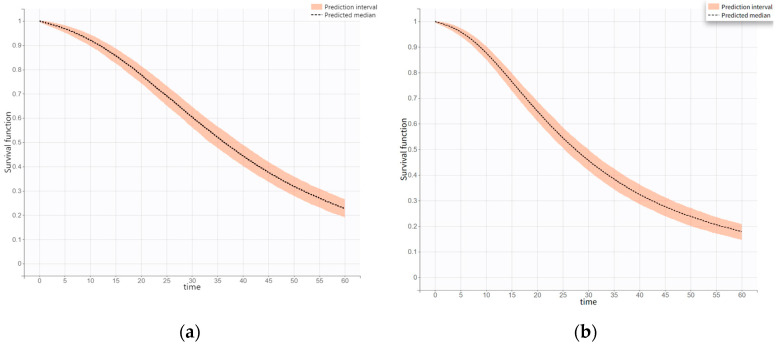
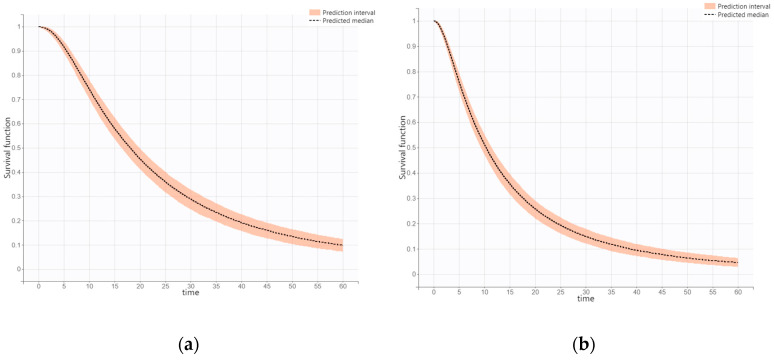
To predict the survival rates of Osimertinib as first- and second-line therapy using time-to-event models based on literature data. Kaplan-Meier curves from randomized clinical trials were extracted after a systematic search of PubMed and Cochrane Library from their inception to 10 May 2023. Randomized clinical trials of Osimertinib reporting both first- and second-line overall survival (OS) and progression-free survival (PFS) in NSCLC patients with specific mutations, compared to earlier epidermal growth factor receptor (EGFR) inhibitors and chemotherapy. Kaplan-Meier curves of OS and PFS were extracted from published articles. A two-column raw dataset (time, survival probability) was extracted, and time-to-event outcomes (time, event) were derived using a graphic reconstructive algorithm. Data analysis was conducted from 1 June 2023 to 31 January 2024. Primary outcomes included OS and PFS for time-to-event modeling of Osimertinib as first- and second-line therapy. The Weibull model, incorporating race as a covariate, best fit the first-line OS data. The log-logistic model best fit first-line PFS and second-line OS/PFS data. Based on these models, the predicted median OS for first-line and second-line treatment were 36.35 months (95% CI, 33.53-39.30 months) and 27.46 months (95% CI, 25.30-29.99 months), respectively. The predicted median PFS were 18.11 months (95% CI, 16.37-19.90 months) and 10.35 months (95% CI, 9.31-11.44 months), respectively. The predicted 3- and 5-year survival rates with first-line Osimertinib were 51% and 23%, respectively. Subgroup analysis revealed longer estimated 3- and 5-year survival rates for non-Asian patients compared to Asian patients (60% vs. 49% and 29% vs. 21%, respectively). The predicted survival rates from the time-to-event modeling align with the original clinical trial results, and an ethnic difference in Osimertinib efficacy was observed.
基于文献数据,使用事件发生时间模型预测奥希替尼作为一线和二线治疗的生存率。在对PubMed和Cochrane图书馆从创建到2023年5月10日进行系统检索后,提取了随机临床试验的Kaplan-Meier曲线。奥希替尼的随机临床试验报告了特定突变的非小细胞肺癌(NSCLC)患者的一线和二线总生存期(OS)及无进展生存期(PFS),并与早期表皮生长因子受体(EGFR)抑制剂和化疗进行了比较。从已发表文章中提取OS和PFS的Kaplan-Meier曲线。提取了一个两列的原始数据集(时间,生存概率),并使用图形重建算法得出事件发生时间结果(时间,事件)。数据分析于2023年6月1日至2024年1月31日进行。主要结局包括奥希替尼作为一线和二线治疗的事件发生时间建模的OS和PFS。纳入种族作为协变量的威布尔模型最适合一线OS数据。对数逻辑模型最适合一线PFS和二线OS/PFS数据。基于这些模型,一线和二线治疗的预测中位OS分别为36.35个月(95%CI,33.53 - 39.30个月)和27.46个月(95%CI,25.30 - 29.99个月)。预测的中位PFS分别为18.11个月(95%CI,16.37 - 19.90个月)和10.35个月(95%CI,9.31 - 11.44个月)。一线使用奥希替尼的预测3年和5年生存率分别为51%和23%。亚组分析显示,非亚洲患者的估计3年和5年生存率比亚洲患者更长(分别为60%对49%和29%对21%)。事件发生时间建模的预测生存率与原始临床试验结果一致,并且观察到奥希替尼疗效存在种族差异。