Movahedi Nia Zahra, Prescod Cheryl, Westin Michelle, Perkins Patricia, Goitom Mary, Fevrier Kesha, Bawa Sylvia, Kong Jude Dzevela
Resilience Research Atlantic Alliance on Sustainability, Supporting Recovery and Renewal (REASURE2) Network, Toronto, ON, Canada.
Africa-Canada Artificial Intelligence and Data Innovation Consortium (ACADIC), Department of Mathematics and Statistics, York University, Toronto, ON, Canada.
Front Public Health. 2025 Jun 11;13:1448812. doi: 10.3389/fpubh.2025.1448812. eCollection 2025.
This work aims to study the disproportionate impact of the COVID-19 pandemic on the Jane and Finch community, one of the socially vulnerable neighborhoods in the Greater Toronto Area (GTA), Ontario, Canada, in terms of morbidity, mortality, and healthcare services.
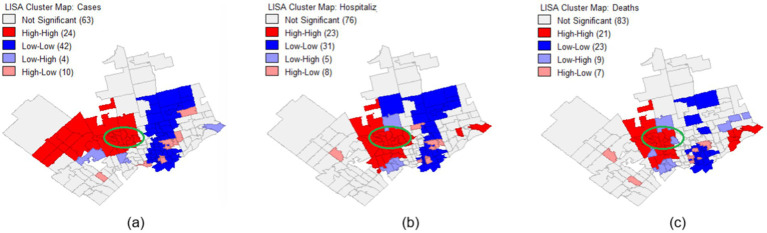
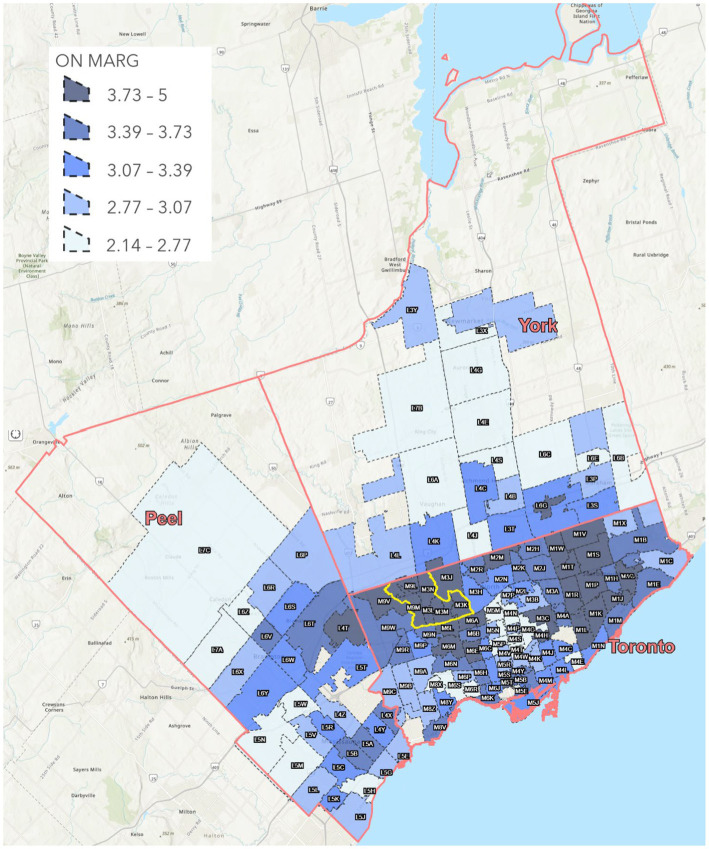
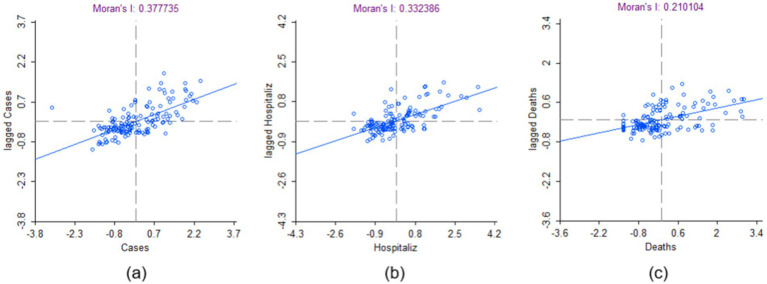
A dataset provided by the Black Creek Community Health Centre (BCCHC), gathered from different health-related portals, covering various health statistics during COVID-19, namely, COVID-19 number of cases, hospitalizations, deaths, percentage of vaccination with one-, two-, and three-dose(s), Primary and Preventive Care (PPC) visits which include fecal and pap-smear cancer tests, and percentage of completed Imaging, Procedures, and Surgeries (IPS) which include the number of patients waiting for surgery were studied using statistical analysis. Underserved communities in the Peel, York, and City of Toronto regions were recognized using the Ontario Marginalized Index (ON-Marg). The Jane and Finch community was selected from the fifth quintile of the ON-Marg index and compared with the remaining locations (first to fourth ON-Marg quantiles) using Kruskal-Wallis, Mann-Whitney u, and -tests. The Gini index was used to understand the inequality of the health parameters among the selected neighborhoods. Local Indicator of Spatial Association (LISA) was used to detect the neighborhoods with significantly higher numbers of COVID-19 cases, hospitalizations, and mortalities.
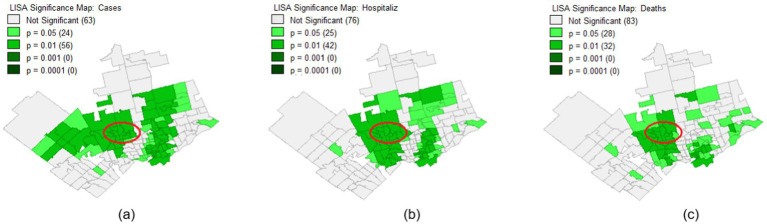
The Jane and Finch community had a significantly ( < 0.0001) higher number of COVID-19 cases, hospitalizations, and mortalities. The significance and cluster analysis of LISA also extracted the Jane and Finch community as one of the hotspots with significantly higher COVID-19 infection, hospitalization, and death. The percentage of the third-dose vaccination was significantly lower for the Jane and Finch community ( = 0.0004). The number of patients during the COVID-19 pandemic versus before that decreased significantly more for pop-smear tests ( = 0.041) and surgery waitlists ( = 0.037) for the Jane and Finch community.
As one of the most socially vulnerable communities of GTA, the Jane and Finch community has endured a heavier burden of the disease during the COVID-19 pandemic. This work aims to help the Jane and Finch community recover faster by shedding light on health areas in which it has suffered more from the COVID-19 outcomes.
本研究旨在探讨新冠疫情对加拿大安大略省大多伦多地区(GTA)社会弱势群体社区之一简芬奇社区在发病率、死亡率和医疗服务方面的不均衡影响。
使用黑溪社区健康中心(BCCHC)提供的数据集,该数据集来自不同的健康相关门户网站,涵盖新冠疫情期间的各种健康统计数据,即新冠病例数、住院人数、死亡人数、一剂、两剂和三剂疫苗接种百分比、初级和预防保健(PPC)就诊情况(包括粪便和巴氏涂片癌症检测)以及完成的影像、程序和手术(IPS)百分比(包括等待手术的患者人数),并进行统计分析。使用安大略省边缘化指数(ON-Marg)识别皮尔、约克和多伦多市地区的服务不足社区。简芬奇社区从ON-Marg指数的第五分位数中选取,并使用克鲁斯卡尔-沃利斯检验、曼-惠特尼U检验和t检验与其余地区(ON-Marg指数的第一至第四分位数)进行比较。基尼指数用于了解所选社区中健康参数的不平等情况。局部空间自相关指标(LISA)用于检测新冠病例、住院人数和死亡人数显著较多的社区。
简芬奇社区的新冠病例数、住院人数和死亡人数显著更高(P<0.0001)。LISA的显著性和聚类分析也将简芬奇社区列为新冠感染、住院和死亡人数显著更高的热点地区之一。简芬奇社区的三剂疫苗接种百分比显著较低(P = 0.0004)。与疫情前相比,简芬奇社区在新冠疫情期间巴氏涂片检测(P = 0.041)和手术等候名单上的患者人数下降幅度更大(P = 0.037)。
作为大多伦多地区社会最脆弱的社区之一,简芬奇社区在新冠疫情期间承受了更沉重的疾病负担。本研究旨在通过揭示简芬奇社区在新冠疫情影响下受影响更大的健康领域,帮助其更快恢复。