Arbel Yuval, Fialkoff Chaim, Kerner Amichai, Kerner Miryam
Sir Harry Solomon School of Economics and Management, Western Galilee College, Derech Hamichlala, P.O. Box 2125, 2412101 Acre, Israel.
Institute of Urban and Regional Studies, Hebrew University of Jerusalem, Mt. Scopus, 9190501 Jerusalem, Israel.
Ann Reg Sci. 2022;68(1):181-206. doi: 10.1007/s00168-021-01073-y. Epub 2021 Aug 29.
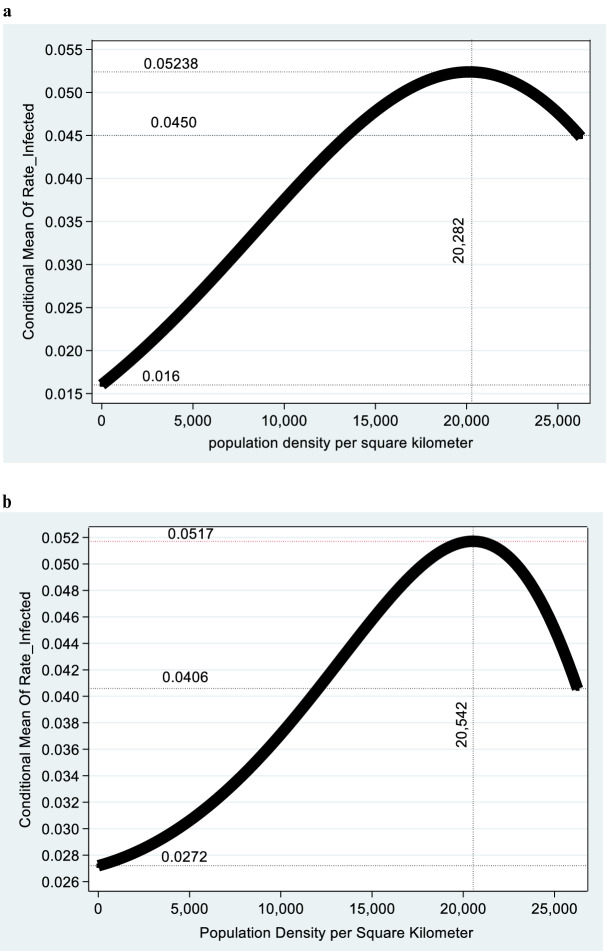
A prominent characteristic of the COVID-19 pandemic is the marked geographic variation in COVID-19 prevalence. The objective of the current study is to assess the influence of population density and socio-economic measures (socio-economic ranking and the Gini Index) across cities on coronavirus infection rates. Israel provides an interesting case study based on the highly non-uniform distribution of urban populations, the existence of one of the most densely populated cities in the world and diversified populations. Moreover, COVID19 challenges the consensus regarding compact planning design. Consequently, it is important to analyze the relationship between COVID19 spread and population density. The outcomes of our study show that projected probabilities to be infected from coronavirus with population density from 1.6 to 2.72% up to a maximum of 5.17-5.238% for a population density of 20,282-20,542 persons per square kilometer (sq. km.). Above this benchmark, the anticipated infection rate up to 4.06-4.50%. Projected infection rates of 4.06-4.50% are equal in cities, towns and regional councils (Local Authorities) with the maximal population density of 26,510 and 11,979-13,343 persons per sq. km. A possible interpretation is that while denser cities facilitate human interactions, they also enable and promote improved health infrastructure. This, in turn, contributes to medical literacy, namely, elevated awareness to the benefits associated with compliance with hygienic practices (washing hands), social distancing rules and wearing masks. Findings may support compact planning design principles, namely, development of dense, mixed use, walkable and transit accessible community design in compact and polycentric regions. Indeed, city planners should weigh the costs and benefits of many risk factors, including the COVID19 pandemic.
新冠疫情的一个突出特征是新冠病毒感染率在地域上存在显著差异。本研究的目的是评估各城市的人口密度和社会经济指标(社会经济排名和基尼系数)对新冠病毒感染率的影响。以色列是一个有趣的案例研究对象,因为其城市人口分布极不均衡,拥有世界上人口最密集的城市之一,且人口多样化。此外,新冠疫情对紧凑型规划设计的共识提出了挑战。因此,分析新冠疫情传播与人口密度之间的关系非常重要。我们的研究结果表明,每平方公里人口密度从1.6人至2.72%时,感染新冠病毒的预计概率最高可达每平方公里20282 - 20542人时的5.17 - 5.238%。高于这个基准,预期感染率最高可达4.06 - 4.50%。在每平方公里人口密度最高为26510人以及11979 - 13343人的城市、城镇和地区议会(地方当局)中,预计感染率均为4.06 - 4.50%。一种可能的解释是,虽然人口密集的城市促进了人际互动,但也使得并推动了更好的卫生基础设施建设。这反过来又有助于提高医疗素养,即提高人们对遵守卫生习惯(洗手)、社交距离规则和佩戴口罩等好处的认识。研究结果可能支持紧凑型规划设计原则,即在紧凑型和多中心区域发展密集、混合用途、适合步行且交通便利的社区设计。事实上,城市规划者应权衡包括新冠疫情在内的许多风险因素的成本和收益。