Conner Clint, Andretti Fabio, Hernandez Alfredo I, Rojas-Rueda Silvia, Azpiazu-Flores Francisco X, Morrow Brian R, Garcia-Godoy Franklin, Jurado Carlos A, Alshabib Abdulrahman
Division of Oper Dent, Department of General Dentistry, College of Dentistry, University of Tennessee Health Science Center, Memphis, TN 38104, USA.
Prosthodontics Department, Arizona School of Dentistry and Oral Health, A.T. Still University, Mesa, AZ 85206, USA.
Materials (Basel). 2025 Jun 19;18(12):2912. doi: 10.3390/ma18122912.
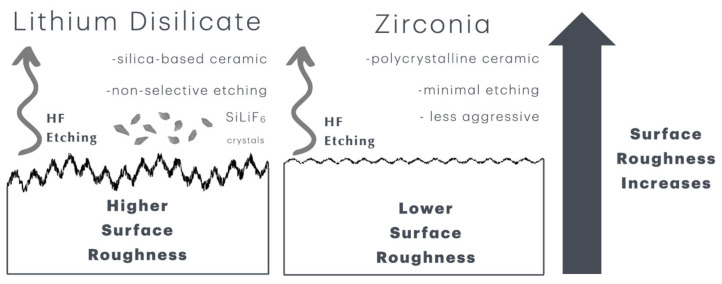
The current investigation evaluated a novel acid-etching solution containing hydrochloric acid (HCl), hydrofluoric acid (HF), nitric acid (HNO), orthophosphoric acid (HPO), and sulfuric acid (HSO) designed for etching zirconia ceramics. Achieving reliable bonding to zirconia is challenging due to its chemical inertia, unlike lithium disilicate, which can be effectively conditioned with HF etching. One hundred and twenty specimens of zirconia and lithium disilicate underwent etching with the experimental solution for six different durations: control, 20 s, 60 s, 5 min, 30 min, and 1 h. Surface roughness was assessed using 3D optical profilometry and scanning electron microscopy (SEM). The roughness of both materials increased with etching time; however, lithium disilicate demonstrated a significantly greater response, with Ra values rising from 0.18 µm (control) to 1.26 µm (1 h), while zirconia increased from 0.21 µm to 0.60 µm. ANOVA revealed significant effects depending on the ceramic type, time, and their interaction ( < 0.001). SEM images revealed non-selective etching of lithium disilicate, suggesting potential over-etching. The novel acid-etching solution improved surface roughness, especially in lithium disilicate ceramics. An application duration of one hour appears optimal for zirconia, improving surface characteristics while reducing damage; however, further research is required to assess its clinical safety and long-term effects on the mechanical properties of this dental ceramic.
当前的研究评估了一种新型的酸蚀溶液,该溶液含有盐酸(HCl)、氢氟酸(HF)、硝酸(HNO)、正磷酸(HPO)和硫酸(HSO),专为蚀刻氧化锆陶瓷而设计。由于氧化锆具有化学惰性,与二硅酸锂不同,后者可以通过氢氟酸蚀刻有效地进行预处理,因此实现与氧化锆的可靠结合具有挑战性。一百二十个氧化锆和二硅酸锂样本用实验溶液进行蚀刻,蚀刻时间分为六种不同时长:对照、20秒、60秒、5分钟、30分钟和1小时。使用三维光学轮廓仪和扫描电子显微镜(SEM)评估表面粗糙度。两种材料的粗糙度均随蚀刻时间增加;然而,二硅酸锂的响应明显更大,其平均粗糙度(Ra)值从0.18微米(对照)升至1.26微米(1小时),而氧化锆则从0.21微米增至0.60微米。方差分析显示,根据陶瓷类型、时间及其相互作用存在显著影响(<0.001)。扫描电子显微镜图像显示二硅酸锂存在非选择性蚀刻,表明可能存在过蚀刻现象。这种新型酸蚀溶液改善了表面粗糙度,尤其是在二硅酸锂陶瓷中。对于氧化锆而言,一小时的应用时长似乎最为理想,既能改善表面特性又能减少损伤;然而,需要进一步研究以评估其临床安全性以及对这种牙科陶瓷机械性能的长期影响。