Kang Haneul, Ko Eun-Ji, Lee Dahye, Kang Junhui, Hwang Jae-Kwan, Kim Eunsoo
Department of Biotechnology, College of Life Science and Biotechnology, Yonsei University, Seoul 03722, Republic of Korea.
College of Pharmacy and Research Institute for Drug Development, Pusan National University, Busan 46241, Republic of Korea.
Pharmaceuticals (Basel). 2025 May 28;18(6):808. doi: 10.3390/ph18060808.
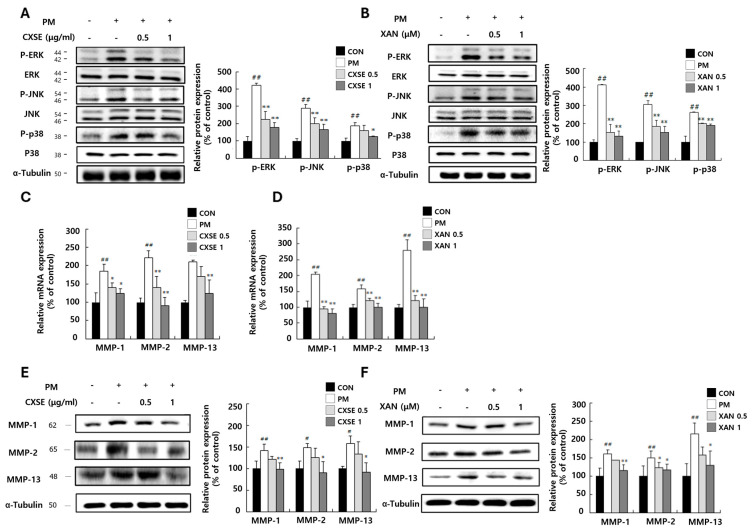
Particulate matter (PM) is a major environmental pollutant that induces oxidative stress, inflammation, and extracellular matrix (ECM) degradation, leading to skin damage and accelerated aging. Xanthorrhizol (XAN), a bioactive compound derived from Roxb., exhibits anti-inflammatory and antioxidative properties, making it a promising candidate for protecting against PM-induced skin damage. This study investigated the protective effects of XAN and supercritical extract (CXSE) on PM-exposed skin cells. A 3D-reconstructed skin model and HaCaT human keratinocytes were exposed to PM (100 µg/mL) with or without CXSE or XAN. Histological analysis, enzyme-linked immunosorbent assay (ELISA), Western blot, reverse transcription-polymerase chain reaction (RT-PCR), and reporter gene assays were performed to assess the ECM integrity, inflammatory cytokine production, aryl hydrocarbon receptor (AhR) activation, and oxidative stress responses. PM exposure activates AhR and mitogen-activated protein kinases (MAPK) signaling, increases reactive oxygen species (ROS) levels, and upregulates matrix metalloproteinases (MMPs) and inflammatory cytokines. CXSE and XAN suppresses AhR-mediated transcriptional activity and downregulates the expression of AhR target genes. Additionally, CXSE and XAN reduces ROS production by upregulating antioxidant enzyme-related genes. CXSE and XAN protect against PM-induced skin damage by inhibiting oxidative stress, inflammation, and ECM degradation, highlighting their potential as natural anti-pollution skincare ingredients.
颗粒物(PM)是一种主要的环境污染物,可诱导氧化应激、炎症和细胞外基质(ECM)降解,导致皮肤损伤和加速衰老。姜黄醇(XAN)是一种从 Roxb. 中提取的生物活性化合物,具有抗炎和抗氧化特性,使其成为预防 PM 诱导的皮肤损伤的有前途的候选物。本研究调查了 XAN 和超临界提取物(CXSE)对暴露于 PM 的皮肤细胞的保护作用。将三维重建皮肤模型和 HaCaT 人角质形成细胞暴露于含有或不含有 CXSE 或 XAN 的 PM(100 µg/mL)中。进行组织学分析、酶联免疫吸附测定(ELISA)、蛋白质印迹、逆转录聚合酶链反应(RT-PCR)和报告基因测定,以评估 ECM 完整性、炎性细胞因子产生、芳烃受体(AhR)激活和氧化应激反应。PM 暴露激活 AhR 和丝裂原活化蛋白激酶(MAPK)信号传导,增加活性氧(ROS)水平,并上调基质金属蛋白酶(MMPs)和炎性细胞因子。CXSE 和 XAN 抑制 AhR 介导的转录活性并下调 AhR 靶基因的表达。此外,CXSE 和 XAN 通过上调抗氧化酶相关基因减少 ROS 产生。CXSE 和 XAN 通过抑制氧化应激、炎症和 ECM 降解来预防 PM 诱导的皮肤损伤,突出了它们作为天然抗污染护肤成分的潜力。