Abdelnaby Mohamed, Sallam Marwa Y, Helmy Mai M, El-Gowelli Hanan M, El-Mas Mahmoud M
Department of Pharmacology and Toxicology, Faculty of Pharmacy, Alexandria University, Alexandria 21511, Egypt.
Department of Pharmacology and Toxicology, Faculty of Medicine, Kuwait University, Jabriya 46300, Kuwait.
Pharmaceuticals (Basel). 2025 Jun 12;18(6):882. doi: 10.3390/ph18060882.
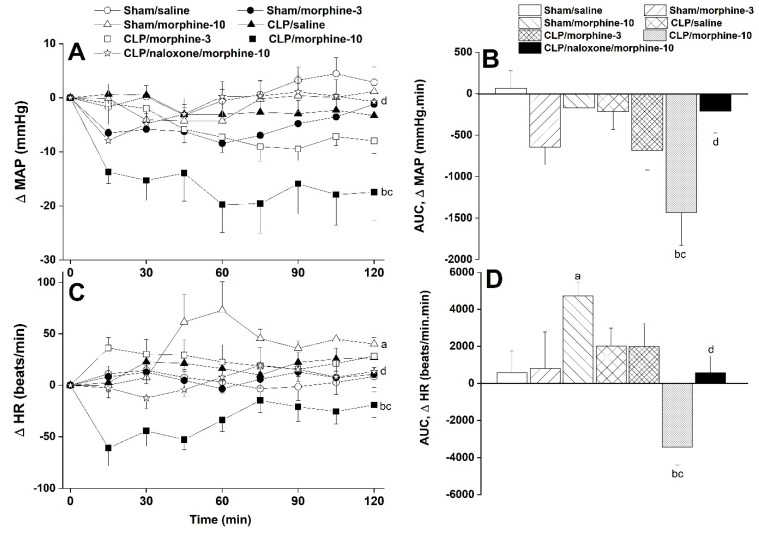
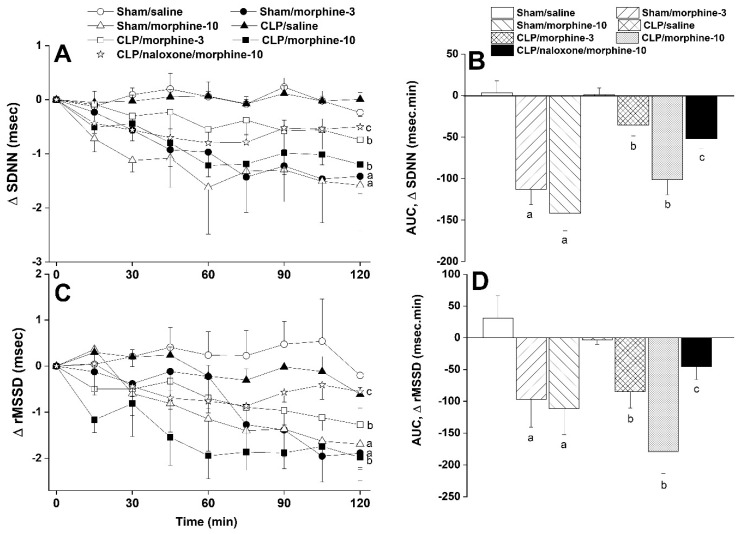
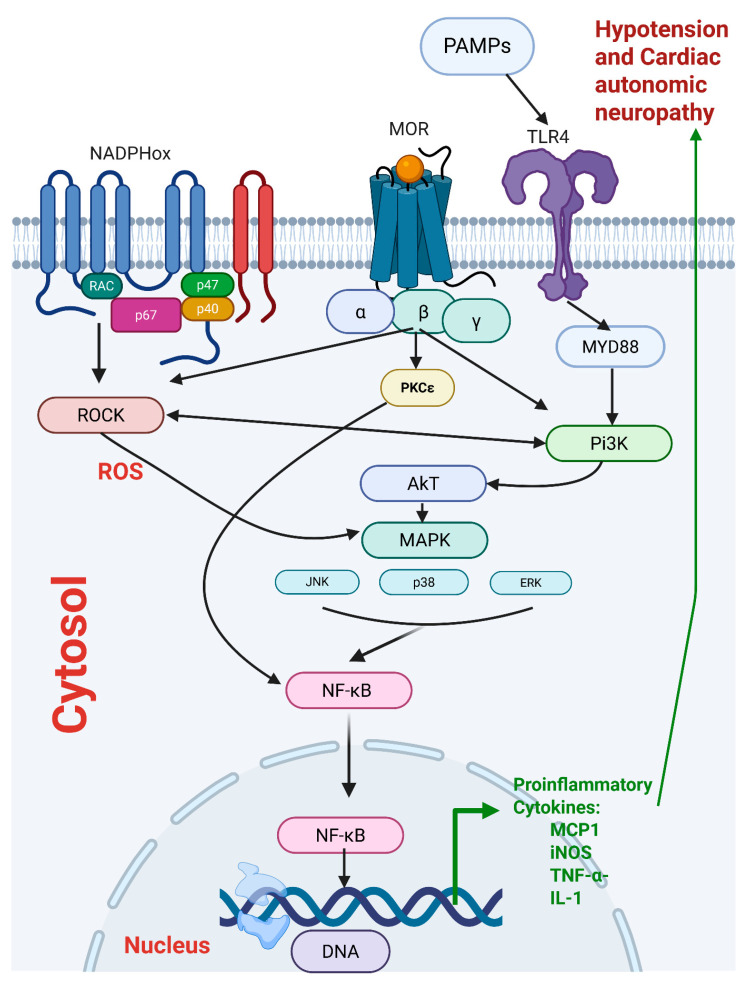
Sepsis remains one of the most serious and possibly fatal complications encountered in intensive care units. Considering the frequent use of narcotic analgesics in this setting, we investigated whether the cardiovascular and peripheral and central inflammatory features of sepsis could be modified by morphine. Rats were instrumented with femoral and intracisternal (i.c.) indwelling catheters and sepsis was induced by cecal ligation and puncture (CLP). The i.v. administration of morphine (3 and 10 mg/kg) significantly and dose-dependently aggravated septic manifestations of hypotension and impaired cardiac autonomic activity, as reflected by the reductions in indices of heart rate variability (HRV). Cardiac contractility (dP/dtmax) was also reduced by morphine in septic rats. The morphine effects were mostly eliminated following (i) blockade of μ-opioid receptors by i.v. naloxone and (ii) inhibition of central PI3K, MAPK-ERK, MAPK-JNK, NADPH oxidase (NADPHox), or Rho-kinase (ROCK) by i.c. wortmannin, PD98059, SP600125, diphenyleneiodonium, and fasudil, respectively. Further, these pharmacologic interventions significantly reduced the heightened protein expression of toll-like receptor 4 (TLR4) and monocyte chemoattractant protein-1 (MCP1) in brainstem rostral ventrolateral medullary (RVLM), but not cardiac, tissues of CLP/morphine-treated rats. Morphine worsens cardiovascular and autonomic disturbances caused by sepsis through a mechanism mediated via μ-opioid receptors and upregulated central inflammatory, chemotactic, and oxidative signals. Clinical studies are warranted to re-affirm the adverse cardiovascular interaction between opioids and the septic challenge.
脓毒症仍然是重症监护病房中最严重且可能致命的并发症之一。鉴于在此环境中经常使用麻醉性镇痛药,我们研究了吗啡是否会改变脓毒症的心血管以及外周和中枢炎症特征。给大鼠植入股静脉和脑池内留置导管,通过盲肠结扎和穿刺(CLP)诱导脓毒症。静脉注射吗啡(3和10mg/kg)显著且剂量依赖性地加重了脓毒症的低血压表现以及心脏自主活动受损,这可通过心率变异性(HRV)指标的降低反映出来。脓毒症大鼠的心脏收缩力(dP/dtmax)也因吗啡而降低。在以下情况下,吗啡的作用大多被消除:(i)静脉注射纳洛酮阻断μ阿片受体;(ii)分别通过脑池内注射渥曼青霉素、PD98059、SP600125、二苯碘鎓和法舒地尔抑制中枢PI3K、MAPK-ERK、MAPK-JNK、NADPH氧化酶(NADPHox)或Rho激酶(ROCK)。此外,这些药理学干预显著降低了CLP/吗啡处理大鼠脑干头端腹外侧延髓(RVLM)而非心脏组织中Toll样受体4(TLR4)和单核细胞趋化蛋白-1(MCP1)升高的蛋白表达。吗啡通过μ阿片受体介导的机制以及上调的中枢炎症、趋化和氧化信号,加重了脓毒症引起的心血管和自主神经紊乱。有必要进行临床研究以再次确认阿片类药物与脓毒症挑战之间不良的心血管相互作用。