Wu Zhe, Yu Yue, Wang Bin
The First Clinical College, Shandong University of Traditional Chinese Medicine, Jinan, China.
The Traditional Chinese Medicine College, Shandong University of Traditional Chinese Medicine, Jinan, China.
PLoS One. 2025 Jun 27;20(6):e0325938. doi: 10.1371/journal.pone.0325938. eCollection 2025.
Peripheral artery disease (PAD) is a common atherosclerotic condition that leads to limb dysfunction and increases mortality risk. Malnutrition is closely related to the long-term mortality of PAD patients. Therefore, studying the relationship between the Geriatric Nutritional Risk Index (GNRI) and long-term mortality in patients with PAD is crucial for identifying high-risk populations and developing targeted interventions.
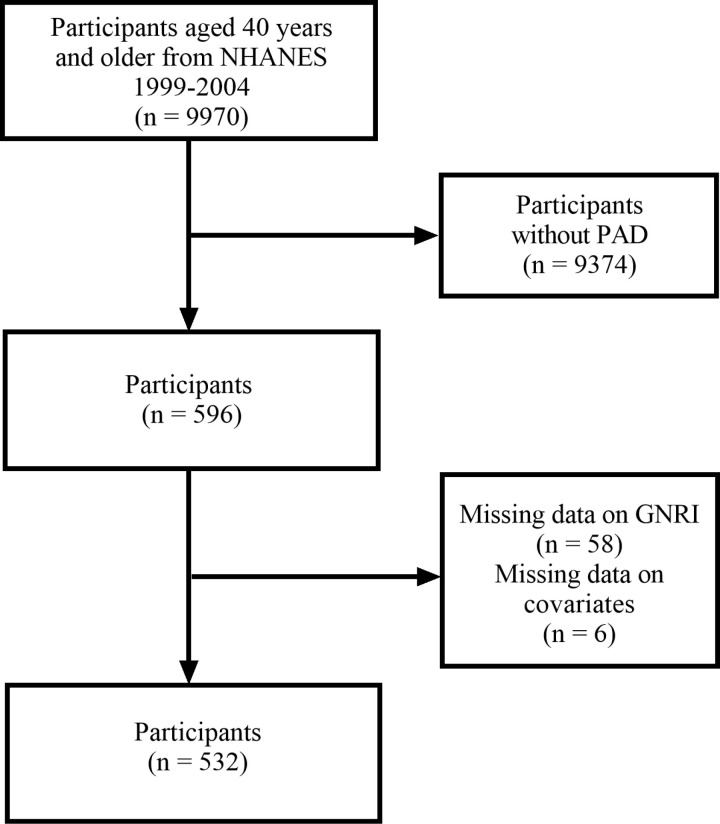
Data were sourced from the National Health and Nutrition Examination Survey (NHANES) conducted between 1999-2004, including 532 PAD patients. Kaplan-Meier survival analysis and multivariate Cox regression models assessed the relationship between GNRI and all-cause mortality in PAD patients. Subgroup analyses were conducted to explore differences based on demographic and disease backgrounds.
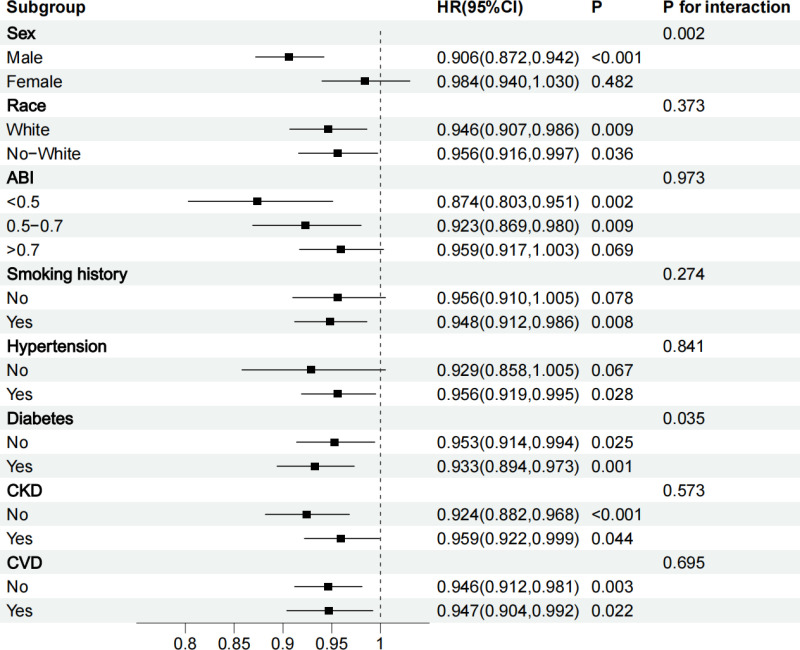
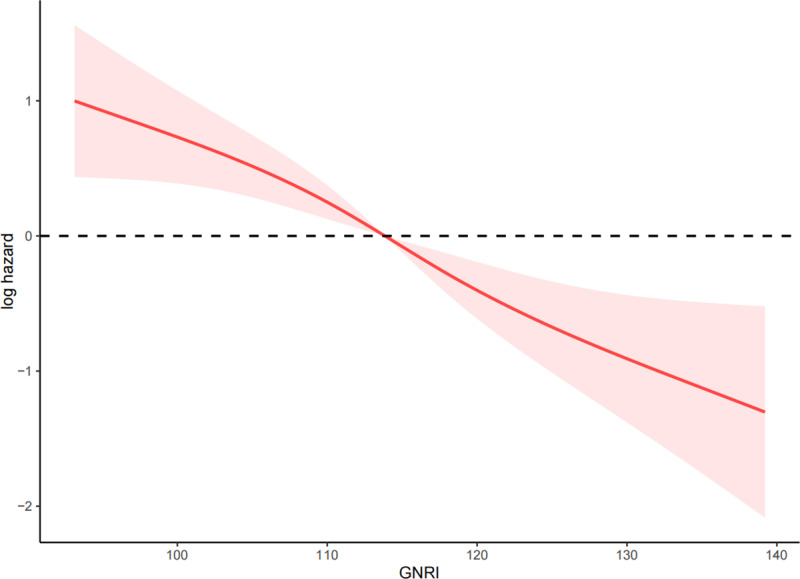
During the follow-up period, a total of 415 all-cause deaths were recorded. The Kaplan-Meier survival curve showed significant differences in mortality rates between the different GNRI quartile groups. Multivariate Cox regression analysis showed a significant negative correlation between GNRI and the long-term mortality risk of PAD patients (HR: 0.950, 95%CI: 0.918, 0.983). Compared to the first GNRI quartile, PAD patients in the third (HR: 0.569, 95%CI: 0.357, 0.909) and fourth (HR: 0.396, 95%CI: 0.208, 0.751) quartiles had a significantly reduced risk of long-term mortality. Restrictive cubic spline analysis showed a significant linear negative correlation between GNRI and all-cause mortality in PAD patients. The subgroup analysis results showed that the negative correlation between GNRI and all-cause mortality in PAD patients was significant in all subgroups except for the female subgroup, subgroup with ABI > 0.7, subgroup without smoking history, and subgroup without hypertension.
There is a significant negative association between GNRI and all-cause mortality in PAD patients, suggesting that malnutrition may be a key factor affecting the prognosis of PAD patients. Early identification and intervention for malnutrition could reduce long-term mortality risks. Future research should further explore the role of nutritional interventions in the management of PAD and validate the findings of this study.
外周动脉疾病(PAD)是一种常见的动脉粥样硬化疾病,可导致肢体功能障碍并增加死亡风险。营养不良与PAD患者的长期死亡率密切相关。因此,研究老年营养风险指数(GNRI)与PAD患者长期死亡率之间的关系对于识别高危人群和制定针对性干预措施至关重要。
数据来源于1999年至2004年进行的美国国家健康与营养检查调查(NHANES),其中包括532例PAD患者。采用Kaplan-Meier生存分析和多变量Cox回归模型评估GNRI与PAD患者全因死亡率之间的关系。进行亚组分析以探讨基于人口统计学和疾病背景的差异。
在随访期间,共记录了415例全因死亡病例。Kaplan-Meier生存曲线显示不同GNRI四分位数组之间的死亡率存在显著差异。多变量Cox回归分析显示GNRI与PAD患者的长期死亡风险呈显著负相关(HR:0.950,95%CI:0.918,0.983)。与第一个GNRI四分位数组相比,第三个(HR:0.569,95%CI:0.357,0.909)和第四个(HR:0.396,95%CI:0.208,0.751)四分位数组的PAD患者长期死亡风险显著降低。限制性立方样条分析显示GNRI与PAD患者全因死亡率之间存在显著的线性负相关。亚组分析结果显示,除女性亚组、ABI>0.7亚组、无吸烟史亚组和无高血压亚组外,GNRI与PAD患者全因死亡率之间的负相关在所有亚组中均显著。
GNRI与PAD患者全因死亡率之间存在显著负相关,表明营养不良可能是影响PAD患者预后的关键因素。早期识别和干预营养不良可降低长期死亡风险。未来的研究应进一步探讨营养干预在PAD管理中的作用,并验证本研究的结果。