Won Jongjun, Lee Grace Yoojin, Jo Sungyang, Lee Jihyun, Lee Sangjin, Kim Jae Seung, Sung Changhwan, Oh Jungsu S, Kwon Kyum-Yil, Park Soo Bin, Lee Joonsang, Yum Jieun, Chung Sun Ju, Kim Namkug
Department of Convergence Medicine, Asan Medical Institute of Convergence Science and Technology, Asan Medical Center, University of Ulsan College of Medicine, Seoul 05505, Republic of Korea.
Department of Medical Science, Asan Medical Institute of Convergence Science and Technology, Asan Medical Center, University of Ulsan College of Medicine, Seoul 05505, Republic of Korea.
Cell Rep Med. 2025 Jul 15;6(7):102207. doi: 10.1016/j.xcrm.2025.102207. Epub 2025 Jun 27.
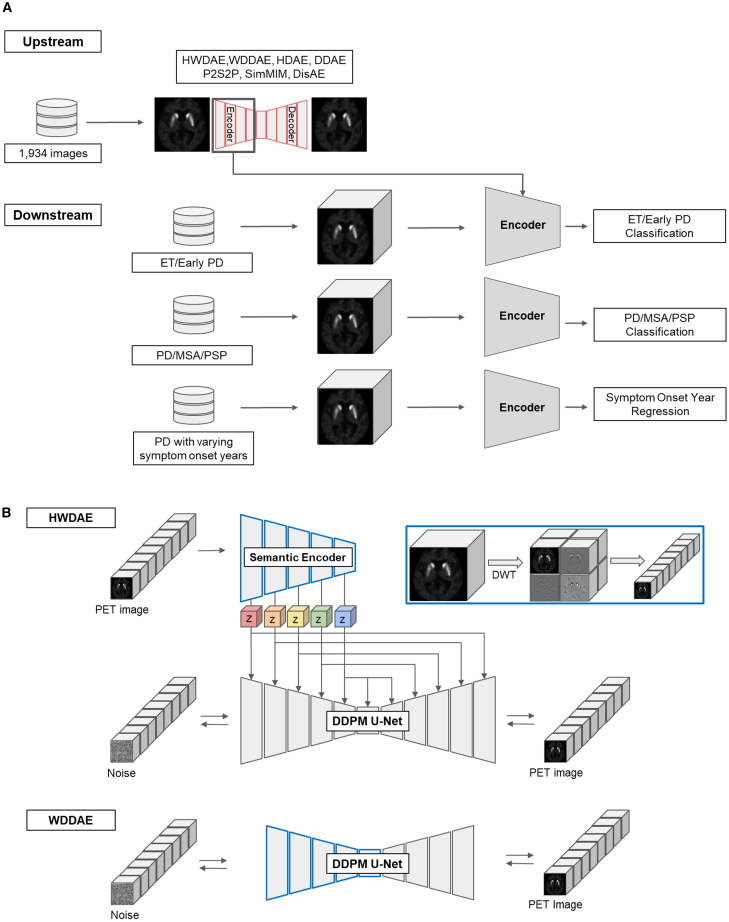
Accurate diagnosis and precise estimation of disease progression states are crucial for developing effective treatment plans for patients with parkinsonism. Although various deep learning-based computer-aided diagnostic models have demonstrated benefits, they have been relatively underexplored in parkinsonism owing to limited data and lack of external validation. We introduce the hierarchical wavelet diffusion autoencoder (HWDAE), a generative self-supervised model trained with 1,934 dopamine transporter positron emission tomography (DAT PET) images. HWDAE learns relevant disease traits during generative training, prior to supervision with human labels, as evidenced by its ability to synthesize realistic images representing different disease states of Parkinson's disease. The pretrained HWDAE is subsequently adapted for two differential diagnostic tasks and one disease progression estimation task, tested on images from two medical centers. Our training approach introduces a paradigm for deep learning research utilizing PET and expands the potential of DAT PET as a biomarker for Parkinson's disease.
准确诊断和精确估计疾病进展状态对于为帕金森症患者制定有效的治疗方案至关重要。尽管各种基于深度学习的计算机辅助诊断模型已显示出优势,但由于数据有限且缺乏外部验证,它们在帕金森症方面的研究相对较少。我们引入了分层小波扩散自动编码器(HWDAE),这是一种使用1934张多巴胺转运体正电子发射断层扫描(DAT PET)图像训练的生成式自监督模型。HWDAE在生成训练过程中学习相关疾病特征,先于人类标签监督,这体现在其能够合成代表帕金森病不同疾病状态的逼真图像的能力上。随后,预训练的HWDAE被应用于两项鉴别诊断任务和一项疾病进展估计任务,并在来自两个医疗中心的图像上进行了测试。我们的训练方法引入了一种利用PET进行深度学习研究的范式,并扩展了DAT PET作为帕金森病生物标志物的潜力。