Kenny Tara, Harris-Roxas Ben, McHugh Sheena, Douglas Margaret, Green Liz, Haigh Fiona, Purdy Joanna, Kavanagh Paul, O'Mullane Monica
School of Public Health, University College Cork, 4th Floor, Western Gateway Building, Western Road, Cork T12 XF62, Ireland.
School of Population Health, University of New South Wales, UNSW Sydney 2052, Australia.
Health Promot Int. 2025 May 13;40(3). doi: 10.1093/heapro/daaf080.
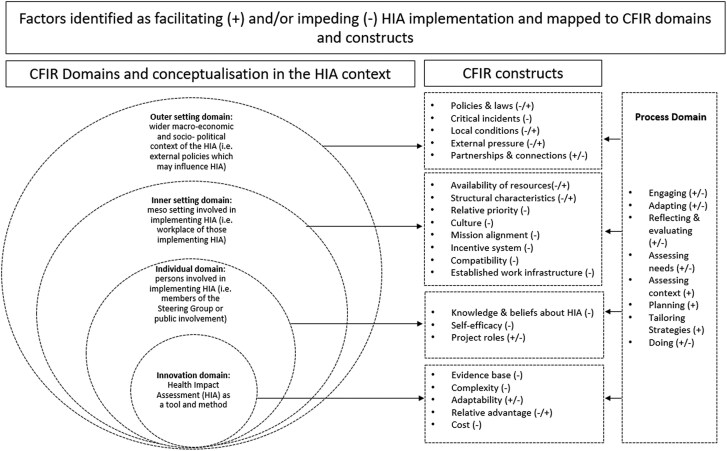
Health Impact Assessment (HIA) provides a practical set of tools to appraise the potential health effects of a policy, programme, or project prior to implementation. HIA has gained significant attention in recent decades due to its utility in facilitating a broader understanding of health and bringing diverse stakeholders and evidence into decision-making processes. Despite this interest in HIA its implementation remains challenging within governance, decision making, and regulatory contexts. The Consolidated Framework for Implementation Research (CFIR) 2.0 provides a methodological framework to identify potential factors influencing implementation and the domains in which they operate, within the framework. For the purpose of this scoping review, implementation refers to the process of carrying out an HIA, and where applicable, the implementation of its recommendations. This review presents a novel exploration of HIA from an implementation science perspective. It provides a synthesis of the factors influencing HIA implementation and identifies a range of considerations and strategies that may facilitate and strengthen HIA implementation and support. The findings suggest that the earlier steps are critical in assisting the practical application and implementation of HIA. However, building wider HIA support, awareness, and capacity essential to progressing HIA is dependent on wider public health advocacy and addressing challenges specific to HIA as a method and tool. CFIR offers a useful and adaptable framework that could be used for supporting HIA planning, practice, and implementation.
健康影响评估(HIA)提供了一套实用工具,用于在政策、计划或项目实施前评估其潜在的健康影响。近几十年来,HIA因其有助于更广泛地理解健康并将不同利益相关者和证据纳入决策过程而受到广泛关注。尽管对HIA有这种兴趣,但其在治理、决策和监管背景下的实施仍然具有挑战性。实施研究综合框架(CFIR)2.0提供了一个方法框架,用于识别影响实施的潜在因素及其运作的领域。就本范围审查而言,实施是指开展HIA的过程,并在适用情况下实施其建议。本审查从实施科学的角度对HIA进行了新颖的探索。它综合了影响HIA实施的因素,并确定了一系列可能促进和加强HIA实施与支持的考虑因素和策略。研究结果表明,早期步骤对于协助HIA的实际应用和实施至关重要。然而,建立更广泛的HIA支持、意识和能力对于推进HIA至关重要,这取决于更广泛的公共卫生宣传以及应对HIA作为一种方法和工具所特有的挑战。CFIR提供了一个有用且可适应的框架,可用于支持HIA的规划、实践和实施。