Hmaidee Thanawat, Rucksaken Rucksak, Kaewchot Supakarn, Sereerak Piya, Thongsahuan Salintorn, Jarudecha Thitichai, Wichainchot Sakulchit, Wilaisri Phakorn, Thabthimsri Chanapath, Premphoolsawat Perm, Sricharern Wanat
Department of Veterinary Nursing, Faculty of Veterinary Technology, Kasetsart University, Bangkok, Thailand.
Royal Thai Government Department of National Park Wildlife and Plant Conservation, Bangkok, Thailand.
Vet Med Int. 2025 Jun 23;2025:3024193. doi: 10.1155/vmi/3024193. eCollection 2025.
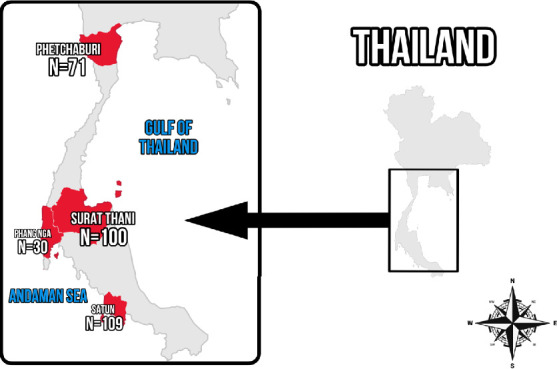
Zoonotic malaria, caused by simian spp., poses a major public health challenge in Southeast Asia, including Thailand, where long-tailed macaques () serve as natural reservoirs. This study investigated the molecular prevalence and species identification of zoonotic simian spp. in macaques from four provinces in Southern Thailand: Phetchaburi, Satun, Phang Nga, and Surat Thani. A total of 310 blood samples were collected between May 2023 and June 2024 and analyzed using nested and seminested polymerase chain reaction (PCR) techniques targeting the 18S rRNA gene. Sequencing analyses confirmed the presence of zoonotic species. Overall, 11.3% (35/310; 95% CI: 7.9-15.3) of the macaques tested positive, with being the most prevalent species at 9.4% (29/310), followed by and , each at 0.9% (3/310). The highest prevalence was observed in Surat Thani at 18% (18/100). These findings underscore the zoonotic potential of simian malaria and its geographic distribution in Southern Thailand, which may be associated with the significant increase in macaque populations and their expanding habitat overlap with human communities. In conclusion, this study highlights the major role of long-tailed macaques as reservoirs for zoonotic spp. Enhanced surveillance and community awareness are crucial for mitigating cross-species transmission and improving malaria control.
由猿猴疟原虫引起的人畜共患疟疾,在包括泰国在内的东南亚地区构成了重大的公共卫生挑战,在泰国,长尾猕猴是天然宿主。本研究调查了泰国南部四个省份(碧武里府、沙敦府、攀牙府和素叻他尼府)猕猴中人畜共患猿猴疟原虫的分子流行情况及种类鉴定。在2023年5月至2024年6月期间共采集了310份血样,并使用针对18S rRNA基因的巢式和半巢式聚合酶链反应(PCR)技术进行分析。测序分析证实了人畜共患疟原虫种类的存在。总体而言,11.3%(35/310;95%置信区间:7.9 - 15.3)的猕猴检测呈阳性,其中诺氏疟原虫最为常见,占9.4%(29/310),其次是食蟹猴疟原虫和猕猴疟原虫,各占0.9%(3/310)。素叻他尼府的患病率最高,为18%(18/100)。这些发现强调了猿猴疟疾的人畜共患潜力及其在泰国南部的地理分布,这可能与猕猴种群的显著增加及其与人类社区不断扩大的栖息地重叠有关。总之,本研究突出了长尾猕猴作为人畜共患疟原虫宿主的主要作用。加强监测和社区意识对于减轻跨物种传播和改善疟疾控制至关重要。