Kostov Iliyan Iliyanov, Yordanova Greta Roussanova
Department of Business Administration, International Business School, Botevgrad, Bulgaria.
Department of Orthodontics, Faculty of Dental Medicine, Medical University-Sofia, Sofia, Bulgaria.
J Med Life. 2025 May;18(5):472-477. doi: 10.25122/jml-2024-0382.
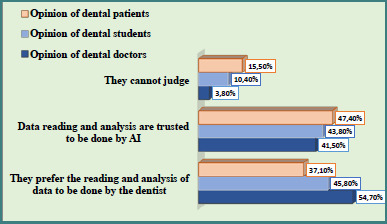
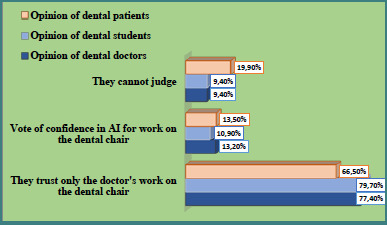
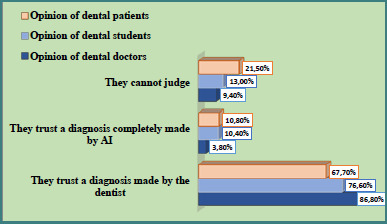
This study evaluated the attitudes of dental professionals and patients regarding the use of artificial intelligence (AI) in dental practice. A survey was conducted among dentists, dental students, and patients to assess their trust in AI-generated diagnoses-whether partially or entirely AI-based-and in the direct involvement of AI in treatment. The collected data were statistically processed and analyzed. While approximately 45% of participants across all groups supported the use of AI software for data collection and analysis, most agreed that final diagnostic decisions should remain the dentist's responsibility. Confidence in fully AI-generated diagnoses was low, with only 3.8% of dentists, 10.4% of students, and 10.8% of patients expressing trust in such outcomes. Similarly, the level of trust in dental treatment performed by a computer-controlled dental machine was unsatisfactory. A significant difference was observed in preferences for direct dental care: 66.5% of patients favored it, compared to 79.9% of students and 77.4% of practicing dentists. This discrepancy may be attributed to concerns that AI could substantially reduce the clinical involvement of dentists and students, whereas patients fear that relying solely on AI could compromise the personalized aspect of care, requiring them to entrust their treatment entirely to machines. Hybrid solutions are models that synchronize the analytical capabilities of a dental practitioner with the data inferred by AI. The study found that doctors and patients have positive attitudes towards the introduction of AI as an auxiliary tool. Dental practices should invest in software and technological equipment that enable a new level of dental diagnosis with the aid of AI.
本研究评估了牙科专业人员和患者对在牙科实践中使用人工智能(AI)的态度。对牙医、牙科学生和患者进行了一项调查,以评估他们对人工智能生成的诊断(无论是部分基于人工智能还是完全基于人工智能)以及人工智能直接参与治疗的信任程度。对收集到的数据进行了统计处理和分析。虽然所有组中约45%的参与者支持使用人工智能软件进行数据收集和分析,但大多数人同意最终的诊断决策仍应由牙医负责。对完全由人工智能生成的诊断的信心较低,只有3.8%的牙医、10.4%的学生和10.8%的患者表示信任此类诊断结果。同样,对计算机控制牙科机器进行牙科治疗的信任程度也不尽人意。在对直接牙科护理的偏好方面观察到显著差异:66.5%的患者喜欢直接牙科护理,而学生和执业牙医的这一比例分别为79.9%和77.4%。这种差异可能归因于人们担心人工智能会大幅减少牙医和学生的临床参与度,而患者则担心完全依赖人工智能可能会损害护理的个性化,从而要求他们将治疗完全托付给机器。混合解决方案是将牙科从业者的分析能力与人工智能推断的数据同步的模型。研究发现,医生和患者对引入人工智能作为辅助工具持积极态度。牙科诊所应投资于软件和技术设备,以便借助人工智能实现更高水平的牙科诊断。