• 文献检索
  • 文档翻译
  • 深度研究
  • 学术资讯
  • Suppr Zotero 插件Zotero 插件
  • 邀请有礼
  • 套餐&价格
  • 历史记录
应用&插件
Suppr Zotero 插件Zotero 插件浏览器插件Mac 客户端Windows 客户端微信小程序
定价
高级版会员购买积分包购买API积分包
服务
文献检索文档翻译深度研究API 文档MCP 服务
关于我们
关于 Suppr公司介绍联系我们用户协议隐私条款
关注我们

Suppr 超能文献

核心技术专利:CN118964589B侵权必究
粤ICP备2023148730 号-1Suppr @ 2026

文献检索

告别复杂PubMed语法,用中文像聊天一样搜索,搜遍4000万医学文献。AI智能推荐,让科研检索更轻松。

立即免费搜索

文件翻译

保留排版,准确专业,支持PDF/Word/PPT等文件格式,支持 12+语言互译。

免费翻译文档

深度研究

AI帮你快速写综述,25分钟生成高质量综述,智能提取关键信息,辅助科研写作。

立即免费体验

人工智能 (AI) 和医疗物联网 (IoMT) 辅助的生物医学系统用于智能医疗保健。

Artificial Intelligence (AI) and Internet of Medical Things (IoMT) Assisted Biomedical Systems for Intelligent Healthcare.

机构信息

Electrodics and Electrocatalysis Division, CSIR-Central Electrochemical Research Institute (CECRI), Karaikudi, Sivagangai 630003, Tamil Nadu, India.

Academy of Scientific & Innovative Research (AcSIR), Ghaziabad 201002, Uttar Pradesh, India.

出版信息

Biosensors (Basel). 2022 Jul 25;12(8):562. doi: 10.3390/bios12080562.

DOI:10.3390/bios12080562
PMID:35892459
原文链接:https://pmc.ncbi.nlm.nih.gov/articles/PMC9330886/
Abstract

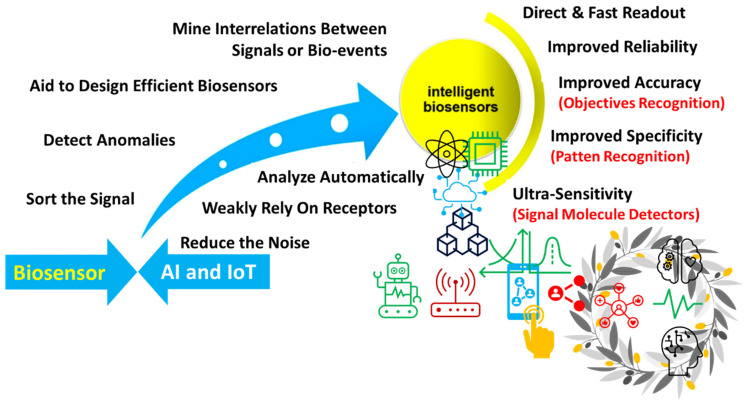
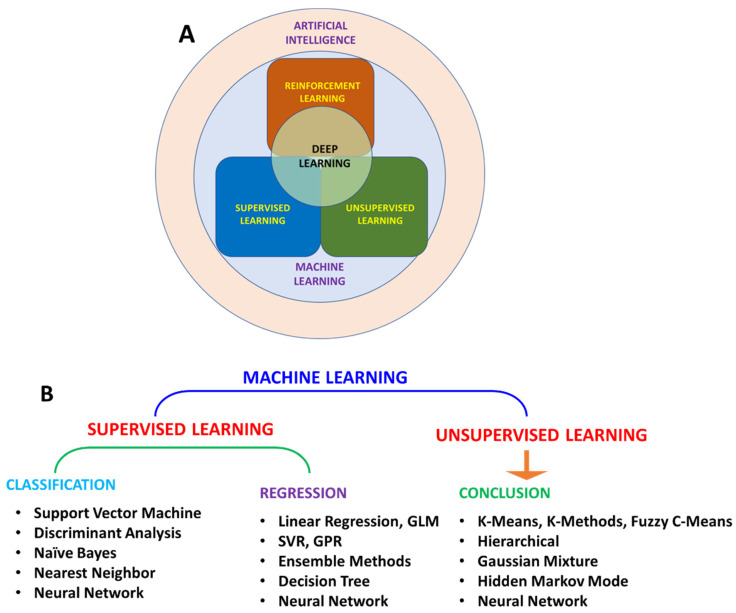
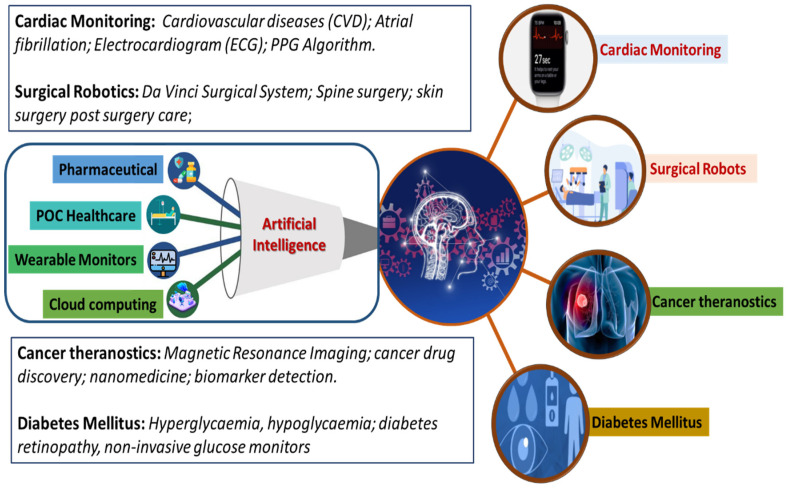
Artificial intelligence (AI) is a modern approach based on computer science that develops programs and algorithms to make devices intelligent and efficient for performing tasks that usually require skilled human intelligence. AI involves various subsets, including machine learning (ML), deep learning (DL), conventional neural networks, fuzzy logic, and speech recognition, with unique capabilities and functionalities that can improve the performances of modern medical sciences. Such intelligent systems simplify human intervention in clinical diagnosis, medical imaging, and decision-making ability. In the same era, the Internet of Medical Things (IoMT) emerges as a next-generation bio-analytical tool that combines network-linked biomedical devices with a software application for advancing human health. In this review, we discuss the importance of AI in improving the capabilities of IoMT and point-of-care (POC) devices used in advanced healthcare sectors such as cardiac measurement, cancer diagnosis, and diabetes management. The role of AI in supporting advanced robotic surgeries developed for advanced biomedical applications is also discussed in this article. The position and importance of AI in improving the functionality, detection accuracy, decision-making ability of IoMT devices, and evaluation of associated risks assessment is discussed carefully and critically in this review. This review also encompasses the technological and engineering challenges and prospects for AI-based cloud-integrated personalized IoMT devices for designing efficient POC biomedical systems suitable for next-generation intelligent healthcare.

摘要

人工智能(AI)是一种基于计算机科学的现代方法,它开发程序和算法,使设备智能化和高效,以执行通常需要人类智能的任务。人工智能涉及到多个子集,包括机器学习(ML)、深度学习(DL)、传统神经网络、模糊逻辑和语音识别,具有独特的功能和功能,可以提高现代医学的性能。这些智能系统简化了人类在临床诊断、医学成像和决策能力方面的干预。在同一时代,医疗物联网(IoMT)作为一种下一代生物分析工具出现,它将网络连接的生物医学设备与软件应用程序结合起来,以促进人类健康。在这篇综述中,我们讨论了人工智能在提高 IoMT 能力和在心脏测量、癌症诊断和糖尿病管理等先进医疗保健领域使用的即时护理(POC)设备方面的重要性。本文还讨论了人工智能在支持用于先进生物医学应用的先进机器人手术中的作用。这篇综述还仔细和批判性地讨论了人工智能在改善 IoMT 设备的功能、检测精度、决策能力以及评估相关风险评估方面的作用。这篇综述还涵盖了基于人工智能的云集成个性化 IoMT 设备的技术和工程挑战和前景,用于设计适合下一代智能医疗保健的高效即时护理生物医学系统。
https://cdn.ncbi.nlm.nih.gov/pmc/blobs/45fa/9330886/36e7038646cf/biosensors-12-00562-g013.jpg
https://cdn.ncbi.nlm.nih.gov/pmc/blobs/45fa/9330886/4632aa90fdd7/biosensors-12-00562-g001.jpg
https://cdn.ncbi.nlm.nih.gov/pmc/blobs/45fa/9330886/75546461252e/biosensors-12-00562-g002.jpg
https://cdn.ncbi.nlm.nih.gov/pmc/blobs/45fa/9330886/3dacd03d7c14/biosensors-12-00562-g003.jpg
https://cdn.ncbi.nlm.nih.gov/pmc/blobs/45fa/9330886/2192e9dab405/biosensors-12-00562-g004.jpg
https://cdn.ncbi.nlm.nih.gov/pmc/blobs/45fa/9330886/eded1455050e/biosensors-12-00562-g005.jpg
https://cdn.ncbi.nlm.nih.gov/pmc/blobs/45fa/9330886/46088e2d2c5a/biosensors-12-00562-g006.jpg
https://cdn.ncbi.nlm.nih.gov/pmc/blobs/45fa/9330886/a30693f9977a/biosensors-12-00562-g007.jpg
https://cdn.ncbi.nlm.nih.gov/pmc/blobs/45fa/9330886/2ad9619d25e4/biosensors-12-00562-g008.jpg
https://cdn.ncbi.nlm.nih.gov/pmc/blobs/45fa/9330886/4ca470d0466d/biosensors-12-00562-g009.jpg
https://cdn.ncbi.nlm.nih.gov/pmc/blobs/45fa/9330886/31295a4dfdd9/biosensors-12-00562-g010.jpg
https://cdn.ncbi.nlm.nih.gov/pmc/blobs/45fa/9330886/2ff9e3f2cb5d/biosensors-12-00562-g011.jpg
https://cdn.ncbi.nlm.nih.gov/pmc/blobs/45fa/9330886/b6a858b811bd/biosensors-12-00562-g012.jpg
https://cdn.ncbi.nlm.nih.gov/pmc/blobs/45fa/9330886/36e7038646cf/biosensors-12-00562-g013.jpg
https://cdn.ncbi.nlm.nih.gov/pmc/blobs/45fa/9330886/4632aa90fdd7/biosensors-12-00562-g001.jpg
https://cdn.ncbi.nlm.nih.gov/pmc/blobs/45fa/9330886/75546461252e/biosensors-12-00562-g002.jpg
https://cdn.ncbi.nlm.nih.gov/pmc/blobs/45fa/9330886/3dacd03d7c14/biosensors-12-00562-g003.jpg
https://cdn.ncbi.nlm.nih.gov/pmc/blobs/45fa/9330886/2192e9dab405/biosensors-12-00562-g004.jpg
https://cdn.ncbi.nlm.nih.gov/pmc/blobs/45fa/9330886/eded1455050e/biosensors-12-00562-g005.jpg
https://cdn.ncbi.nlm.nih.gov/pmc/blobs/45fa/9330886/46088e2d2c5a/biosensors-12-00562-g006.jpg
https://cdn.ncbi.nlm.nih.gov/pmc/blobs/45fa/9330886/a30693f9977a/biosensors-12-00562-g007.jpg
https://cdn.ncbi.nlm.nih.gov/pmc/blobs/45fa/9330886/2ad9619d25e4/biosensors-12-00562-g008.jpg
https://cdn.ncbi.nlm.nih.gov/pmc/blobs/45fa/9330886/4ca470d0466d/biosensors-12-00562-g009.jpg
https://cdn.ncbi.nlm.nih.gov/pmc/blobs/45fa/9330886/31295a4dfdd9/biosensors-12-00562-g010.jpg
https://cdn.ncbi.nlm.nih.gov/pmc/blobs/45fa/9330886/2ff9e3f2cb5d/biosensors-12-00562-g011.jpg
https://cdn.ncbi.nlm.nih.gov/pmc/blobs/45fa/9330886/b6a858b811bd/biosensors-12-00562-g012.jpg
https://cdn.ncbi.nlm.nih.gov/pmc/blobs/45fa/9330886/36e7038646cf/biosensors-12-00562-g013.jpg

相似文献

1
Artificial Intelligence (AI) and Internet of Medical Things (IoMT) Assisted Biomedical Systems for Intelligent Healthcare.人工智能 (AI) 和医疗物联网 (IoMT) 辅助的生物医学系统用于智能医疗保健。
Biosensors (Basel). 2022 Jul 25;12(8):562. doi: 10.3390/bios12080562.
2
AI-Enabled Framework for Fog Computing Driven E-Healthcare Applications.基于雾计算的人工智能框架在电子医疗保健中的应用。
Sensors (Basel). 2021 Dec 1;21(23):8039. doi: 10.3390/s21238039.
3
A Hybrid Stacked CNN and Residual Feedback GMDH-LSTM Deep Learning Model for Stroke Prediction Applied on Mobile AI Smart Hospital Platform.基于移动 AI 智能医院平台的应用,采用混合堆叠 CNN 和残差反馈 GMDH-LSTM 深度学习模型进行中风预测。
Sensors (Basel). 2023 Mar 27;23(7):3500. doi: 10.3390/s23073500.
4
Internet of Medical Things (IoMT)-Based Smart Healthcare System: Trends and Progress.基于物联网的智慧医疗系统:趋势与进展。
Comput Intell Neurosci. 2022 Jul 16;2022:7218113. doi: 10.1155/2022/7218113. eCollection 2022.
5
Internet of medical things (IoMT)-integrated biosensors for point-of-care testing of infectious diseases.物联网医疗(IoMT)集成生物传感器,用于即时检测传染病。
Biosens Bioelectron. 2021 May 1;179:113074. doi: 10.1016/j.bios.2021.113074. Epub 2021 Feb 6.
6
Multirole of the internet of medical things (IoMT) in biomedical systems for managing smart healthcare systems: An overview of current and future innovative trends.医疗物联网(IoMT)在生物医学系统中对智能医疗系统管理的多重作用:当前及未来创新趋势概述
J Infect Public Health. 2024 Apr;17(4):559-572. doi: 10.1016/j.jiph.2024.01.013. Epub 2024 Jan 22.
7
New Opportunities, Challenges, and Applications of Edge-AI for Connected Healthcare in Internet of Medical Things for Smart Cities.边缘人工智能在智慧城市医疗物联网中用于互联医疗的新机遇、挑战与应用
J Healthc Eng. 2022 Feb 23;2022:2950699. doi: 10.1155/2022/2950699. eCollection 2022.
8
Enhancing Healthcare through Sensor-Enabled Digital Twins in Smart Environments: A Comprehensive Analysis.利用智能环境中具备传感器功能的数字孪生体增强医疗保健:全面分析。
Sensors (Basel). 2024 Apr 27;24(9):2793. doi: 10.3390/s24092793.
9
Current Technologies for Detection of COVID-19: Biosensors, Artificial Intelligence and Internet of Medical Things (IoMT): Review.用于检测 COVID-19 的当前技术:生物传感器、人工智能和医疗物联网 (IoMT):综述。
Sensors (Basel). 2022 Dec 30;23(1):426. doi: 10.3390/s23010426.
10
Efficient anomaly detection from medical signals and images with convolutional neural networks for Internet of medical things (IoMT) systems.基于卷积神经网络的物联网 (IoMT) 系统的医疗信号和图像的高效异常检测。
Int J Numer Method Biomed Eng. 2022 Jan;38(1):e3530. doi: 10.1002/cnm.3530. Epub 2021 Dec 18.

引用本文的文献

1
AI-Powered Adaptive Disability Prediction and Healthcare Analytics Using Smart Technologies.使用智能技术的人工智能驱动的适应性残疾预测与医疗保健分析
Diagnostics (Basel). 2025 Aug 21;15(16):2104. doi: 10.3390/diagnostics15162104.
2
An ensemble of deep representation learning with metaheuristic optimisation algorithm for critical health monitoring using internet of medical things.一种结合元启发式优化算法的深度表征学习集成方法,用于通过医疗物联网进行关键健康监测。
Sci Rep. 2025 Aug 10;15(1):29241. doi: 10.1038/s41598-025-15005-9.
3
IoMT Architecture for Fully Automated Point-of-Care Molecular Diagnostic Device.

本文引用的文献

1
Exploring magneto-electric nanoparticles (MENPs): a platform for implanted deep brain stimulation.探索磁电纳米颗粒(MENPs):一种用于植入式深部脑刺激的平台。
Neural Regen Res. 2023 Jan;18(1):129-130. doi: 10.4103/1673-5374.340411.
2
Bio-acceptability of wearable sensors: a mechanistic study towards evaluating ionic leaching induced cellular inflammation.可穿戴传感器的生物可接受性:评估离子浸出诱导细胞炎症的机制研究。
Sci Rep. 2022 Jun 24;12(1):10782. doi: 10.1038/s41598-022-13810-0.
3
Artificial intelligence perspective in the future of endocrine diseases.
用于全自动即时分子诊断设备的物联网医疗架构。
Sensors (Basel). 2025 Jul 16;25(14):4426. doi: 10.3390/s25144426.
4
A Technological Review of Digital Twins and Artificial Intelligence for Personalized and Predictive Healthcare.个性化与预测性医疗保健中数字孪生与人工智能的技术综述
Healthcare (Basel). 2025 Jul 21;13(14):1763. doi: 10.3390/healthcare13141763.
5
Evaluating the Potential of ChatGPT as a Supplementary Intelligent Virtual Assistant in Periodontology.评估ChatGPT作为牙周病学辅助智能虚拟助手的潜力。
J Pharm Bioallied Sci. 2025 Jun;17(Suppl 2):S1415-S1417. doi: 10.4103/jpbs.jpbs_1727_24. Epub 2025 Jun 18.
6
Machine Learning in Primary Health Care: The Research Landscape.初级卫生保健中的机器学习:研究概况
Healthcare (Basel). 2025 Jul 7;13(13):1629. doi: 10.3390/healthcare13131629.
7
Attitudes of dentists and patients towards the introduction of artificial intelligence in dentistry.牙医和患者对牙科领域引入人工智能的态度。
J Med Life. 2025 May;18(5):472-477. doi: 10.25122/jml-2024-0382.
8
The digital transformation and future era: bibliometric view of artificial intelligence application in pediatric surgery.数字转型与未来时代:小儿外科人工智能应用的文献计量学视角
Front Pediatr. 2025 Jun 12;13:1528666. doi: 10.3389/fped.2025.1528666. eCollection 2025.
9
The Role of Artificial Intelligence in Advancing Biosensor Technology: Past, Present, and Future Perspectives.人工智能在推动生物传感器技术发展中的作用:过去、现在和未来展望。
Adv Mater. 2025 Aug;37(34):e2504796. doi: 10.1002/adma.202504796. Epub 2025 Jun 16.
10
Women's Preferences and Willingness to Pay for AI Chatbots in Women's Health: Discrete Choice Experiment Study.女性健康领域中女性对人工智能聊天机器人的偏好及支付意愿:离散选择实验研究
J Med Internet Res. 2025 Jun 10;27:e67303. doi: 10.2196/67303.
人工智能在内分泌疾病未来发展中的视角。
J Diabetes Metab Disord. 2022 Jan 11;21(1):971-978. doi: 10.1007/s40200-021-00949-2. eCollection 2022 Jun.
4
Comparative performance analysis of K-nearest neighbour (KNN) algorithm and its different variants for disease prediction.用于疾病预测的K近邻(KNN)算法及其不同变体的性能比较分析。
Sci Rep. 2022 Apr 15;12(1):6256. doi: 10.1038/s41598-022-10358-x.
5
Towards the development of reagent-free and reusable electrochemical aptamer-based cortisol sensor.迈向无试剂且可重复使用的基于适体的电化学皮质醇传感器的开发。
Bioelectrochemistry. 2022 Jun;145:108098. doi: 10.1016/j.bioelechem.2022.108098. Epub 2022 Mar 16.
6
Predicting pancreatic ductal adenocarcinoma using artificial intelligence analysis of pre-diagnostic computed tomography images.利用人工智能分析术前 CT 图像预测胰腺导管腺癌。
Cancer Biomark. 2022;33(2):211-217. doi: 10.3233/CBM-210273.
7
Exploring nano-enabled CRISPR-Cas-powered strategies for efficient diagnostics and treatment of infectious diseases.探索基于纳米技术的CRISPR-Cas驱动策略用于传染病的高效诊断与治疗。
J Nanostructure Chem. 2022;12(5):833-864. doi: 10.1007/s40097-022-00472-7. Epub 2022 Feb 14.
8
Interval Cancer Detection Using a Neural Network and Breast Density in Women with Negative Screening Mammograms.使用神经网络和乳腺密度对乳腺钼靶筛查阴性女性进行间期癌症检测。
Radiology. 2022 May;303(2):269-275. doi: 10.1148/radiol.210832. Epub 2022 Feb 8.
9
Electrochemical SARS-CoV-2 Sensing at Point-of-Care and Artificial Intelligence for Intelligent COVID-19 Management.用于即时护理的电化学新冠病毒刺突蛋白传感及用于智能新冠疫情管理的人工智能
ACS Appl Bio Mater. 2020 Nov 16;3(11):7306-7325. doi: 10.1021/acsabm.0c01004. Epub 2020 Oct 27.
10
ECG-AI: electrocardiographic artificial intelligence model for prediction of heart failure.心电图人工智能:用于预测心力衰竭的心电图人工智能模型。
Eur Heart J Digit Health. 2021 Oct 9;2(4):626-634. doi: 10.1093/ehjdh/ztab080. eCollection 2021 Dec.