Zhou Song, Li Jiayu, Meng Fanlun, Chen Mengqin, Cao Jing, Li Xusheng
Basic Teaching Department, Yantai Vocational College Yantai 264670 China
School of Chemistry and Materials Science, Ludong University Yantai 264025 China.
RSC Adv. 2025 Jun 30;15(28):22386-22410. doi: 10.1039/d5ra02594j.
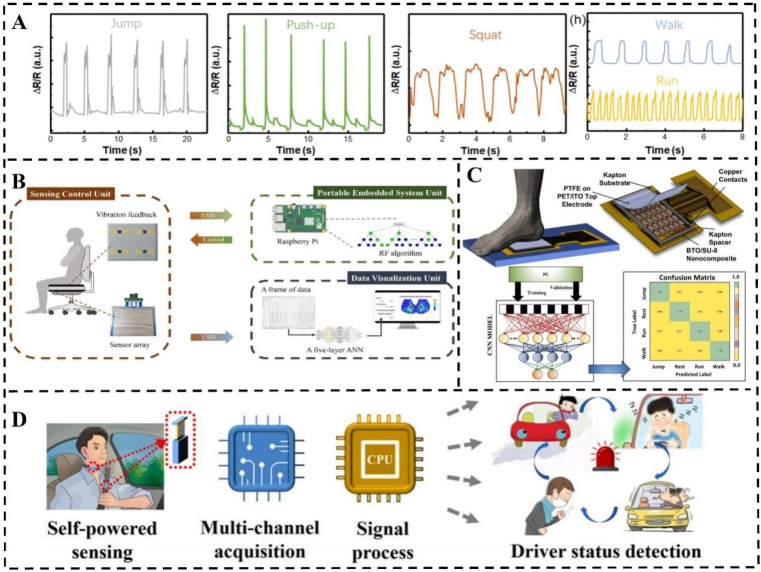
In recent years, the demand for improved health management has become increasingly higher; however, the existing medical resources have made it difficult to meet this demand. The field of health management is in urgent need for self-help monitoring equipment, intelligent identification technology and personalized medical services. This article reviews the application of flexible materials in health management, particularly the application of flexible wearable sensing devices combined with machine learning technology in various medical scenarios, and classifies them into several types of applications such as health monitoring and prevention, disease diagnosis and treatment, rehabilitation treatment and assistance. Flexible materials can be used to fabricate or integrate various types of high-sensitivity sensors with the characteristics of high flexibility and self-adhesion, resulting in a wealth of health monitoring equipment. These devices can self-monitor various physiological indicators in various parts of the human body. The integration of machine learning (ML) makes it possible to analyze and identify subtle, massive, multi-channel and multi-modal sensor data, accelerating the intelligent process of health management and personalized medicine. This paper not only elaborates on various flexible materials and ML algorithms commonly used in the field of health management, but also focuses on discussing the application of ML-assisted flexible materials in different stages of health management, and puts forward prospects for the future development direction, providing reference and inspiration for major changes in the field of health management.
近年来,对改善健康管理的需求越来越高;然而,现有的医疗资源已难以满足这一需求。健康管理领域迫切需要自助监测设备、智能识别技术和个性化医疗服务。本文综述了柔性材料在健康管理中的应用,特别是柔性可穿戴传感设备与机器学习技术相结合在各种医疗场景中的应用,并将其分为健康监测与预防、疾病诊断与治疗、康复治疗与辅助等几种应用类型。柔性材料可用于制造或集成各种具有高柔韧性和自粘性特点的高灵敏度传感器,从而产生丰富的健康监测设备。这些设备可以自我监测人体各个部位的各种生理指标。机器学习(ML)的集成使得分析和识别细微、海量、多通道和多模态的传感器数据成为可能,加速了健康管理和个性化医疗的智能化进程。本文不仅阐述了健康管理领域常用的各种柔性材料和ML算法,还重点讨论了ML辅助柔性材料在健康管理不同阶段的应用,并对未来的发展方向提出了展望,为健康管理领域的重大变革提供参考和启示。