Messman Elizabeth, Scott Briana, Smith-Darden Joanne, Cortina Kai, Thulin Elyse, Zimmerman Marc, Kernsmith Poco
University of Michigan School of Public Health, 1415 Washington Heights, Ann Arbor, MI 48109, USA.
Michigan State University School of Social Work, 655 Auditorium Road, East Lansing, MI 48824, USA.
J Appl Dev Psychol. 2022 Nov;83. doi: 10.1016/j.appdev.2022.101458.
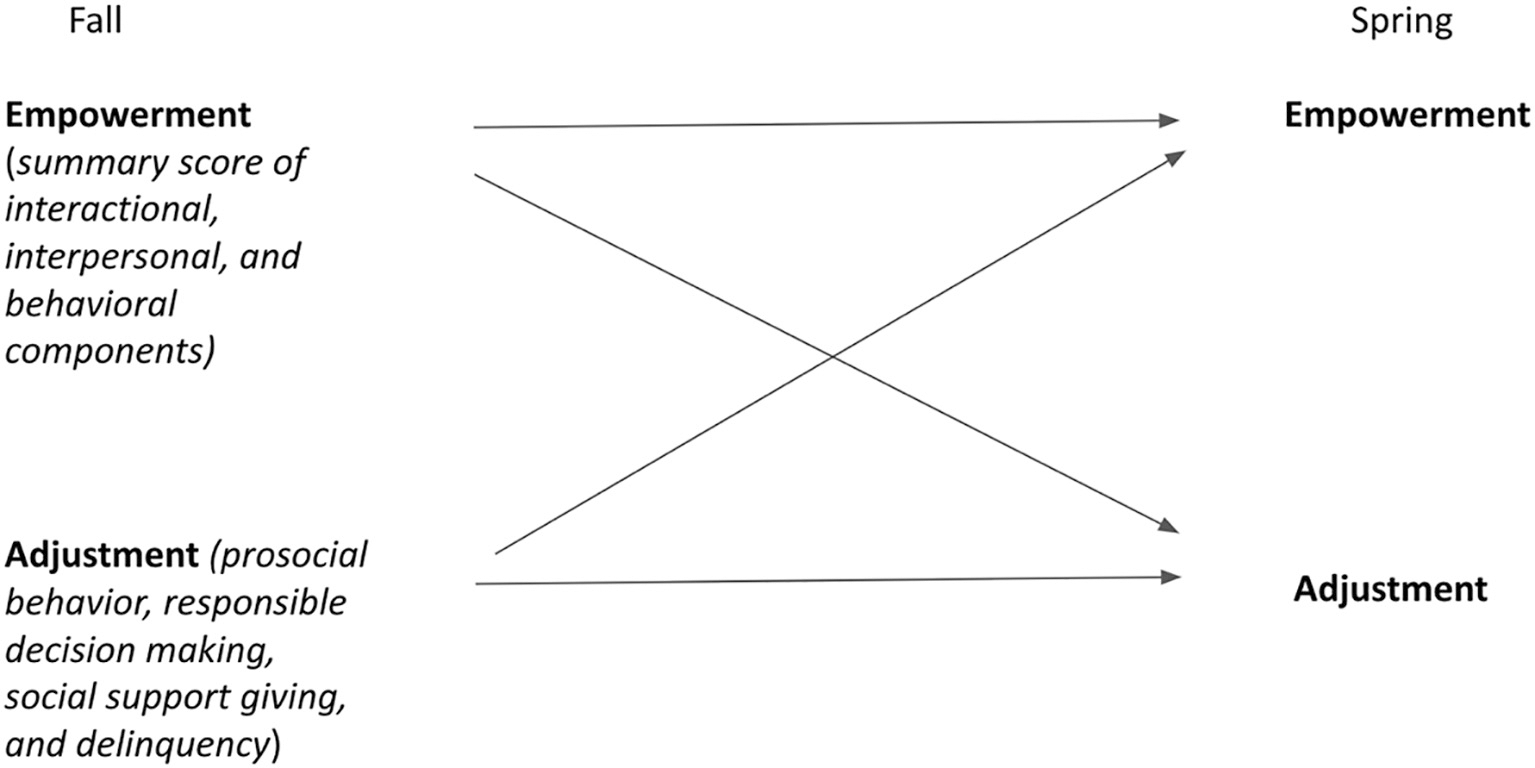
Empowerment theory (Zimmerman, 2000) provides a framework for understanding and promoting positive youth development during adolescence. The current study considers reciprocal associations between psychological empowerment and adolescents' prosocial behavior, responsible decision making, social support giving, and delinquent behavior across the school year ( = 837 8th grade youth; 50.5% female). Results from cross-lagged analyses support Zimmerman's (2000) model of empowerment. Psychological empowerment was related to increases in prosocial behavior, responsible decision making and social support giving, and decreases in delinquent behavior over time, controlling for prior levels. Also in support of empowerment theory, we found less evidence for behavior predicting changes in empowerment. Results suggest that supporting adolescents' empowerment provides a route for positive youth development above and beyond prior behavioral tendencies.
赋权理论(齐默尔曼,2000年)为理解和促进青少年时期积极的青少年发展提供了一个框架。本研究考察了心理赋权与青少年亲社会行为、负责任决策、社会支持给予以及整个学年的犯罪行为之间的相互关联(样本为837名八年级青少年;50.5%为女性)。交叉滞后分析的结果支持了齐默尔曼(2000年)的赋权模型。心理赋权与亲社会行为、负责任决策和社会支持给予的增加以及犯罪行为的减少有关,同时控制了先前的水平。同样支持赋权理论的是,我们发现行为预测赋权变化的证据较少。结果表明,支持青少年的赋权为积极的青少年发展提供了一条超越先前行为倾向的途径。