Zhang Zihan, Ma Bin, Li Buyao, Li Zhiwei, Gao Min, Zhao Hailong, Peng Rui, Hu Jiang, Wang Yu, You Wei, Gui Xun, Wang Rui, Hu Xiaoqing, Chen Beidi, Zhang Yuanjie, Hao Yanyun, Sun Xiaolin, Rao Peishi, Zhang Liang, Lu Ming, Zhou Demin, Yang Yun, Deng Mi, Miao Lei
State Key Laboratory of Natural and Biomimetic Drugs, School of Pharmaceutical Sciences, Peking University, Beijing 100191, China; Beijing Key Laboratory of Molecular Pharmaceutics, School of Pharmaceutical Sciences, Peking University, Beijing 100191, China.
State Key Laboratory of Molecular Oncology, Peking University International Cancer Institute, Health Science Center, Peking University, Beijing 100191, China.
Cell Rep Med. 2025 Jul 15;6(7):102209. doi: 10.1016/j.xcrm.2025.102209. Epub 2025 Jul 1.
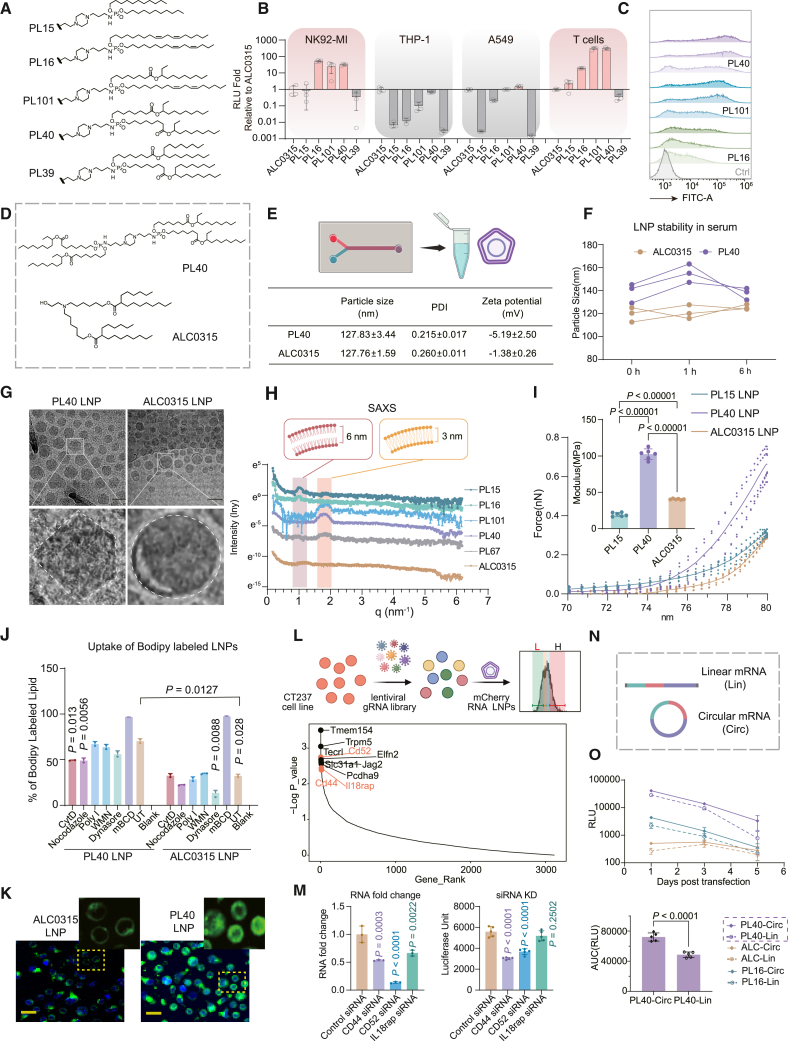
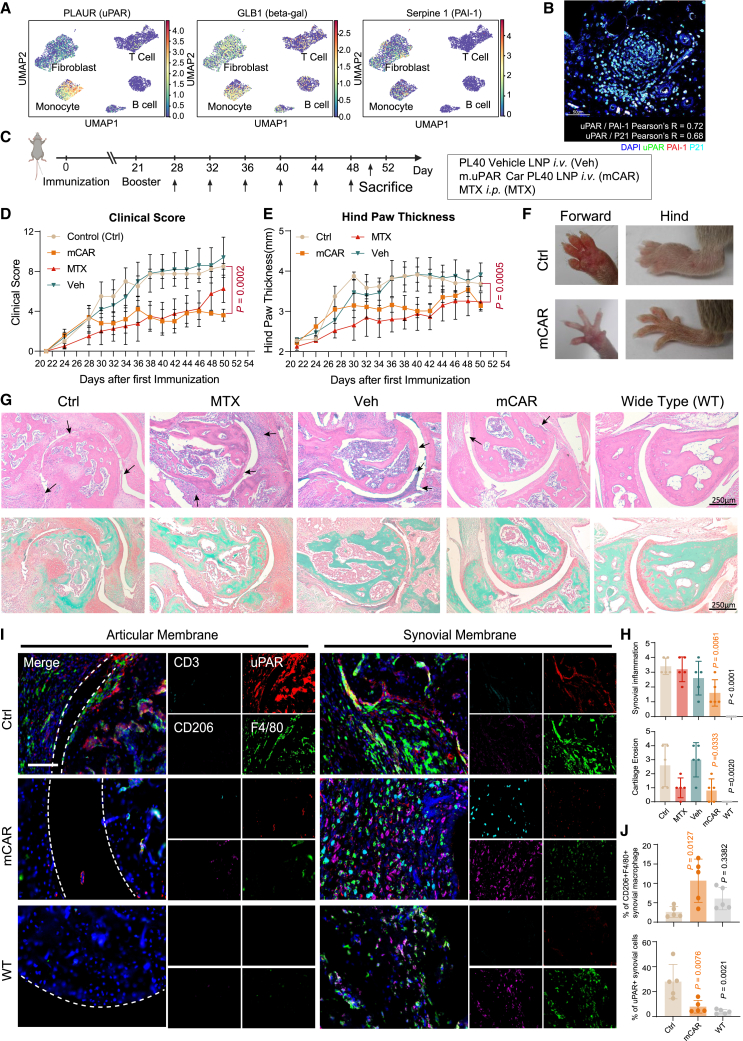
mRNA-based in vivo chimeric antigen receptor (CAR)-T cell engineering offers advantages over ex vivo therapies, including streamlined manufacturing and transient expression. However, current delivery methods require antibody-modified vehicles with manufacturing challenges. In this study, inspired by cardiolipin, we identify cardiolipin-like di-phosphoramide lipids that improve T cell transfection without targeting ligands, both in vitro and in vivo. The T cell-favored tropism is likely due to the lipid's packing, shape, and rigidity. Encapsulating circular RNA further prolongs mRNA expression in the spleen and T cells. Using PL40 lipid nanoparticles, we deliver mRNA encoding a CAR targeting the senolytic and inflammatory antigen urokinase-type plasminogen activator receptor (uPAR), alleviating uPAR-related liver fibrosis and rheumatoid arthritis (RA). Single-cell sequencing in humans confirms uPAR's relevance to senescence and inflammation in RA. To facilitate clinical translation, we screen and humanize single-chain variable fragments (scFvs) against uPAR, establishing a PL40 mRNA-encoded humanized uPAR CAR with potential for treating aging-inflamed disorders.
基于信使核糖核酸(mRNA)的体内嵌合抗原受体(CAR)-T细胞工程相较于体外疗法具有诸多优势,包括简化制造流程和实现瞬时表达。然而,目前的递送方法需要经过抗体修饰的载体,这存在制造方面的挑战。在本研究中,受心磷脂的启发,我们鉴定出了类心磷脂二磷酰胺脂质,其在体外和体内均可在无靶向配体的情况下提高T细胞转染效率。T细胞偏好的趋向性可能归因于该脂质的堆积、形状和刚性。封装环状核糖核酸可进一步延长脾脏和T细胞中mRNA的表达。使用PL40脂质纳米颗粒,我们递送了编码靶向衰老溶解和炎症抗原尿激酶型纤溶酶原激活剂受体(uPAR)的CAR的mRNA,减轻了与uPAR相关的肝纤维化和类风湿性关节炎(RA)。人体单细胞测序证实了uPAR与RA中的衰老和炎症的相关性。为推动临床转化,我们筛选并对针对uPAR的单链可变片段(scFv)进行人源化改造,构建了一种具有治疗衰老炎症性疾病潜力的PL40 mRNA编码的人源化uPAR CAR。