State Key Laboratory of Natural and Biomimetic Drugs, School of Pharmaceutical Sciences, Peking University, Beijing, China.
Beijing Key Laboratory of Molecular Pharmaceutics, School of Pharmaceutical Sciences, Peking University, Beijing, China.
Nat Commun. 2024 Aug 27;15(1):7263. doi: 10.1038/s41467-024-51571-8.
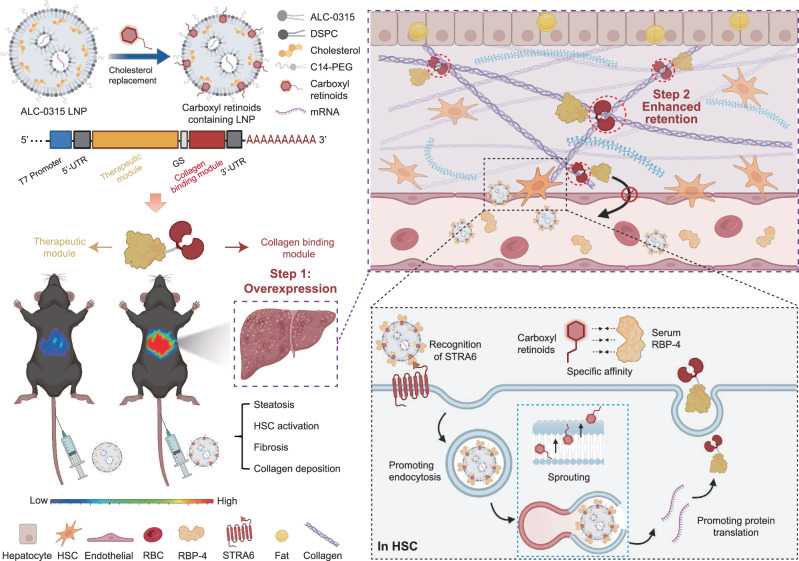
Metabolic dysfunction-associated steatohepatitis (MASH) poses challenges for targeted delivery and retention of therapeutic proteins due to excess extracellular matrix (ECM). Here we present a new approach to treat MASH, termed "Fibrosis overexpression and retention (FORT)". In this strategy, we design (1) retinoid-derivative lipid nanoparticle (LNP) to enable enhanced mRNA overexpression in fibrotic regions, and (2) mRNA modifications which facilitate anchoring of therapeutic proteins in ECM. LNPs containing carboxyl-retinoids, rather than alcohol- or ester-retinoids, effectively deliver mRNA with over 10-fold enhancement of protein expression in fibrotic livers. The carboxyl-retinoid rearrangement on the LNP surface improves protein binding and membrane fusion. Therapeutic proteins are then engineered with an endogenous collagen-binding domain. These fusion proteins exhibit increased retention in fibrotic lesions and reduced systemic toxicity. In vivo, fibrosis-targeting LNPs encoding fusion proteins demonstrate superior therapeutic efficacy in three clinically relevant male-animal MASH models. This approach holds promise in fibrotic diseases unsuited for protein injection.
代谢相关脂肪性肝炎(MASH)由于细胞外基质(ECM)过剩,给治疗性蛋白的靶向递送和保留带来了挑战。在这里,我们提出了一种治疗 MASH 的新方法,称为“纤维化过度表达和保留(FORT)”。在该策略中,我们设计了 (1) 视黄醇衍生物脂质纳米颗粒(LNP),以在纤维化区域实现增强的 mRNA 过表达,和 (2) mRNA 修饰,以促进治疗性蛋白在 ECM 中的锚定。含有羧酸视黄醇的 LNP 而不是醇或酯视黄醇,可有效递送 mRNA,在纤维化肝脏中蛋白质表达增强超过 10 倍。LNP 表面上羧酸视黄醇的重排可改善蛋白质结合和膜融合。然后,将治疗性蛋白与内源性胶原结合结构域进行工程设计。这些融合蛋白在纤维化病变中的保留增加,全身性毒性降低。在体内,编码融合蛋白的纤维化靶向 LNP 在三种具有临床相关性的雄性动物 MASH 模型中显示出优越的治疗效果。这种方法有望应用于不适合蛋白注射的纤维化疾病。