Wang Zhaoxiang, Liu Ruoshuang, Tang Fengyan, Shen Yirong
Department of Endocrinology, Affiliated Kunshan Hospital of Jiangsu University, Kunshan, Jiangsu, China.
Department of Endocrinology, The First Affiliated Hospital of Nanjing Medical University, Nanjing, Jiangsu, China.
Front Endocrinol (Lausanne). 2025 Jun 18;16:1567789. doi: 10.3389/fendo.2025.1567789. eCollection 2025.
The estimated glucose disposal rate (eGDR) is a simple and noninvasive clinical measure used to assess insulin resistance (IR), yet its potential utility as a marker for hyperuricemia risk had not been systematically evaluated. This study aimed to investigate the relationship between eGDR and hyperuricemia risk among American adults.
Data for this cross-sectional study were obtained from the 2007-2018 National Health and Nutrition Examination Survey (NHANES). Hyperuricemia was identified as a serum urate (SU) concentration of ≥7 mg/dL in males and ≥6 mg/dL in females. The relationship between eGDR and hyperuricemia risk was assessed using multivariate logistic regression and restricted cubic spline (RCS) methods, with additional subgroup and interaction analyses performed.
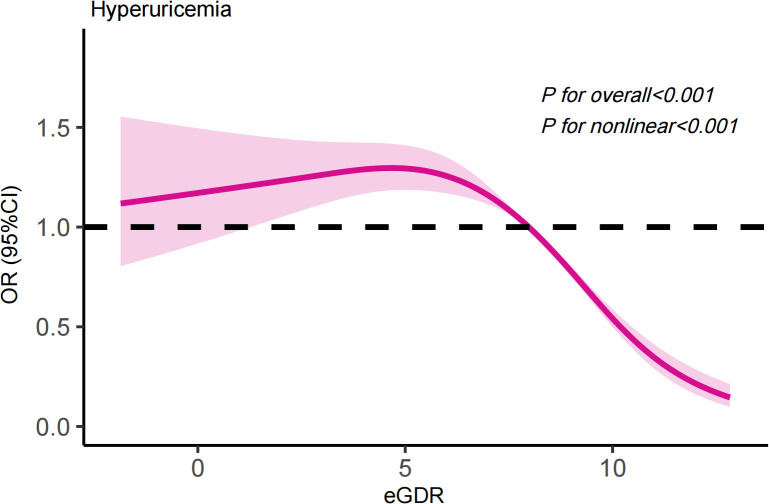
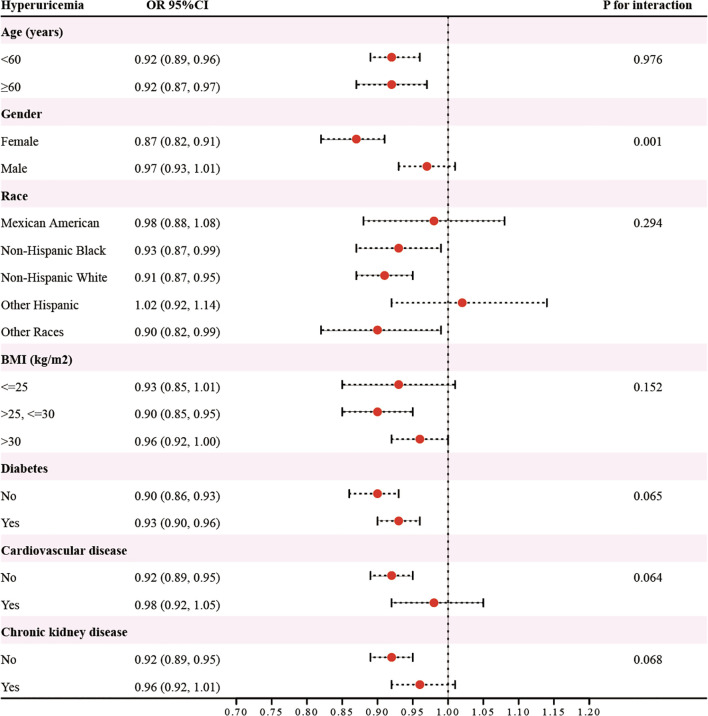
With increasing eGDR values, the prevalence of hyperuricemia decreased significantly (29.93% vs. 19.11% vs. 13.20% vs. 5.03%, <0.001). Multivariate logistic regression indicated that eGDR was independently associated with the risk of hyperuricemia after controlling for covariates including demographic, lifestyle, and clinical factors (OR=0.93, 95%CI: 0.90-0.96, <0.001). RCS analysis further revealed a nonlinear relationship, with a turning point at eGDR 7.96 mg/kg/min. Subgroup analysis revealed a stronger inverse association between eGDR and hyperuricemia risk in females.
The eGDR is inversely associated with hyperuricemia and appears to be a promising epidemiological tool for evaluating the impact of IR on the risk of hyperuricemia.
估计葡萄糖处置率(eGDR)是一种用于评估胰岛素抵抗(IR)的简单且无创的临床指标,但其作为高尿酸血症风险标志物的潜在效用尚未得到系统评估。本研究旨在调查美国成年人中eGDR与高尿酸血症风险之间的关系。
这项横断面研究的数据来自2007 - 2018年美国国家健康与营养检查调查(NHANES)。高尿酸血症定义为男性血清尿酸(SU)浓度≥7mg/dL,女性≥6mg/dL。使用多变量逻辑回归和受限立方样条(RCS)方法评估eGDR与高尿酸血症风险之间的关系,并进行了额外的亚组分析和交互分析。
随着eGDR值的增加,高尿酸血症的患病率显著降低(29.93%对19.11%对13.20%对5.03%,<0.001)。多变量逻辑回归表明,在控制了包括人口统计学、生活方式和临床因素等协变量后,eGDR与高尿酸血症风险独立相关(OR = 0.93,95%CI:0.90 - 0.96,<0.001)。RCS分析进一步揭示了一种非线性关系,转折点在eGDR 7.96mg/kg/min处。亚组分析显示,女性中eGDR与高尿酸血症风险之间的负相关更强。
eGDR与高尿酸血症呈负相关,似乎是评估IR对高尿酸血症风险影响的一种有前景的流行病学工具。