Kitagawa Daisuke, Nishihara Shin, Murata Masayuki, Onishi Mai, Mori Takahiro, Hachisuka Soshi, Okubo Tenshin, Yamamoto Naohiro, Nishikawa Hiroki, Onaka Masayuki, Suzuki Rika, Suzuki Soma, Yamamoto Ayu, Uejima Ritsuki, Nakamura Fumihiko, Yoshida Sayaka, Kitano Taito
Department of Laboratory Medicine, Nara Prefecture General Medical Center, Nara, Japan.
Sukusuku Kid's Clinic, Nara, Japan.
J Clin Microbiol. 2025 Aug 13;63(8):e0045825. doi: 10.1128/jcm.00458-25. Epub 2025 Jul 3.
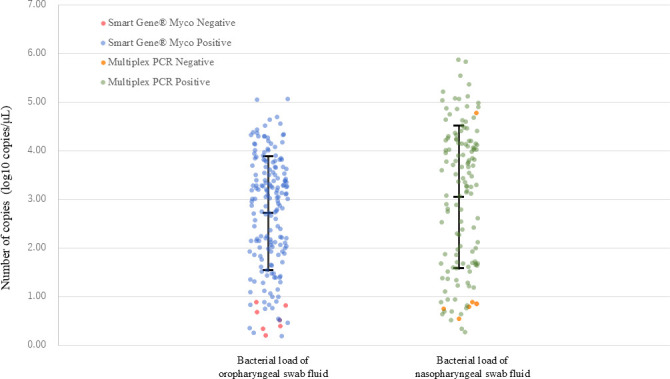
The differential impact of sample type on polymerase chain reaction (PCR) detection of (MP) has rarely been investigated. The study aimed to evaluate the diagnostic performance of PCR for the detection of MP and to measure MP DNA load between nasopharyngeal and oropharyngeal swabs. Nasopharyngeal and oropharyngeal samples were obtained simultaneously to evaluate their diagnostic performance in children with suspected MP. Two commercially available PCR tests, multiplex PCR and Smart Gene Myco, were used to analyze the nasopharyngeal and oropharyngeal samples, respectively. Furthermore, real-time PCR (RT-PCR) tests were conducted on both sample residues to validate the results. In total, 422 participants underwent simultaneous PCR testing using nasopharyngeal and oropharyngeal swabs; 139 samples (32.9%) from nasopharyngeal swabs and 176 samples (41.7%) from oropharyngeal samples that tested positive using commercially available tests. RT-PCR tests were positive for 136 (32.2%) nasopharyngeal and 183 (43.4%) oropharyngeal residual samples. With the RT-PCR test of the residual extract from oropharyngeal swabs as a reference, the sensitivity and specificity of detecting MP were 74.9% (95% confidence interval 67.9%-81.0%) and 99.2% (97.0%-99.9%) with the multiplex PCR test on nasopharyngeal swabs, and 96.2% (92.3%-98.4%) and 100.0% (98.5%-100.0%) with the Smart Gene Myco on oropharyngeal samples. A negative correlation was observed between fluoroquinolone use and oropharyngeal DNA loads ( = 0.004). The sensitivity of MP detection was significantly better in oropharyngeal samples than in nasopharyngeal samples. This study indicates that oropharyngeal samples should be used to detect MP rather than nasopharyngeal samples.IMPORTANCEObtaining the best sample is crucial for the accurate diagnosis of (MP) and timely and appropriate treatment. This study aimed to assess the diagnostic performance of MP detection using polymerase chain reaction (PCR) tests between nasopharyngeal and oropharyngeal samples. This study showed that the sensitivity of detecting MP was 74.9% (95% confidence interval 67.9%-81.0%) with a commercially available PCR test on nasopharyngeal swabs, and 96.2% (92.3%-98.4%) with a commercially available PCR test on oropharyngeal samples. The sensitivity of MP detection was significantly better in oropharyngeal samples than in nasopharyngeal samples. This study supports the idea that oropharyngeal samples should be used to detect MP. The results contribute to guidance in the recommendation regarding sampling methods to detect MP. Accurate identification of MP is crucial not only for timely and appropriate antimicrobial treatment but also for efficient epidemiological surveillance.
样本类型对聚合酶链反应(PCR)检测肺炎支原体(MP)的差异影响鲜有研究。本研究旨在评估PCR检测MP的诊断性能,并测量鼻咽拭子和口咽拭子之间的MP DNA载量。同时采集鼻咽和口咽样本,以评估其在疑似MP儿童中的诊断性能。分别使用两种市售PCR检测方法,即多重PCR和Smart Gene Myco,对鼻咽和口咽样本进行分析。此外,对两份样本的残余物进行实时PCR(RT-PCR)检测以验证结果。共有422名参与者同时使用鼻咽拭子和口咽拭子进行PCR检测;使用市售检测方法时,鼻咽拭子样本中有139份(32.9%)呈阳性,口咽样本中有176份(41.7%)呈阳性。RT-PCR检测显示,鼻咽残余样本中有136份(32.2%)呈阳性,口咽残余样本中有183份(43.4%)呈阳性。以口咽拭子残余提取物的RT-PCR检测结果为参照,鼻咽拭子多重PCR检测法检测MP的灵敏度和特异性分别为74.9%(95%置信区间67.9%-81.0%)和99.2%(97.0%-99.9%),口咽样本Smart Gene Myco检测法的灵敏度和特异性分别为96.2%(92.3%-98.4%)和100.0%(98.5%-100.0%)。观察到氟喹诺酮类药物使用与口咽DNA载量之间呈负相关(P = 0.004)。口咽样本中MP检测的灵敏度显著高于鼻咽样本。本研究表明,应使用口咽样本而非鼻咽样本检测MP。
重要性
获取最佳样本对于准确诊断肺炎支原体(MP)以及及时、恰当治疗至关重要。本研究旨在评估使用聚合酶链反应(PCR)检测法在鼻咽和口咽样本中检测MP的诊断性能。本研究表明,使用市售PCR检测法检测鼻咽拭子时,检测MP的灵敏度为74.9%(95%置信区间67.9%-81.0%),检测口咽样本时为96.2%(92.3%-98.4%)。口咽样本中MP检测的灵敏度显著高于鼻咽样本。本研究支持应使用口咽样本检测MP这一观点。研究结果有助于为检测MP的采样方法推荐提供指导。准确鉴定MP不仅对于及时、恰当的抗菌治疗至关重要,而且对于有效的流行病学监测也至关重要。