Nweke Martins, van Vuuren Megan, Bester Kobus, Maritz Andrea, van Vuuren Lané, Vilakazi Yolanda, Dlamini Ayanda, Ncedani Andiswa, Mostert Karien
Department of Physiotherapy, Faculty of Health Sciences, University of Pretoria, Pretoria, South Africa.
Department of Physiotherapy, Faculty of Health Sciences David Umahi Federal University of Health Sciences, Uburu, Nigeria.
BMC Sports Sci Med Rehabil. 2025 Jul 3;17(1):179. doi: 10.1186/s13102-024-01021-1.
Identifying the determinants of physical (in)activity behaviour among people with spinal cord injury (PWSCI) will aid the prediction of speed and extent of recovery and inform strategies to optimise physical activity participation during physical rehabilitation. This review examined the association between socio-demographics, injury factors, and physical activity in PWSCI.
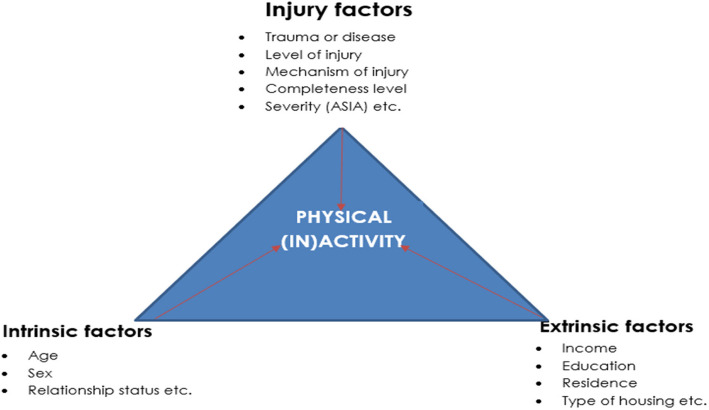
The Preferred Items for Reporting Systematic Reviews and Meta-analysis Protocols (PRISMA-P) provided the structure for this review. The epidemiological triangle and Bradford criteria further informed the review, as well as Rothman's causality model and Nweke's viewpoints. The review outcomes included injury factors and socio-demographic (intrinsic and extrinsic) factors associated with physical (in)activity in PWSCI. We searched four databases: PubMed, Medline, the Cumulative Index for Nursing and Allied Health Literature (CINHAL) and Academic Search Complete. The review used predefined eligibility criteria and a data screening and extraction template. The first author verified the extracted data. We employed narrative and quantitative syntheses and used a comprehensive Meta-analysis 4 to answer the review question.
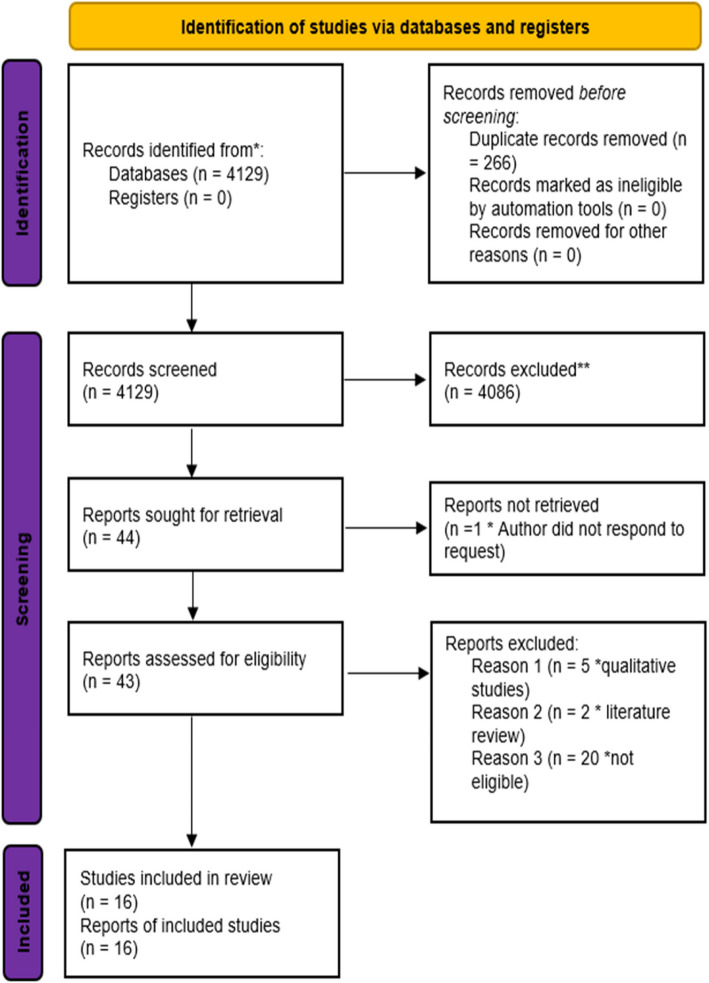
We retrieved 4,129 articles, of which 16 (nine cross-sectional studies, six cohorts and one non-randomised clinical trial) with 2,716 participants were eligible. The mean age of participants in the included studies was 45 years, and about 14% were female. Physical (in) activity was statistically significantly associated with income (OR = 1.58, CI 1.23-2.04), completeness of lesion (OR = 0.86 CI 0.82-0.90), and mobility aid (3.12, CI 1.57-6.19). No statistically significant association existed between physical (in) activity and age (OR = 1.09, CI 0.46-2.58), sex (OR = 0.66, CI 0.43-1.03), education (OR = 0.66, CI 0.42-1.06), time since injury (OR = 0,971, CI 0,749-1,26), vertebral level of the lesion (OR = 0.92, CI 0.71-1.11), or mechanism of injury (OR = 1.48, CI 0.74-2.97) among PWSCI.
Efforts to optimise physical activity participation among PWSCI should consider the completeness of injury, income and type of mobility aid during rehabilitation programs. Factors such as employment status, residence, and type of house were less underscoring, and most studies needed more robust conceptual and theoretical underpinnings.
The review was registered with PROSPERO (ID: CRD42024544295).
确定脊髓损伤患者(PWSCI)身体活动(不活动)行为的决定因素,将有助于预测恢复的速度和程度,并为在物理康复过程中优化身体活动参与度的策略提供依据。本综述研究了PWSCI的社会人口统计学、损伤因素与身体活动之间的关联。
系统评价和Meta分析方案报告的首选项目(PRISMA-P)为本次综述提供了结构框架。流行病学三角和布拉德福德标准以及罗斯曼因果模型和恩韦克的观点为综述提供了进一步的参考。综述结果包括与PWSCI身体活动(不活动)相关的损伤因素和社会人口统计学(内在和外在)因素。我们检索了四个数据库:PubMed、Medline、护理及相关健康文献累积索引(CINHAL)和学术搜索完整版。本综述使用了预先定义的纳入标准以及数据筛选和提取模板。第一作者对提取的数据进行了核实。我们采用了叙述性和定量综合分析,并使用综合Meta分析4来回答综述问题。
我们检索到4129篇文章,其中16篇(9项横断面研究、6项队列研究和1项非随机临床试验)符合纳入标准,共2716名参与者。纳入研究的参与者平均年龄为45岁,约14%为女性。身体活动(不活动)与收入(OR = 1.58,CI 1.23 - 2.04)、损伤完整性(OR = 0.86,CI 0.82 - 0.90)和移动辅助工具(3.12,CI 1.57 - 6.19)在统计学上具有显著关联。在PWSCI中,身体活动(不活动)与年龄(OR = 1.09,CI 0.46 - 2.58)、性别(OR = 0.66,CI 0.43 - 1.03)、教育程度(OR = 0.66,CI 0.42 - 1.06)、受伤时间(OR = 0.971,CI 0.749 - 1.26)、损伤的椎体水平(OR = 0.92,CI 0.71 - 1.11)或损伤机制(OR = 1.48,CI 0.74 - 2.97)之间不存在统计学上的显著关联。
在康复计划中,优化PWSCI身体活动参与度的努力应考虑损伤的完整性、收入和移动辅助工具的类型。就业状况、居住地址和房屋类型等因素的影响较小,大多数研究需要更坚实的概念和理论基础。
本综述已在PROSPERO注册(ID:CRD4202454429)。