
基于T2加权成像和T2映射的放射组学分析用于子宫内膜纤维化分期
Radiomics analysis based on T2-weighed imaging and T2 mapping for staging endometrial fibrosis.
作者信息
Liang Huanhuan, Wang Huanhuan, Chen Yucan, Sun Kaibo, Zhou Nan, Zhu Hui, Jiang Peipei, Ma Ke, Zhou Kefeng, Hu Yali, Zhou Zhengyang
机构信息
Department of Radiology, Nanjing Drum Tower Hospital, Affiliated Hospital of Medical School, Nanjing University, Nanjing, China.
Department of Obstetrics and Gynecology, Nanjing Drum Tower Hospital, Affiliated Hospital of Medical School, Nanjing University, Nanjing, China.
出版信息
Sci Rep. 2025 Jul 8;15(1):24378. doi: 10.1038/s41598-025-09782-6.
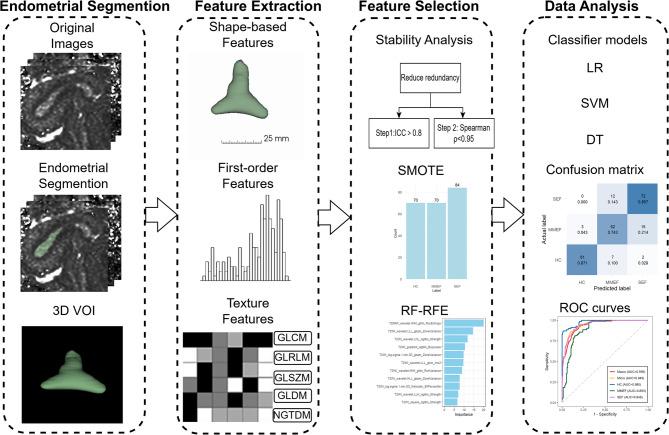
Endometrial fibrosis can lead to uterine infertility. Accurate staging of endometrial fibrosis is crucial for developing treatment plans and performing dynamic follow-ups. This study aimed to evaluate the feasibility of radiomics models based on T2-weighed imaging (T2WI) and T2 mapping for staging endometrial fibrosis. This prospective study included 120 patients with severe endometrial fibrosis (SEF) and 50 patients with mild-moderate endometrial fibrosis (MMEF) confirmed by hysteroscopy, and 100 healthy controls (HC). Radiomic features were extracted from the volume of interest of endometrium on T2WI images and T2 maps to generate three models: T2WI, T2 mapping, and both T2WI and T2 mapping (merged). Feature importance selection was assessed with recursive feature elimination (RFE). Subsequently, logistic regression (LR), support vector machine (SVM), and decision tree (DT) were developed to determine the optimal radiomics models. Endometrial thickness (ET) and mean T2 value (Mean T2) were analyzed to construct ET+T2 model. The performance of the models was evaluated using receiver operating characteristic curve analysis and area under the curve (AUC). The merged radiomics model constructed by LR showed the highest performance with the macro and micro average AUC of 0.897 and 0.898, sensitivity of 0.744 and 0.873, specificity of 0.880 and 0.816, precision of 0.738 and 0.873, F1-score of 0.740 and 0.873, respectively. The LR-merged radiomics model had better classification performance [AUC (macro/micro), 0.897/0.898; overall accuracy, 0.765] than that of the ET+T2 model [AUC (macro/micro), 0.788/0.786; overall accuracy, 0.593]. Radiomics analysis based on T2WI and T2 mapping had the potential for the noninvasively staging endometrial fibrosis.
子宫内膜纤维化可导致子宫性不孕。准确对子宫内膜纤维化进行分期对于制定治疗方案和进行动态随访至关重要。本研究旨在评估基于T2加权成像(T2WI)和T2映射的放射组学模型对子宫内膜纤维化进行分期的可行性。这项前瞻性研究纳入了120例经宫腔镜检查确诊的重度子宫内膜纤维化(SEF)患者、50例轻度至中度子宫内膜纤维化(MMEF)患者以及100名健康对照者(HC)。从T2WI图像和T2映射上的子宫内膜感兴趣体积中提取放射组学特征,以生成三个模型:T2WI、T2映射以及T2WI和T2映射两者合并(融合)。使用递归特征消除(RFE)评估特征重要性选择。随后,开发逻辑回归(LR)、支持向量机(SVM)和决策树(DT)以确定最佳放射组学模型。分析子宫内膜厚度(ET)和平均T2值(Mean T2)以构建ET + T2模型。使用受试者工作特征曲线分析和曲线下面积(AUC)评估模型的性能。由LR构建的融合放射组学模型表现最佳,宏观和微观平均AUC分别为0.897和0.898,灵敏度分别为0.744和0.873,特异性分别为0.880和0.816,精确度分别为0.738和0.873,F1分数分别为0.740和0.873。LR融合放射组学模型的分类性能[AUC(宏观/微观),0.897/0.898;总体准确率,0.765]优于ET + T2模型[AUC(宏观/微观),0.788/0.786;总体准确率,0.593]。基于T2WI和T2映射的放射组学分析具有对子宫内膜纤维化进行非侵入性分期的潜力。




 Zotero 插件