Fry Lucy, Adhvaryu Het, Roys Hayden, Bowlin Anne, Venugopal Gopinath, Bird Jordan T, Washam Charity, Yamamoto Masahiro, Coers Jörn, Byrum Stephanie, Voth Daniel, Weinkopff Tiffany
Department of Microbiology and Immunology, College of Medicine, University of Arkansas for Medical Sciences, Little Rock, AR, USA 72205.
Department of Biochemistry and Molecular Biology, College of Medicine, University of Arkansas for Medical Sciences, Little Rock, AR, USA 72205.
bioRxiv. 2025 Jun 30:2025.06.26.661809. doi: 10.1101/2025.06.26.661809.
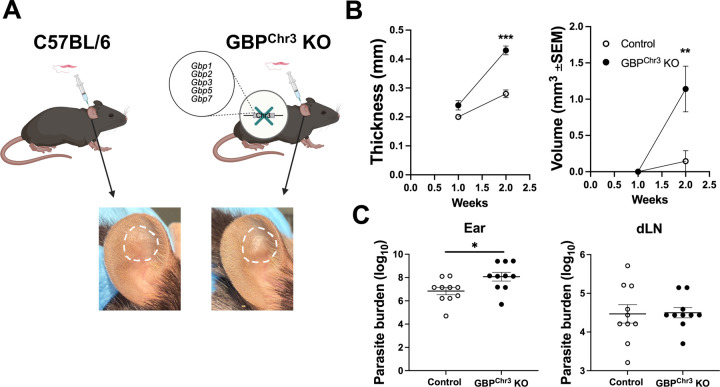
Cutaneous leishmaniasis (CL) is a debilitating neglected tropical disease characterized by lesions that can range from self-healing to permanent disfigurations. A predominant Th1 response, which stimulates IFN-γ production, is crucial for parasite control during self-healing CL. While IFN-γ primarily activates macrophages to produce nitric oxide via inducible nitric oxide synthase (iNOS) leading to parasite control, IFN-γ also activates other downstream pathways involved in cell autonomous immunity. One such pathway is the activation of guanylate binding proteins (GBPs), a class of interferon inducible GTPases. However, the role of GBPs during CL has been minimally explored. Utilizing RNA-Seq we found that infection leads to the upregulation of several GBPs in C57Bl/6 mice. In vitro studies using GBPChr3 knockout (KO), and C57Bl/6 control mice reveal that bone marrow-derived macrophages (BMDMs) from KO mice exhibit higher parasite burdens following IFN-γ treatment, independent of GBP localization to the parasite. Single-cell RNA-Seq identifies macrophages as the primary expressers of GBPs during infection . , GBPChr3 KO mice display increased disease severity and parasite load. GBPChr3 KO macrophages and monocytes show elevated ARG-1 and reduced iNOS expression, indicating a shift toward a parasite-permissive environment that supports parasite growth. These findings highlight a critical role for GBPs in immune-mediated control of CL.
皮肤利什曼病(CL)是一种使人衰弱的被忽视的热带疾病,其特征是病变范围从自愈到永久性毁容。在自愈性CL期间,刺激干扰素-γ(IFN-γ)产生的主要Th1反应对于控制寄生虫至关重要。虽然IFN-γ主要通过诱导型一氧化氮合酶(iNOS)激活巨噬细胞产生一氧化氮从而控制寄生虫,但IFN-γ也激活其他参与细胞自主免疫的下游途径。其中一条途径是鸟苷酸结合蛋白(GBPs)的激活,GBPs是一类干扰素诱导的GTP酶。然而,GBPs在CL中的作用鲜有研究。利用RNA测序,我们发现感染会导致C57Bl/6小鼠中几种GBPs上调。使用GBPChr3基因敲除(KO)小鼠和C57Bl/6对照小鼠进行的体外研究表明,IFN-γ处理后,KO小鼠骨髓来源的巨噬细胞(BMDMs)表现出更高的寄生虫负荷,且与GBP在寄生虫上的定位无关。单细胞RNA测序确定巨噬细胞是感染期间GBPs的主要表达细胞。此外,GBPChr3 KO小鼠表现出疾病严重程度增加和寄生虫负荷增加。GBPChr3 KO巨噬细胞和单核细胞显示精氨酸酶-1(ARG-1)升高,iNOS表达降低,表明向支持寄生虫生长的有利于寄生虫的环境转变。这些发现突出了GBPs在免疫介导的CL控制中的关键作用。