Di Giacomo Stefania, Bresciano Luca, Ferrara Lorenza, Pederiva Sabina, Zotti Carla Maria, D'Ancona Fortunato Paolo, Vicentini Costanza
Department of Public Health and Pediatrics, University of Turin, Via Santena 5 Bis, 10126, Turin, Italy.
Settore "Prevenzione, Sanità Pubblica Veterinaria E Sicurezza Alimentare", Regione Piemonte, Turin, Italy.
Antimicrob Resist Infect Control. 2025 Jul 9;14(1):86. doi: 10.1186/s13756-025-01604-8.
The Italian National action plan to contrast antimicrobial resistance (PNCAR) was adopted in Italy with the aim of reducing antimicrobial resistance (AMR) rates through a "One Health" approach. The project "Support for the National Plan to Combat Antimicrobial Resistance (SPiNCAR)" was developed to evaluate the level of implementation of actions outlined by the PNCAR, through a self-assessment tool, addressed to regional and local health authorities. This study presents the findings of the first use of the SPiNCAR tool in the Region of Piedmont, detailing the level of implementation as of 31 December 2022.
The self-assessment questionnaire is divided into 7 central "areas" representing the main actions against AMR: governance, surveillance and monitoring, appropriate use of antimicrobials, healthcare-associated infection (HAI) control and prevention, education and training, alliance among stakeholders, evaluation of the impact and implementation of the program. Areas are structured into two or more items called "standards", subdivided into "criteria". Different questionnaires were developed for Regional and Local Authorities. Scores were calculated as the percentage of criteria met within each area, aggregated at both regional and local levels.
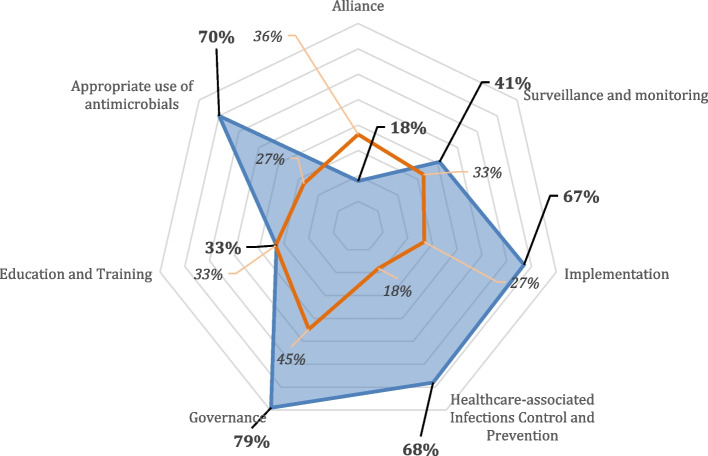
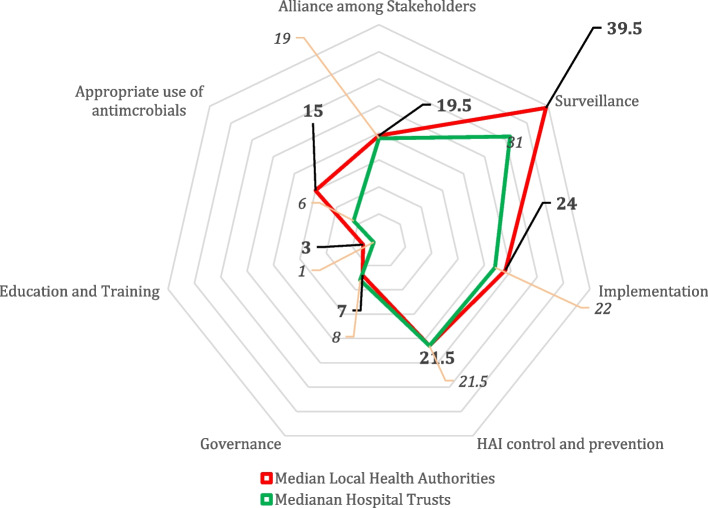
By analysing results at the regional level, it was possible to identify domains of strength in the areas of Governance (79%), Appropriate use of antimicrobials (70%), HAI Control and Prevention (68%) and areas for improvement in Alliance among Stakeholders (18%), Training (33%) and Surveillance (41%). Local authorities showed encouraging median results in Surveillance (37%), Appropriate Use of Antimicrobials (22,5%), and HAI Control and Prevention (21,5%), whereas Implementation (10,5%), Education and Training (8%) and Alliance among Stakeholders (2,5%) need to be improved.
The first SPiNCAR assessment offered valuable insights to enhance healthcare quality; the evaluation identified stakeholder engagement and training as priority areas for improvement and targeted interventions for AMR containment.
意大利通过了国家抗击抗菌药物耐药性行动计划(PNCAR),旨在通过“同一健康”方法降低抗菌药物耐药性(AMR)发生率。开展了“支持国家抗击抗菌药物耐药性计划(SPiNCAR)”项目,以通过面向地区和地方卫生当局的自我评估工具,评估PNCAR所概述行动的实施水平。本研究介绍了SPiNCAR工具在皮埃蒙特大区首次使用的结果,详细说明了截至2022年12月31日的实施水平。
自我评估问卷分为7个核心“领域”,代表抗击AMR的主要行动:治理、监测、抗菌药物的合理使用、医疗保健相关感染(HAI)的控制与预防、教育与培训、利益相关者之间的联盟、项目影响评估与实施。各领域由两个或更多称为“标准”的项目构成,再细分为“准则”。为地区和地方当局制定了不同的问卷。分数计算为每个领域内符合准则的百分比,在地区和地方层面进行汇总。
通过分析地区层面的结果,可以确定治理领域(79%)、抗菌药物的合理使用领域(70%)、HAI控制与预防领域(68%)的优势领域,以及利益相关者之间的联盟(18%)、培训(33%)和监测(41%)方面需要改进的领域。地方当局在监测(37%)、抗菌药物的合理使用(22.5%)以及HAI控制与预防(21.5%)方面的中位数结果令人鼓舞,而实施(10.5%)、教育与培训(8%)以及利益相关者之间的联盟(2.5%)需要改进。
首次SPiNCAR评估为提高医疗质量提供了宝贵见解;评估确定利益相关者参与和培训是需要改进的优先领域以及遏制AMR的目标干预措施。