Mukerenge Ndinohokwe Foibe, Schmollgruber Shelley, Klaas Ntombifikile
Department of Nursing Education, School of Therapeutic Science, Faculty of Health Sciences, University of the Witwatersrand, Johannesburg, South Africa.
School of Nursing and Public Health, Faculty of Health Sciences and Veterinary Medicine, University of Namibia, Rundu, Namibia.
Int J Nurs Stud Adv. 2025 Jun 6;9:100359. doi: 10.1016/j.ijnsa.2025.100359. eCollection 2025 Dec.
Adolescents living with HIV face unique challenges as they gain greater independence while transitioning into adulthood. They must adjust their self-management activities and take primary responsibility for their health, including adhering to medication regimens and attending clinic visits. These young individuals need to acquire knowledge about HIV and Antiretroviral treatment to manage their condition and improve their health outcomes effectively. This study aims to map existing interventions for adolescents with HIV, focusing on the types, content, and best practices that enhance their understanding of both HIV and Antiretroviral treatment.
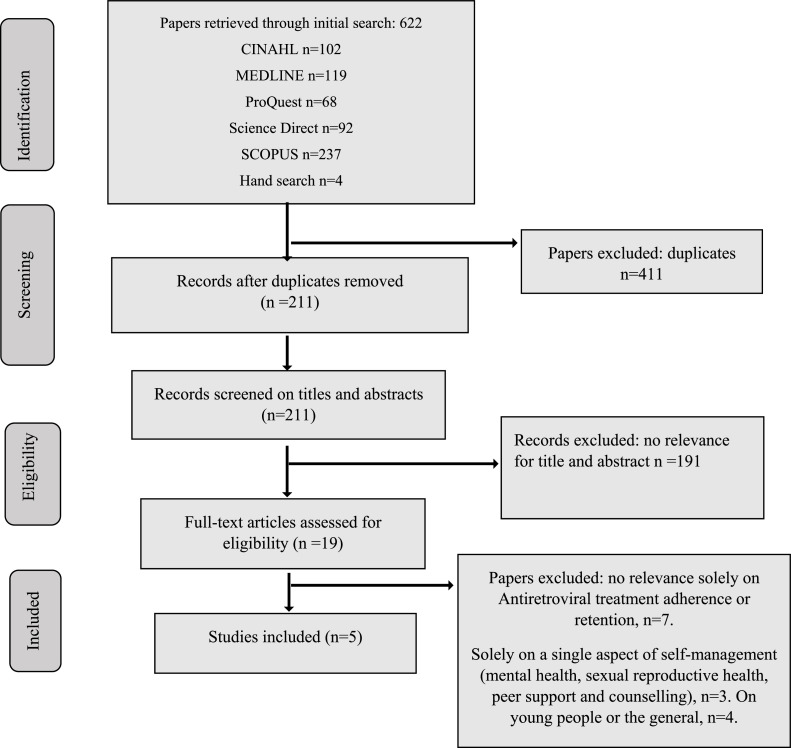
The scoping review utilised a Joanna Briggs Institute (JBI) framework to map the relevant literature. We searched the CINAHL Complete, MEDLINE (via PubMed), ProQuest, Science Direct, and Scopus databases for studies published between January 1, 2000, and January 31, 2023. We selected studies using the inclusion criteria. Studies included health education programs as the intervention, which developed or implemented strategies to improve knowledge and skills related to HIV and self-management of antiretroviral treatment adherence among this population.
Only five (5) studies met the eligibility criteria and were included in this review. Three (3) broad categories emerged from the analysis of the scoping review: the nature of interventions available for Adolescents living with HIV, the content of existing interventions, and best practices. The findings revealed limited evidence of programs aimed at adolescents in various settings. Most notable was the paucity of evidence on programs targeting Adolescents living with HIV, especially those that are designed to help them learn about their condition and associated treatment.
The review highlights the existence of limited evidence-based, context-specific, and consumer-tailored educational interventions for Adolescents living with HIV. More comprehensive, age-appropriate and personalised interventions are needed for adolescent self-management of HIV as a chronic health condition.
感染艾滋病毒的青少年在向成年过渡并获得更大独立性的过程中面临着独特的挑战。他们必须调整自我管理活动,并对自身健康承担主要责任,包括坚持药物治疗方案和按时就诊。这些年轻人需要了解艾滋病毒和抗逆转录病毒治疗的相关知识,以便有效地控制病情并改善健康状况。本研究旨在梳理针对感染艾滋病毒青少年的现有干预措施,重点关注增强他们对艾滋病毒和抗逆转录病毒治疗理解的干预类型、内容及最佳实践。
本综述采用乔安娜·布里格斯研究所(JBI)框架来梳理相关文献。我们在CINAHL Complete、MEDLINE(通过PubMed)、ProQuest、ScienceDirect和Scopus数据库中检索了2000年1月1日至2023年1月31日期间发表的研究。我们根据纳入标准选择研究。纳入的研究将健康教育项目作为干预措施,这些项目制定或实施了旨在提高该人群对艾滋病毒及抗逆转录病毒治疗依从性自我管理的知识和技能的策略。
仅有五项研究符合纳入标准并被纳入本综述。对综述分析得出了三大类:针对感染艾滋病毒青少年的现有干预措施的性质、现有干预措施的内容以及最佳实践。研究结果显示,针对不同环境下青少年的项目证据有限。最值得注意的是,针对感染艾滋病毒青少年的项目,尤其是旨在帮助他们了解自身病情及相关治疗的项目,证据匮乏。
该综述强调,针对感染艾滋病毒青少年的循证、因地制宜且符合消费者需求的教育干预措施有限。对于将艾滋病毒作为慢性健康状况的青少年自我管理而言,需要更全面、适合年龄且个性化的干预措施。