Zeng Jiayi, Beck Miranda, Barouti Afroditi Alexandra, Löfvenborg Josefin E, Carlsson Sofia, Lampousi Anna-Maria
Institute of Environmental Medicine, Karolinska Institutet, Stockholm, Sweden.
Department of Epidemiological Methods and Etiological Research, Leibniz Institute for Prevention Research and Epidemiology - BIPS, Bremen, Germany.
EClinicalMedicine. 2025 Apr 28;83:103222. doi: 10.1016/j.eclinm.2025.103222. eCollection 2025 May.
Effective glucose management is essential to prevent complications in type 1 diabetes. While nutrition therapy is crucial, the optimal diet remains uncertain. Our systematic review and meta-analysis synthesized evidence from randomized controlled trials (RCTs) on the impact of various diets on glucose management in type 1 diabetes.
We systematically searched Medline, Embase, and Cochrane Library up to 11 November 2024 for RCTs on dietary patterns and glucose control outcomes in type 1 diabetes, including HbA1c, time in range (TIR), coefficient of variation (CV), hypoglycemia, insulin dose, and anthropometric characteristics. Two reviewers independently extracted data and assessed the risk of bias using the RoB-2 tool. We estimated summary mean differences (MD) with 95% CIs using random-effects models. The certainty of the evidence was evaluated using GRADE. The study protocol was registered in PROSPERO (CRD42023479252).
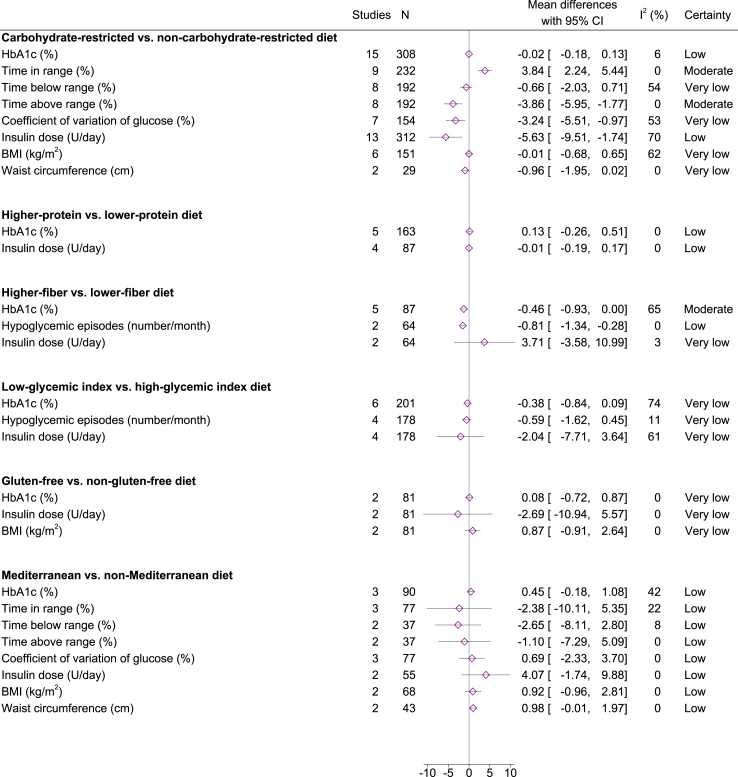
Out of 5287 studies, 35 RCTs involving children, adolescents, and adults with type 1 diabetes were eligible. Higher-fiber diets (≥35 g/day, 5 RCTs) reduced HbA1c (MD -0.46%, 95% CI -0.93 to 0.00, I 65%) and hypoglycemia (MD -0.81 episodes/month, 95% CI -1.34 to -0.28, I 0%), with moderate and low certainty of evidence, respectively. Carbohydrate-restricted diets (≤45% energy, 20 RCTs) improved TIR (MD 3.84%, 95% CI 2.24-5.44, I 0%), CV (MD -3.24%, 95% CI -5.51 to -0.97, I 53%), and insulin needs (MD -5.63 U/day, 95% CI -9.51 to -1.74, I 70%), but not HbA1c, with low to moderate certainty of evidence. Higher-protein, low-glycemic index, gluten-free, Mediterranean, vegan, and intermittent fasting diets showed no effects on glucose management (1-6 RCTs), although certainty of evidence was low.
Maintaining a high-fiber diet while restricting other carbohydrates may improve glycemic control in individuals with type 1 diabetes. Further investigation is needed into long-term effects and other diets.
Swedish Research Council, Swedish Diabetes Foundation, and the Strategic Research Programme in Diabetes at Karolinska Institutet.
有效的血糖管理对于预防1型糖尿病并发症至关重要。虽然营养治疗至关重要,但最佳饮食仍不确定。我们的系统评价和荟萃分析综合了来自随机对照试验(RCT)的证据,这些试验涉及各种饮食对1型糖尿病患者血糖管理的影响。
我们系统检索了截至2024年11月11日的Medline、Embase和Cochrane图书馆,以查找关于1型糖尿病饮食模式和血糖控制结果的随机对照试验,包括糖化血红蛋白(HbA1c)、血糖达标时间(TIR)、变异系数(CV)、低血糖、胰岛素剂量和人体测量特征。两名评价员独立提取数据,并使用RoB-2工具评估偏倚风险。我们使用随机效应模型估计了95%置信区间的汇总平均差(MD)。使用GRADE评估证据的确定性。该研究方案已在国际前瞻性系统评价注册库(PROSPERO,注册号:CRD42023479252)注册。
在5287项研究中,35项涉及1型糖尿病儿童、青少年和成人的随机对照试验符合纳入标准。高纤维饮食(≥35克/天,5项随机对照试验)降低了糖化血红蛋白(MD -0.46%,95%置信区间 -0.93至0.00,I² = 65%)和低血糖发生率(MD -0.81次/月,95%置信区间 -1.34至 -0. : 28,I² = 0%),证据确定性分别为中等和低等。碳水化合物限制饮食(≤45%能量,20项随机对照试验)改善了血糖达标时间(MD 3.84%,95%置信区间2.24 - 5.44,I² = 0%)、变异系数(MD -3.24%,95%置信区间 -5.51至 -0.97,I² = 53%)和胰岛素需求量(MD -5.63单位/天,95%置信区间 -9.51至 -1.7 : 4,I² = 70%),但对糖化血红蛋白无影响,证据确定性为低到中等。高蛋白饮食、低血糖指数饮食、无麸质饮食、地中海饮食(1 - 6项随机对照试验)对血糖管理均无影响,尽管证据确定性较低。
对于1型糖尿病患者,在限制其他碳水化合物的同时保持高纤维饮食可能改善血糖控制。需要进一步研究其长期影响以及其他饮食。
瑞典研究理事会、瑞典糖尿病基金会以及卡罗林斯卡学院糖尿病战略研究计划。