Janzen Sabine, Saxena Prajvi, Agnes Cicy, Maaß Wolfgang
Smart Service Engineering, Deutsches Forschungszentrum für Künstliche Intelligenz (DFKI), Stuhlsatzenhausweg 3, 66123, Saarbrücken, Deutschland.
Bundesgesundheitsblatt Gesundheitsforschung Gesundheitsschutz. 2025 Aug;68(8):889-897. doi: 10.1007/s00103-025-04090-w. Epub 2025 Jul 4.
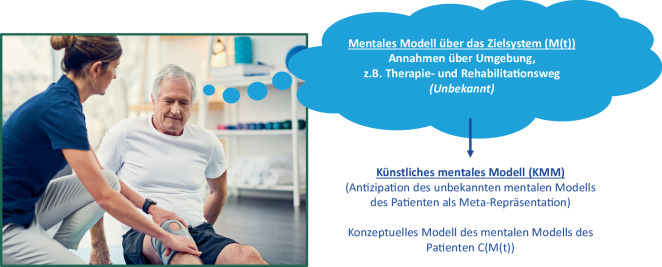
Artificial intelligence (AI) can support patient-centered care in prevention and rehabilitation. In Germany, almost 1.9 million patients were treated in rehabilitation hospitals in 2023, mostly due to musculoskeletal disorders. The success of rehabilitation depends on cooperation between patient, doctor, and therapist as well as active participation. However, cognitive limitations, language barriers, and psychological factors tackle decision-making and communication abilities of patients. This leads to incomplete or distorted data and impairs individualized therapy. A potential solution approach is to apply artificial mental models (AMMs) that anticipate patients' unknown mental models. These concepts are based on cognitive science theories and world models from AI. AMMs can optimize treatment decisions, correct misjudgments, and thus increase the success of rehabilitation. Particularly in knee rehabilitation, an AI agent can determine how patients perceive their recovery and enable individual adjustments. The BMFTR project FedWELL investigates the use of AMM in rehabilitation. A non-discriminatory base model was developed using data from online forums, user studies, and machine learning models. Initial results show that AI-supported models can predict individual assumptions and expectations of patients within the rehabilitation process and enable personalized therapies. This article presents the research design of the project and reports the first results of the initial survey phase.
人工智能(AI)可以在预防和康复方面支持以患者为中心的护理。在德国,2023年有近190万患者在康复医院接受治疗,主要原因是肌肉骨骼疾病。康复的成功取决于患者、医生和治疗师之间的合作以及患者的积极参与。然而,认知局限、语言障碍和心理因素会影响患者的决策和沟通能力。这会导致数据不完整或失真,并损害个性化治疗。一种潜在的解决方法是应用人工心理模型(AMM),它可以预测患者未知的心理模型。这些概念基于认知科学理论和人工智能的世界模型。AMM可以优化治疗决策,纠正错误判断,从而提高康复的成功率。特别是在膝关节康复中,一个人工智能代理可以确定患者如何看待自己的康复情况,并进行个性化调整。BMFTR项目FedWELL研究了AMM在康复中的应用。利用来自在线论坛、用户研究和机器学习模型的数据开发了一个无歧视的基础模型。初步结果表明,人工智能支持的模型可以预测患者在康复过程中的个人假设和期望,并实现个性化治疗。本文介绍了该项目的研究设计,并报告了初始调查阶段的首批结果。