Klingler David, Fallon Lucy, Cohn Daniel, Crawford Amy, Marcus Liza, Jones Alisha N
Department of Chemistry, New York University, New York, New York, USA.
Department of Chemistry, New York University, New York, New York, USA.
J Biol Chem. 2025 Jul 9;301(8):110468. doi: 10.1016/j.jbc.2025.110468.
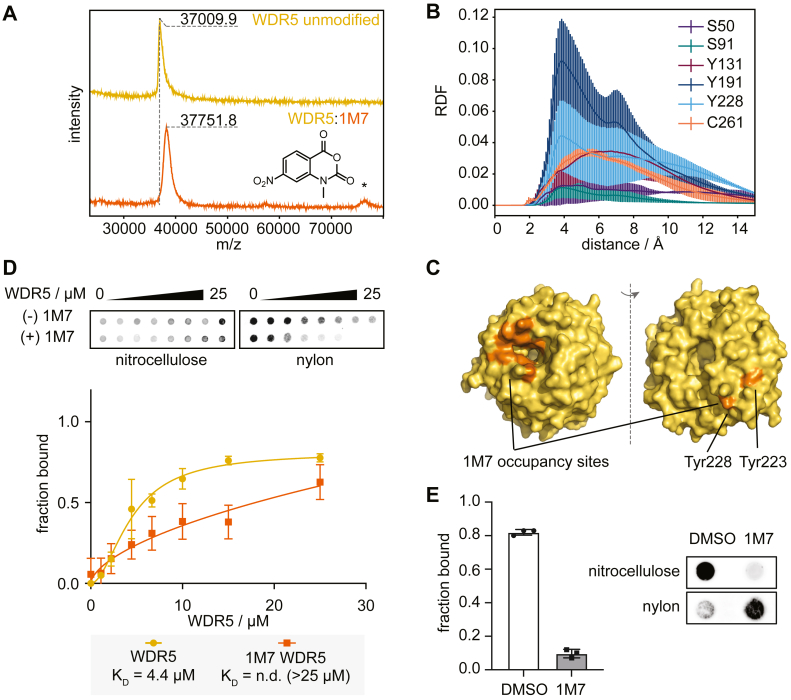
RNA chemical probing experiments are a broadly used method for revealing the structure of RNA as well as for identifying protein binding sites. This is beneficial for expanding our understanding of biological processes governed by protein-RNA complex interactions, as well as facilitating the identification of complex inhibiting molecules. The reagents commonly used in chemical probing experiments are highly reactive, methylating or acylating flexible RNA nucleotides. The highly reactive nature of the chemical probes means that they can also react with nucleophilic amino acid side chains, subsequently affecting protein-RNA binding events. We combine molecular dynamics (MD) simulations, matrix-assisted laser desorption ionization mass spectrometry (MALDI-MS), and nuclear magnetic resonance (NMR) experiments to demonstrate that commonly used RNA chemical probes interact with protein amino acids and that this interaction alters protein-RNA binding through binding assays. We discuss the implications of this phenomenon in elucidating the protein-RNA interaction interface using chemical probing experiments.
RNA化学探测实验是一种广泛应用的方法,用于揭示RNA的结构以及识别蛋白质结合位点。这有助于拓展我们对由蛋白质-RNA复合物相互作用所调控的生物过程的理解,同时也便于鉴定复合物抑制分子。化学探测实验中常用的试剂具有高反应活性,可甲基化或酰化柔性的RNA核苷酸。化学探针的高反应活性意味着它们也能与亲核氨基酸侧链发生反应,进而影响蛋白质-RNA结合事件。我们结合分子动力学(MD)模拟、基质辅助激光解吸电离质谱(MALDI-MS)和核磁共振(NMR)实验,以证明常用的RNA化学探针与蛋白质氨基酸相互作用,并且这种相互作用通过结合测定改变蛋白质-RNA结合。我们讨论了这一现象在利用化学探测实验阐明蛋白质-RNA相互作用界面方面的意义。