Vera-Ponce Víctor Juan, Zuzunaga-Montoya Fiorella E, Vásquez-Romero Luisa Erika Milagros, Loayza-Castro Joan A, Vigil-Ventura Enrique, Ramos Willy
Instituto de Investigación de Enfermedades Tropicales, Universidad Nacional Toribio Rodríguez de Mendoza de Amazonas (UNTRM), Amazonas, Perú.
Facultad de Medicina (FAMED), Universidad Nacional Toribio Rodríguez de Mendoza de Amazonas (UNTRM), Amazonas, Perú.
Diabetol Metab Syndr. 2025 Jul 11;17(1):260. doi: 10.1186/s13098-025-01844-z.
Diabetes mellitus (DM) and prediabetes represent significant public health challenges in Peru, with prevalence rates showing considerable variation across recent epidemiological studies.
To conduct a systematic review and meta-analysis to determine the pooled prevalence of diabetes and prediabetes in Peru and identify temporal trends and sources of heterogeneity.
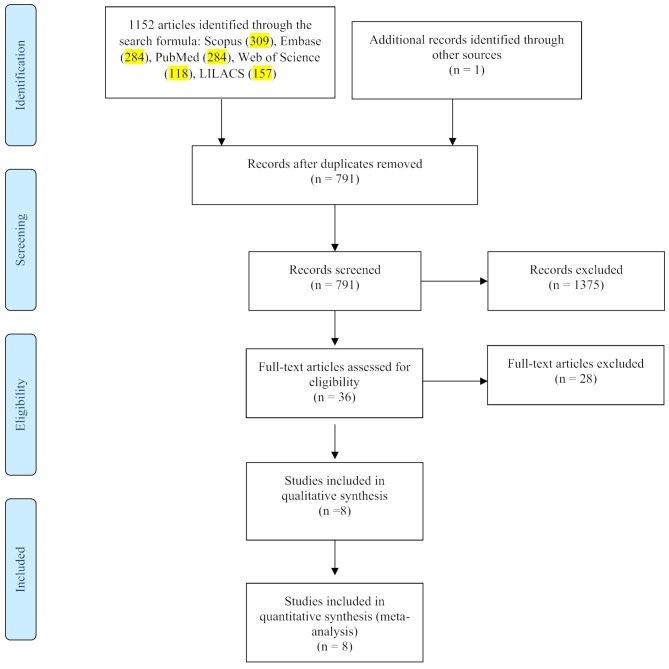
A comprehensive search was conducted in PubMed, Web of Science, SCOPUS, EMBASE and LILACS databases for studies reporting DM and prediabetes prevalence in Peru. Both national and subnational studies using standardized diagnostic criteria and representative sampling were included. Random-effects meta-analysis was performed, with subgroup analyses by sex, age and geographic scope. Meta-regression was conducted to explore temporal trends and sources of heterogeneity.
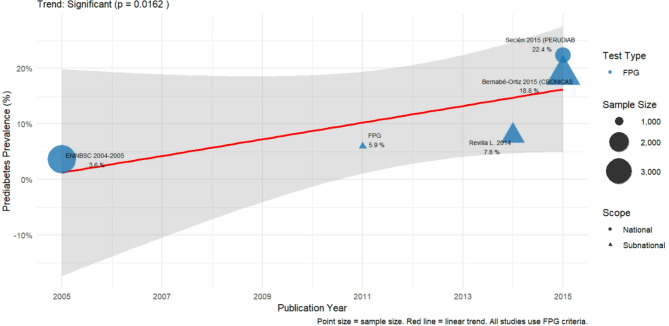
Eight independent studies comprising 18,502 participants provided diabetes data, while five studies with 11,056 participants reported prediabetes data, spanning 2005-2018. The pooled DM prevalence was 7.47% (95% CI: 5.02-10.35%) and prediabetes prevalence was 10.66% (95% CI: 4.29-19.42%). Meta-regression revealed a significant increasing temporal trend for DM (p < 0.0001), with prevalence rising from 2.99% in 2005 to 16.97% in 2018. Substantial heterogeneity was observed for both conditions (I² = 98-99%).
Diabetes and prediabetes prevalence in Peru have increased significantly over the past decade, reaching concerning levels that require urgent public health attention. The substantial heterogeneity observed emphasizes the need for standardized diagnostic protocols and more comprehensive national surveillance systems to accurately monitor these conditions and guide evidence-based prevention strategies.
糖尿病(DM)和糖尿病前期是秘鲁面临的重大公共卫生挑战,近期流行病学研究显示患病率存在显著差异。
进行系统评价和荟萃分析,以确定秘鲁糖尿病和糖尿病前期的合并患病率,并确定时间趋势和异质性来源。
在PubMed、科学网、SCOPUS、EMBASE和LILACS数据库中进行全面检索,以查找报告秘鲁糖尿病和糖尿病前期患病率的研究。纳入使用标准化诊断标准和代表性抽样的国家和次国家研究。进行随机效应荟萃分析,并按性别、年龄和地理范围进行亚组分析。进行Meta回归以探索时间趋势和异质性来源。
八项独立研究共18,502名参与者提供了糖尿病数据,五项研究共11,056名参与者报告了糖尿病前期数据,研究时间跨度为2005年至2018年。糖尿病合并患病率为7.47%(95%CI:5.02 - 10.35%),糖尿病前期患病率为10.66%(95%CI:4.29 - 19.42%)。Meta回归显示糖尿病存在显著的时间上升趋势(p < 0.0001),患病率从2005年的2.99%上升至2018年的16.97%。两种情况均观察到大量异质性(I² = 98 - 99%)。
在过去十年中,秘鲁的糖尿病和糖尿病前期患病率显著增加,达到了令人担忧的水平,需要公共卫生部门紧急关注。观察到的大量异质性强调了需要标准化诊断方案和更全面的国家监测系统,以准确监测这些情况并指导基于证据的预防策略。