Vera-Ponce Víctor Juan, Loayza-Castro Joan A, Zuzunaga-Montoya Fiorella E, Sanchez-Tamay Nataly Mayely, Bustamante-Rodríguez Juan Carlos, Valladolid-Sandoval Lupita Ana Maria, Vásquez-Romero Luisa Erika Milagros, Gutiérrez de Carrillo Carmen Inés
Instituto de Investigación de Enfermedades Tropicales, Universidad Nacional Toribio Rodríguez de Mendoza de Amazonas (UNTRM), Amazonas, Perú.
Facultad de Medicina (FAMED), Universidad Nacional Toribio Rodríguez de Mendoza de Amazonas (UNTRM), Amazonas, Perú.
J Diabetes Metab Disord. 2024 Dec 27;24(1):25. doi: 10.1007/s40200-024-01549-6. eCollection 2025 Jun.
Prediabetes represents a significant public health challenge in Latin America. Its prevalence varies considerably depending on the diagnostic criteria used, which hinders a precise understanding of its magnitude in the region.
To estimate the prevalence and incidence of prediabetes in Latin America through a systematic review (SR).
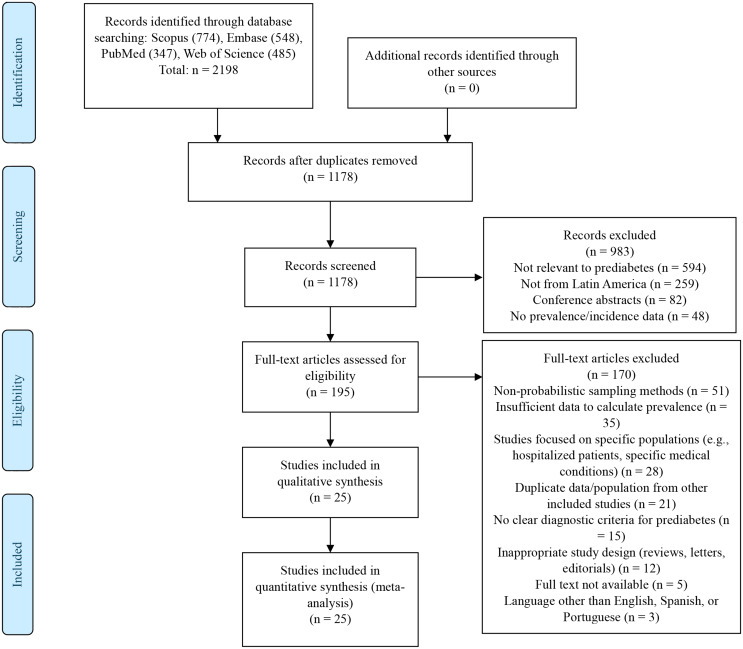
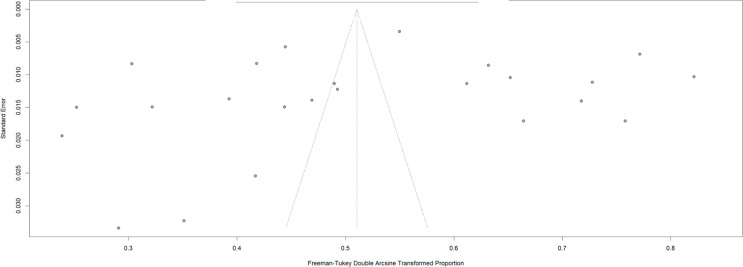
A SR and meta-analysis was conducted searching through October 25, 2024 in SCOPUS, EMBASE, Web of Science, and PubMed. Studies were included if they: (1) used probabilistic sampling methods, (2) included adult participants (≥ 18 years), (3) assessed prediabetes using WHO criteria, fasting glucose, postprandial glucose, or HbA1c, and (4) were published in English, Spanish, or Portuguese. Studies using non-probabilistic sampling, focusing on specific medical conditions, or lacking sufficient data to calculate prevalence or incidence were excluded. Random-effect models were used to estimate pooled prevalence, with heterogeneity assessed using I² statistics and publication bias through funnel plots.
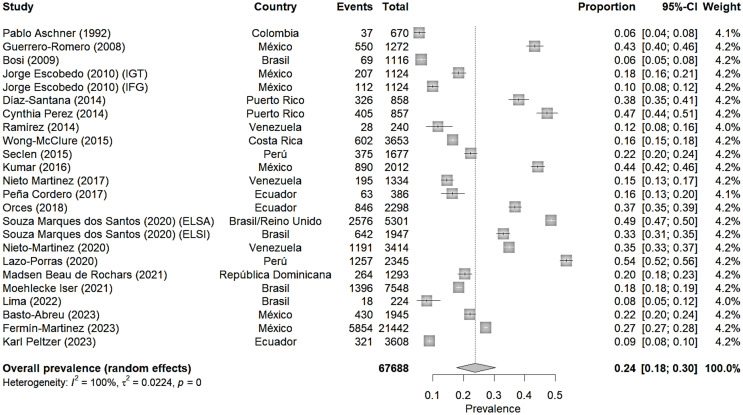
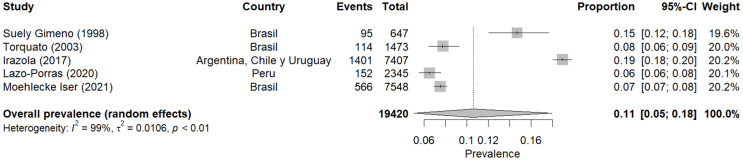
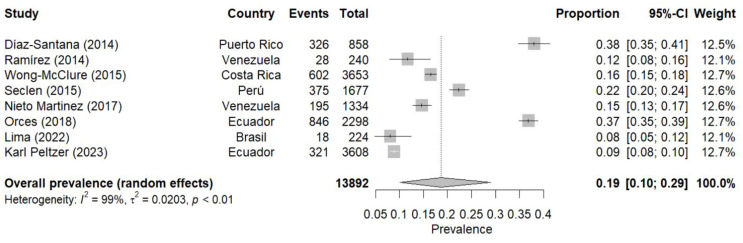
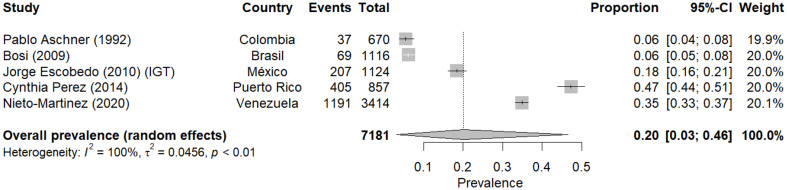
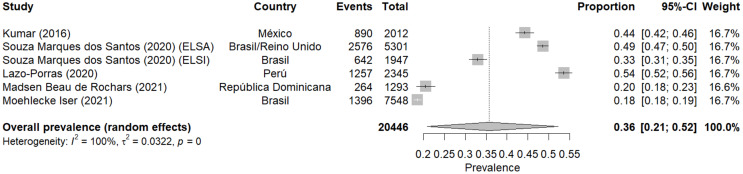
Twenty-five studies from 9 countries published between 1992 and 2023 were analyzed. The pooled prevalence of prediabetes was 24% (95% CI: 18-30%). According to specific criteria, the prevalences were: WHO 11% (95% CI: 5-18%), FG 18% (95% CI: 10-27%), PPG 20% (95% CI: 3-46%), and HbA1c 32% (95% CI: 21-52%). High heterogeneity was observed among studies (I² = 99-100%, < 0.001). Only one study analyzed the incidence, which was 12.8%.
Prediabetes prevalence in Latin America is high, with significant variations by diagnostic criteria. The limited number of incidence studies and high heterogeneity highlight the need for standardized approaches in future research. Implementation of preventive strategies and strengthening of epidemiological surveillance systems are crucial for addressing this public health challenge.
The online version contains supplementary material available at 10.1007/s40200-024-01549-6.
糖尿病前期是拉丁美洲一项重大的公共卫生挑战。其患病率因所采用的诊断标准不同而有很大差异,这妨碍了对该地区糖尿病前期规模的精确了解。
通过系统评价(SR)估计拉丁美洲糖尿病前期的患病率和发病率。
进行了一项系统评价和荟萃分析,检索截至2024年10月25日的SCOPUS、EMBASE、Web of Science和PubMed数据库。纳入的研究需满足以下条件:(1)采用概率抽样方法;(2)纳入成年参与者(≥18岁);(3)使用世界卫生组织标准、空腹血糖、餐后血糖或糖化血红蛋白评估糖尿病前期;(4)以英文、西班牙文或葡萄牙文发表。排除使用非概率抽样、聚焦特定医疗状况或缺乏足够数据计算患病率或发病率的研究。采用随机效应模型估计合并患病率,使用I²统计量评估异质性,并通过漏斗图评估发表偏倚。
分析了1992年至2023年间9个国家发表的25项研究。糖尿病前期的合并患病率为24%(95%置信区间:18 - 30%)。根据特定标准,患病率分别为:世界卫生组织标准11%(95%置信区间:5 - 18%),空腹血糖18%(95%置信区间:10 - 27%),餐后血糖20%(95%置信区间:3 - 46%),糖化血红蛋白32%(95%置信区间:21 - 52%)。研究间观察到高度异质性(I² = 99 - 100%,P < 0.001)。仅有一项研究分析了发病率,为12.8%。
拉丁美洲糖尿病前期患病率很高,因诊断标准不同存在显著差异。发病率研究数量有限且异质性高,凸显未来研究需要标准化方法。实施预防策略和加强流行病学监测系统对于应对这一公共卫生挑战至关重要。
在线版本包含可在10.