Kattah Fabiana Martins, Figueiredo Nayra, Bezerra Kamilla Kenned, Oliveira Emilly Santos, Melo Cinara Costa de, Lima Gislene Batista, Cavalcante Jocélia Paula Rocha, Benetti Beatriz Bacheschi do Carmo, Lima Glaucia Carielo, Mota João Felipe, Corgosinho Flávia Campos
Faculty of Nutrition, Federal University of Goiás, Goiânia 74605-080, Brazil.
Faculty of Medicine, Federal University of Goiás, Goiânia 74605-080, Brazil.
Nutrients. 2025 Jun 20;17(13):2064. doi: 10.3390/nu17132064.
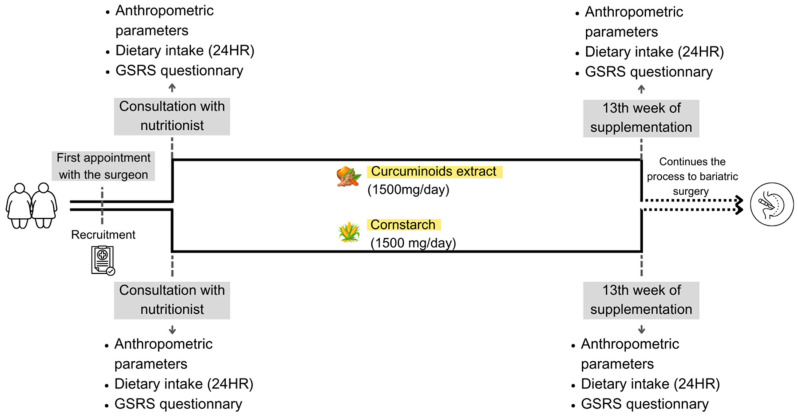
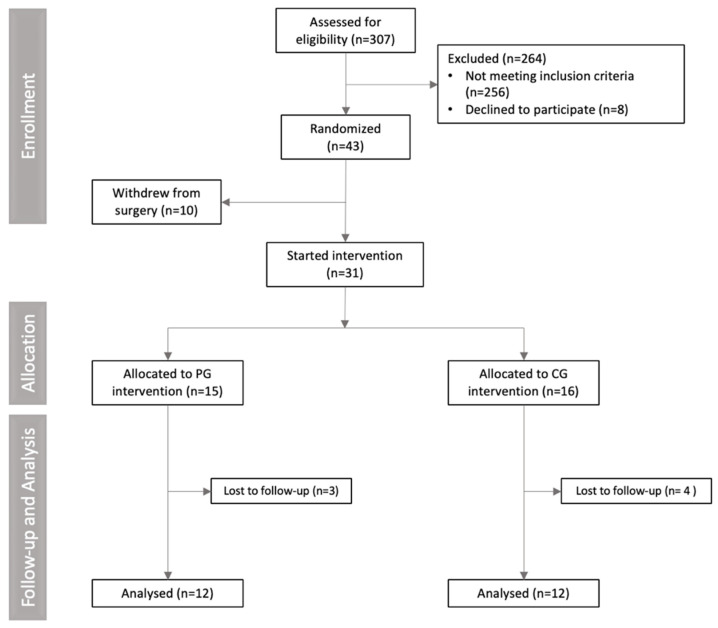
Gastrointestinal symptoms, including reflux, bloating, dyspepsia, stomach pain, and altered bowel patterns, are commonly reported in individuals with severe obesity and may significantly impact quality of life. : Curcumin, a bioactive compound found in turmeric ( L.), possesses anti-inflammatory and antioxidant properties and has been investigated for its potential role in gastrointestinal health. However, its effects in individuals with severe obesity remain unclear. : This double-blind, placebo-controlled clinical trial aimed to evaluate the effect of curcumin supplementation on gastrointestinal symptoms in women with severe obesity. Thirty-one women with a body mass index (BMI) ≥ 40 kg/m undergoing bariatric surgery were randomized to receive either 1500 mg of curcumin (98.75%) or a placebo (1500 mg corn starch) daily for 13 weeks. Gastrointestinal symptoms were assessed using the Gastrointestinal Symptom Rating Scale (GSRS), and stool consistency was assessed using the Bristol Stool Scale. Anthropometric measurements were also collected. : Participants had an average age of 33.1 ± 8 years and a BMI of 45.6 ± 3.31 kg/m. No differences were observed between groups at baseline. At the end of the study, the curcumin group showed a significant reduction in the GSRS's total score compared to the placebo group ( = 0.002), with improvements in eructation ( = 0.011) and constipation ( = 0.007). Additionally, the curcumin group showed reduced BMI ( = 0.019) and neck circumference ( = 0.042). : These findings suggest that curcumin supplementation may alleviate some gastrointestinal symptoms and improve anthropometric measures in women with severe obesity, providing a potential dietary strategy.
胃肠道症状,包括反流、腹胀、消化不良、胃痛和排便习惯改变,在重度肥胖个体中很常见,可能会显著影响生活质量。姜黄素是姜黄中发现的一种生物活性化合物,具有抗炎和抗氧化特性,并已对其在胃肠道健康中的潜在作用进行了研究。然而,其在重度肥胖个体中的作用仍不清楚。这项双盲、安慰剂对照的临床试验旨在评估补充姜黄素对重度肥胖女性胃肠道症状的影响。31名体重指数(BMI)≥40kg/m²且接受减肥手术的女性被随机分为两组,一组每天服用1500mg姜黄素(98.75%),另一组每天服用安慰剂(1500mg玉米淀粉),持续13周。使用胃肠道症状评分量表(GSRS)评估胃肠道症状,使用布里斯托大便分类法评估大便稠度。还收集了人体测量数据。参与者的平均年龄为33.1±8岁,BMI为45.6±3.31kg/m²。两组在基线时未观察到差异。在研究结束时,与安慰剂组相比,姜黄素组的GSRS总分显著降低(P=0.002),嗳气(P=0.011)和便秘(P=0.007)有所改善。此外,姜黄素组的BMI(P=0.019)和颈围(P=0.042)降低。这些发现表明,补充姜黄素可能会缓解重度肥胖女性的一些胃肠道症状并改善人体测量指标,提供了一种潜在的饮食策略。