Duceac Covrig Mădălina, Buzea Călin Gheorghe, Pleșea-Condratovici Alina, Eva Lucian, Duceac Letiția Doina, Dabija Marius Gabriel, Costăchescu Bogdan, Elkan Eva Maria, Guțu Cristian, Voinescu Doina Carina
Faculty of Medicine and Pharmacy, Doctoral School of Biomedical Sciences, "Dunărea de Jos" University of Galați, 47 Domnească Street, 800008 Galați, Romania.
Clinical Emergency Hospital "Prof. Dr. Nicolae Oblu", 700309 Iași, Romania.
Diagnostics (Basel). 2025 Jun 26;15(13):1628. doi: 10.3390/diagnostics15131628.
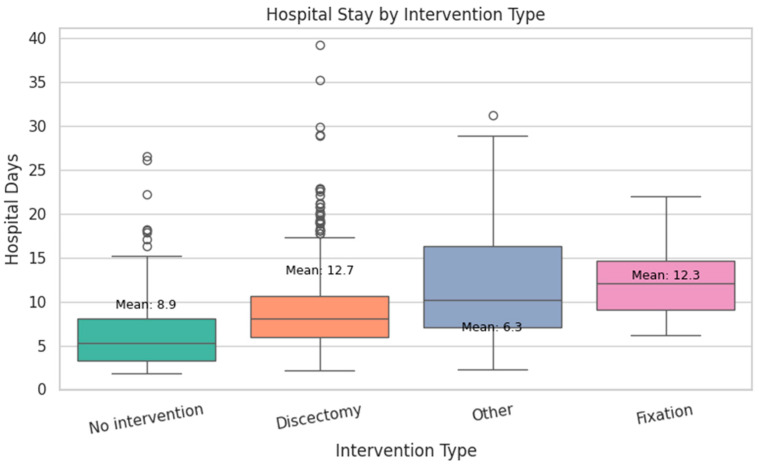
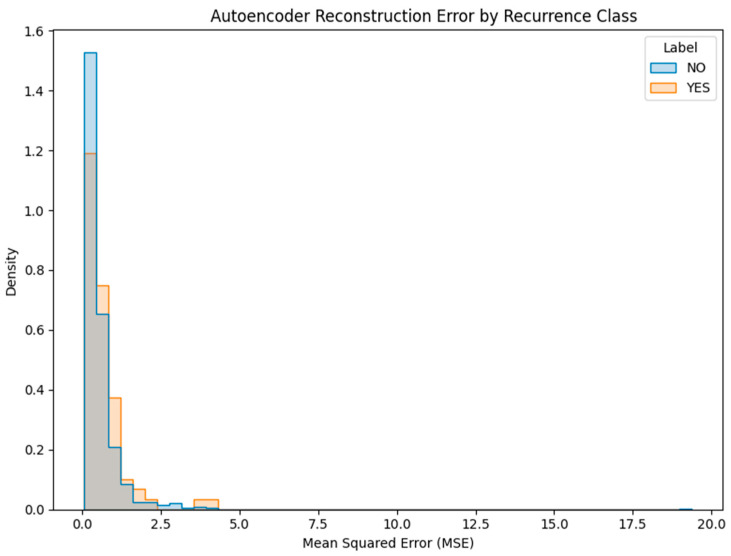
Lumbar disc herniation (LDH) recurrence remains a pressing clinical challenge, with limited predictive tools available to support early identification and personalized intervention. Predicting recurrence after lumbar disc herniation (LDH) remains clinically important but algorithmically difficult due to extreme class imbalance and low signal-to-noise ratio. This study proposes a hybrid machine learning framework that integrates supervised classifiers, unsupervised anomaly detection, and decision threshold tuning to predict LDH recurrence using routine clinical data. A dataset of 977 patients from a Romanian neurosurgical center was used. We trained a deep neural network, random forest, and an autoencoder (trained only on non-recurrence cases) to model baseline and anomalous patterns. Their outputs were stacked into a meta-classifier and optimized via sensitivity-focused threshold tuning. Evaluation was performed via stratified cross-validation and external holdout testing. Baseline models achieved high accuracy but failed to recall recurrence cases (0% sensitivity). The proposed ensemble reached 100% recall internally with a threshold of 0.05. Key predictors included hospital stay duration, L4-L5 herniation, obesity, and hypertension. However, external holdout performance dropped to 0% recall, revealing poor generalization. The ensemble approach enhances detection of rare recurrence cases under internal validation but exhibits poor external performance, emphasizing the challenge of rare-event modeling in clinical datasets. Future work should prioritize external validation, longitudinal modeling, and interpretability to ensure clinical adoption.
腰椎间盘突出症(LDH)复发仍然是一个紧迫的临床挑战,目前可用的预测工具有限,难以支持早期识别和个性化干预。预测腰椎间盘突出症(LDH)后的复发在临床上仍然很重要,但由于极端的类别不平衡和低信噪比,在算法上具有难度。本研究提出了一种混合机器学习框架,该框架整合了监督分类器、无监督异常检测和决策阈值调整,以使用常规临床数据预测LDH复发。使用了来自罗马尼亚神经外科中心的977例患者的数据集。我们训练了一个深度神经网络、随机森林和一个自动编码器(仅在非复发病例上进行训练)来对基线和异常模式进行建模。它们的输出被堆叠到一个元分类器中,并通过以敏感性为重点的阈值调整进行优化。通过分层交叉验证和外部保留测试进行评估。基线模型实现了高准确率,但未能召回复发病例(敏感性为0%)。所提出的集成模型在阈值为0.05时内部召回率达到100%。关键预测因素包括住院时间、L4-L5椎间盘突出、肥胖和高血压。然而,外部保留测试的性能降至0%召回率,显示出泛化能力较差。集成方法在内部验证中增强了对罕见复发病例的检测,但外部性能较差,这凸显了临床数据集中罕见事件建模的挑战。未来的工作应优先进行外部验证、纵向建模和可解释性,以确保临床应用。