Vega-Quiroz Magdalena, Reyes-Maciel Agustin, Lopez-Ayuso Christian Andrea, Jurado Carlos A, Guzman-Juarez Hector, Alvarez-Gayosso Carlos Andres, Aranda-Herrera Benjamin, Alshabib Abdulrahman, Garcia-Contreras Rene
Interdisciplinary Research Laboratory, Nanostructures, and Biomaterials Area, Escuela Nacional de Estudios Superiores (ENES) Unidad León, Universidad Nacional Autónoma de México (UNAM), León 37684, Guanajuato, Mexico.
Division of Operative Dentistry, Department of General Dentistry, College of Dentistry, The University of Tennessee Health Science Center, Memphis, TN 38103, USA.
Polymers (Basel). 2025 Jun 26;17(13):1768. doi: 10.3390/polym17131768.
Reconstructing maxillofacial defects is important in dentistry, so efforts are being made to develop materials that promote cell migration and repair. Graphene oxide (GO) is used to enhance the biocompatibility of polymethylmethacrylate (PMMA) due to its nanostructure.
to assess cytotoxicity, cell proliferation, and differentiation of human dental pulp stem cells (hDPSC) in response to a conventional PMMA (PMMA) and polymer enriched with GO (PMMA+GO).
Experiments were carried out with primary hDPSC subcultures. The PMMA and PMMA+GO were tested in direct and indirect contact. Cytotoxicity (1 day) and proliferation (3, 7, and 14 days) were evaluated with an MTT bioassay. The osteogenic, adipogenic, and chondrogenic aspects were determinate with alizarin red, oil red, and safranine. Mean values, standard deviation, and percentages were calculated; data were analyzed with Shapiro-Wilks normality and Student's -test.
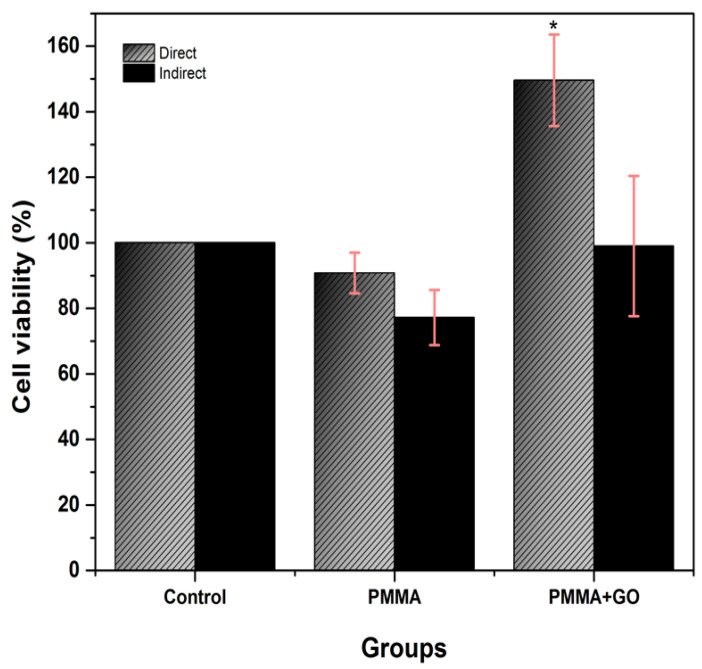
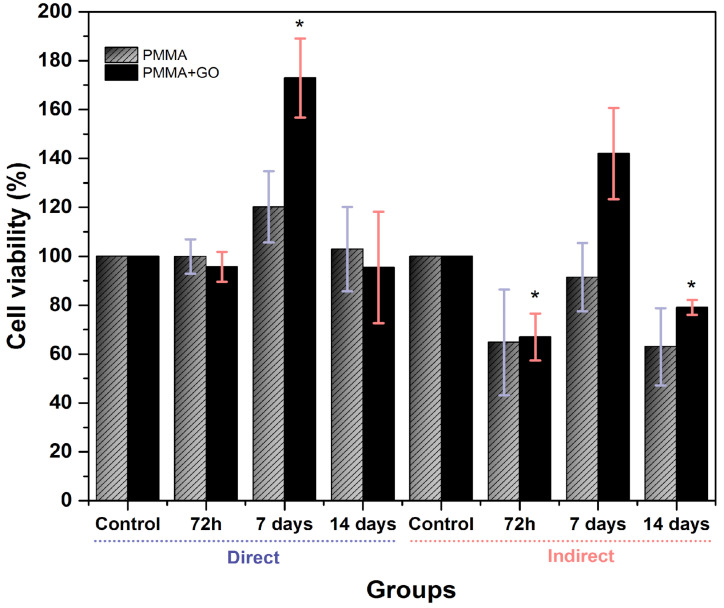
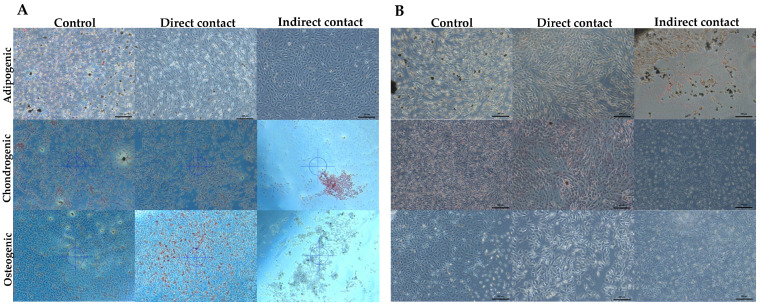
The cell viability of PMMA and PMMA+GO in direct contact correspond to 90.8 ± 6.2, 149.6 ± 14.5 (1 day); 99.9 ± 7.0, 95.7 ± 6.1 (3 days); 120.2 ± 14.6, 172.9 ± 16.2 (7 days); and 102.9 ± 17.3, 95.4 ± 22.8 (14 days). For indirect contact, 77.2 ± 8.4, 99 ± 21.4 (1 day); 64.8 ± 21.6, 67.0 ± 9.6 (3 days); 91.4 ± 16.5, 142 ± 18.7 (7 days); and 63 ± 15.8, 79.1 ± 3.1 (14 days). PMMA+GO samples showed enhanced adipogenic, chondrogenic, and osteogenic aspects.
The integration of GO into PMMA biopolymers stimulates cell proliferation and differentiation, holding great promise for future applications in the field of biomedicine.
颌面缺损修复在牙科领域至关重要,因此人们正在努力研发能促进细胞迁移和修复的材料。氧化石墨烯(GO)因其纳米结构被用于增强聚甲基丙烯酸甲酯(PMMA)的生物相容性。
评估人牙髓干细胞(hDPSC)对传统PMMA(PMMA)和富含GO的聚合物(PMMA+GO)的细胞毒性、细胞增殖及分化情况。
对原代hDPSC传代培养物进行实验。对PMMA和PMMA+GO进行直接接触和间接接触测试。采用MTT生物测定法评估细胞毒性(1天)和增殖情况(3天、7天和14天)。用茜素红、油红和番红确定成骨、成脂和成软骨情况。计算均值、标准差和百分比;数据采用Shapiro-Wilks正态性检验和学生t检验进行分析。
直接接触时,PMMA和PMMA+GO的细胞活力分别为90.8±6.2、149.6±14.5(1天);99.9±7.0、95.7±6.1(3天);120.2±14.6、172.9±16.2(7天);102.9±17.3、95.4±22.8(14天)。间接接触时,分别为77.2±8.4、99±21.4(1天);64.8±21.6、67.0±9.6(3天);91.4±16.5、142±18.7(7天);63±15.8、79.1±3.1(14天)。PMMA+GO样本在成脂、成软骨和成骨方面表现增强。
将GO整合到PMMA生物聚合物中可刺激细胞增殖和分化,在生物医学领域的未来应用中具有巨大潜力。