Umapathy Vidhya Rekha, Natarajan Prabhu Manickam, Swamikannu Bhuminathan
Department of Public Health Dentistry, Thai Moogambigai Dental College and Hospital, Dr. M.G.R. Educational and Research Institute, Chennai 600107, Tamil Nadu, India.
Department of Clinical Sciences, Centre of Medical and Bio-Allied Health Sciences and Research, Ajman University, Ajman P.O. Box 346, United Arab Emirates.
Biomolecules. 2025 Apr 8;15(4):546. doi: 10.3390/biom15040546.
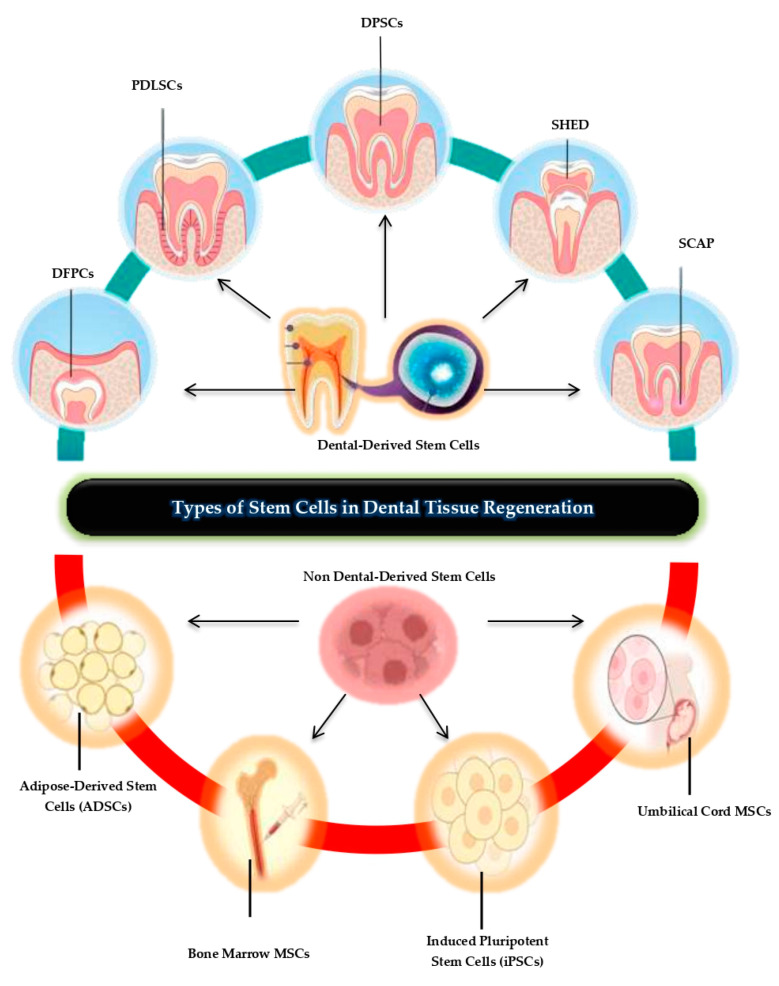
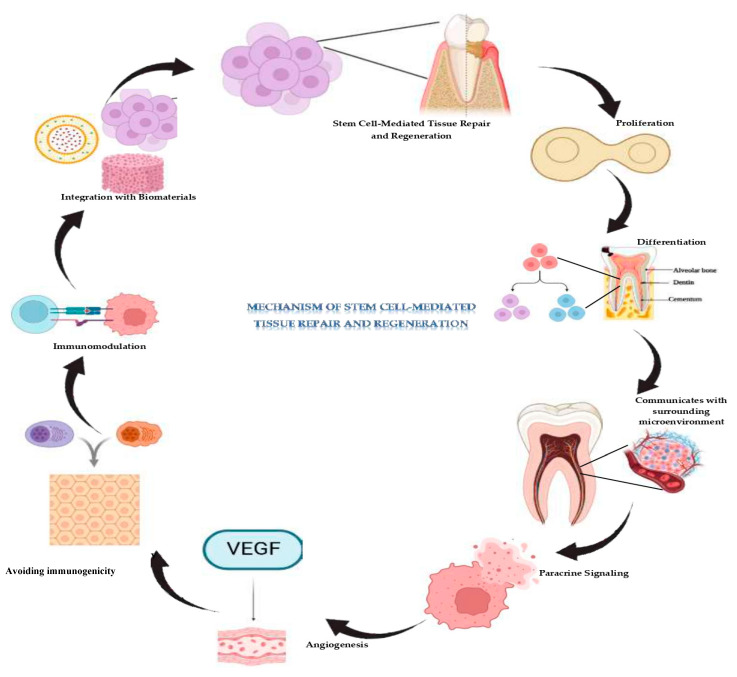
Advanced bioengineering, popularly known as regenerative dentistry, has emerged and is steadily developing with the aim of replacement of lost or injured tissues in the mouth using stem cells and other biomaterials. Conventional therapies for reparative dentistry, for instance fillings or crowns, mainly entail the replenishment of affected tissues without much concern given to the regeneration of tissues. However, these methods do not enable the natural function and aesthetics of the teeth to be maintained in the long term. There are several regenerative strategies that offer the potential to address these limitations to the extent of biologically restoring the function of teeth and their components, like pulp, dentin, bone, and periodontal tissues. Hence, stem cells, especially dental tissue derived stem cells, such as dental pulp stem cells, periodontal ligament stem cells, or apical papilla stem cells, are quite promising in this regard. These stem cells have the potentiality of generating precise dental cell lineages and thus are vital for tissue healing and renewal. Further, hydrogels, growth factors, and synthetic scaffolds help in supporting the stem cells for growth, proliferation, and differentiation into functional tissues. This review aims at describing the process of stem cell-based tissue repair biomaterials in dental regeneration, and also looks into the practice and prospects of regenerative dentistry, analysing several case reports and clinical investigations that demonstrate the efficacy and limitations of the technique. Nonetheless, the tremendous potential for regenerative dentistry is a reality that is currently challenged by biological and technical constraints, such as scarcity of stem cell sources, inadequate vascularization, and the integration of the materials used in the procedure. As we move forward, the prospects for regenerative dentistry are in subsequent developments of stem cell technology, biomaterial optimization, and individualized treatment methods, which might become increasingly integrated in dental practices globally. However, there are regulatory, ethical and economic issues that may pose a hurdle in the further advancement of this discipline.
先进生物工程,通常称为再生牙科,已经出现并正在稳步发展,其目的是利用干细胞和其他生物材料替代口腔中缺失或受损的组织。传统的修复牙科治疗方法,如补牙或牙冠,主要是对受影响的组织进行补充,而不太关注组织的再生。然而,这些方法无法长期维持牙齿的自然功能和美观。有几种再生策略有可能在生物学上恢复牙齿及其组成部分(如牙髓、牙本质、骨骼和牙周组织)的功能,从而解决这些局限性。因此,干细胞,尤其是源自牙齿组织的干细胞,如牙髓干细胞、牙周膜干细胞或根尖乳头干细胞,在这方面很有前景。这些干细胞具有生成精确牙细胞谱系的潜力,因此对组织愈合和更新至关重要。此外,水凝胶、生长因子和合成支架有助于支持干细胞生长、增殖并分化为功能组织。这篇综述旨在描述基于干细胞的组织修复生物材料在牙齿再生中的过程,同时探讨再生牙科的实践和前景,分析一些病例报告和临床研究,以证明该技术的有效性和局限性。尽管如此,再生牙科的巨大潜力是一个现实,但目前受到生物学和技术限制的挑战,如干细胞来源稀缺、血管化不足以及手术中使用材料的整合问题。随着我们向前发展,再生牙科的前景在于干细胞技术的后续发展、生物材料优化和个性化治疗方法,这些可能会在全球牙科实践中越来越多地整合。然而,监管、伦理和经济问题可能会对该学科的进一步发展构成障碍。