Pang Yanrong, Yang Yuping, Zheng Kaifeng, Wu Xiaozhuo, Zhang Yanfen, Chen Jinyuan, Geng Guigong, Qiao Feng, Han Shengcheng
College of Life Sciences, Beijing Normal University, Beijing 100875, China.
Key Laboratory of Biodiversity Formation Mechanism and Comprehensive Utilization of the Qinghai-Tibet Plateau in Qinghai Province, School of Life Sciences, Qinghai Normal University, Xining 810008, China.
Plants (Basel). 2025 Jun 25;14(13):1946. doi: 10.3390/plants14131946.
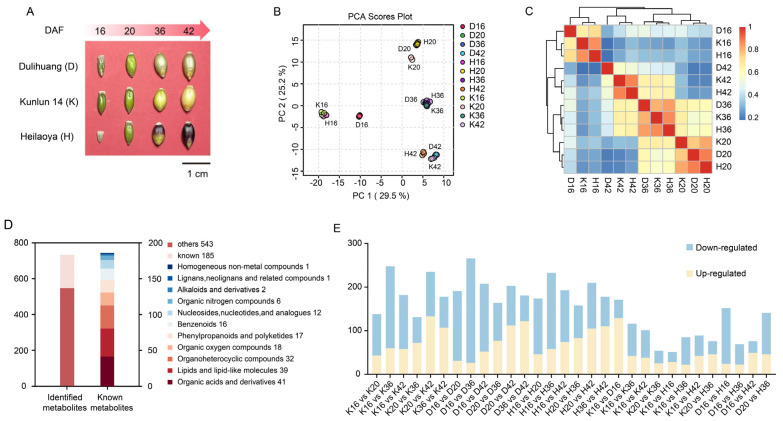
Tibetan hulless barley (qingke) grains are becoming more popular because of their high nutritional benefits. Comparative metabolomics and proteomics analyses of qingke grains (at 16, 20, 36, and 42 days after flowering) were conducted to explore the metabolic dynamics during grain filling and compare the differences in quality among three different varieties, Dulihuang, Kunlun 14, and Heilaoya. A total of 728 metabolites and 4864 proteins were identified. We first found that both the metabolite and protein profiles were more closely associated with the grain developmental stage in each cultivar than across different stages in a single cultivar. Next, we focused on the energy metabolism and biosynthesis pathways of key quality components, such as flavonoids, starch, and β-glucans in qingke grains. Quantitative analysis revealed significant variation in the abundance of cellulose synthase-like enzyme (CslF) among the three cultivars. Notably, Heilaoya displayed substantially lower CslF6 levels at 36 and 42 DAF than Kunlun 14 and Dulihuang did. These observed differences in CslF6 abundance may represent a key regulatory mechanism underlying the distinct β-glucan biosynthesis patterns among the three cultivars. Collectively, our results enhance the understanding of metabolic networks involved in qingke grain development and serve as a foundation for advancing breeding studies.
青稞因其高营养价值而越来越受欢迎。开展了青稞籽粒(开花后16、20、36和42天)的比较代谢组学和蛋白质组学分析,以探究籽粒灌浆期间的代谢动态,并比较三个不同品种肚里黄、昆仑14和黑老鸦之间的品质差异。共鉴定出728种代谢物和4864种蛋白质。我们首先发现,与单个品种不同发育阶段相比,每个品种的代谢物和蛋白质谱与籽粒发育阶段的关联更为紧密。接下来,我们聚焦于青稞籽粒中关键品质成分如类黄酮、淀粉和β-葡聚糖的能量代谢和生物合成途径。定量分析显示,三个品种间纤维素合酶类酶(CslF)丰度存在显著差异。值得注意的是,在开花后36天和42天,黑老鸦的CslF6水平显著低于昆仑14和肚里黄。观察到的CslF6丰度差异可能代表了三个品种间不同β-葡聚糖生物合成模式的关键调控机制。总体而言,我们的结果增进了对青稞籽粒发育所涉及代谢网络的理解,并为推进育种研究奠定了基础。