Sanz-Moreno A, da Silva-Buttkus P, Terwee C B, Raess M, Fuchs H, Gailus-Durner V, Hrabě de Angelis M
Institute of Experimental Genetics, German Mouse Clinic, Helmholtz Zentrum München, 85764, Neuherberg, Germany.
Department of Epidemiology and Data Science, Amsterdam UMC, Vrije Universiteit Amsterdam, Amsterdam Public Health Research Institute, Amsterdam, 1081 HV, Netherlands.
Neurosci Appl. 2024 Mar 19;3:104058. doi: 10.1016/j.nsa.2024.104058. eCollection 2024.
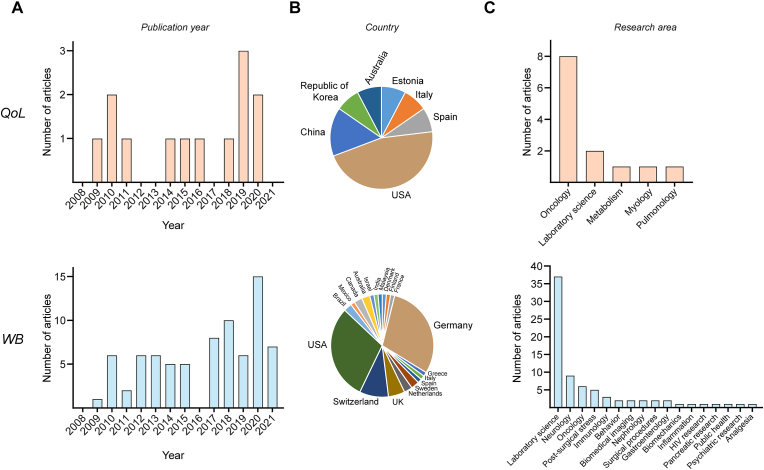
Mouse preclinical research is of great scientific interest to understand the mechanisms of human diseases and test potential therapeutic interventions. Researchers characterize biological and physiological traits, behaviors and disease symptoms using standardized phenotypic protocols in the context of mouse studies. However, the procedures applied do not always fully translate to reported outcomes in clinical trials. Quality of life (QoL) and wellbeing (WB) are particularly relevant outcomes in human medicine in general, and in neurology in particular, that are routinely measured by patient self-reports but rarely monitored in mouse research. In this novel scoping review, we have identified and described the instruments/tests and outcomes used to assess QoL and WB in recent mouse research (spanning 13 years). We found that WB was stated to be measured more frequently in murine studies (77 publications fulfilled our selection criteria) than QoL (only 13 articles). Instruments measuring WB were commonly used in neurology but less frequently in behavior and psychiatric research articles. Interestingly, we found a high variability of QoL and WB instruments/tests used as well as outcomes measured in the reviewed mouse studies. In addition, among similar parameters tested, we observed variable methodological procedures and mouse sample sizes. Thus, there is a lack of consensus on how to measure QoL and WB in the mouse research field. For ensuring a better translation from mouse to human, outcomes that are important in clinical trials (e.g., QoL and WB) should be measured in mouse studies. Finally, we would like to point out that a proper standardization of QoL and WB assessment protocols, for instance through a modified Delphi consultation survey, should be pursued by the mouse research community.
The study was registered on the PROSPERO Database (registration number CRD42018103507).
小鼠临床前研究对于理解人类疾病机制和测试潜在治疗干预措施具有重大科学意义。研究人员在小鼠研究中使用标准化表型方案来描述生物学和生理特征、行为及疾病症状。然而,所应用的程序并不总是能完全转化为临床试验中报告的结果。生活质量(QoL)和幸福感(WB)在一般医学尤其是神经学中是特别相关的结果,通常通过患者自我报告进行测量,但在小鼠研究中很少受到监测。在这项新颖的范围综述中,我们识别并描述了最近小鼠研究(跨度13年)中用于评估QoL和WB的工具/测试及结果。我们发现,在小鼠研究中(77篇出版物符合我们的选择标准)声称测量WB的频率高于QoL(仅13篇文章)。测量WB的工具在神经学中常用,但在行为和精神病学研究文章中使用频率较低。有趣的是,我们发现在所综述的小鼠研究中,使用的QoL和WB工具/测试以及测量的结果存在很大差异。此外,在测试的类似参数中,我们观察到方法学程序和小鼠样本量各不相同。因此,在小鼠研究领域如何测量QoL和WB缺乏共识。为确保从小鼠到人类有更好的转化,在小鼠研究中应测量在临床试验中重要的结果(例如QoL和WB)。最后,我们想指出,小鼠研究界应通过改进的德尔菲咨询调查等方式,对QoL和WB评估方案进行适当标准化。
该研究已在PROSPERO数据库注册(注册号CRD42018103507)。