Rama Moorthy Hejamadi, Avinash N J, Krishnaraj Rao N S, Raghunandan K R, Dodmane Radhakrishna, Blum Jeremy Joseph, Gabralla Lubna A
Nitte (Deemed to be University), Nitte Institute of Professional Education (NIPE), Department of Computer Applications, Mangalore, Karnataka, India.
Department of Electronics & Communication Engineering, Mangalore Institute of Technology and Engineering, Moodabidre, Karnataka, India.
Sci Rep. 2025 Jul 14;15(1):25436. doi: 10.1038/s41598-025-05586-w.
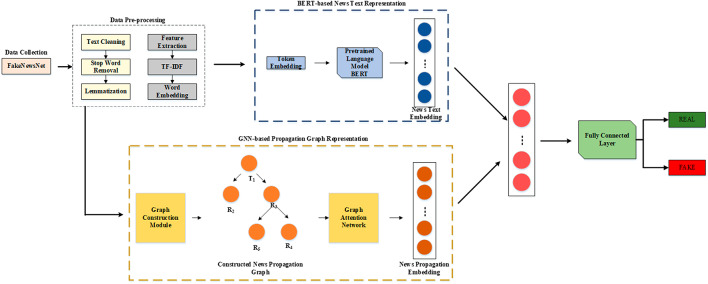
The rapid proliferation of misinformation across digital platforms has highlighted the critical need for advanced fake news detection mechanisms. Traditional methods primarily rely on textual analysis, often neglecting the structural patterns of news dissemination, which play a crucial role in determining credibility. To address this limitation, this study proposes a Dual-Stream Graph-Augmented Transformer Model, integrating BERT for deep textual representation and Graph Neural Networks (GNNs) to model the propagation structure of misinformation. The objective is to enhance fake news detection by leveraging both linguistic and network-based features. The proposed method employs Graph Attention Networks (GAT) and Graph Transformers to extract contextual relationships, while an attention-based fusion mechanism effectively integrates textual and graph embeddings for classification. The model is implemented using PyTorch and Hugging Face Transformers, with experiments conducted on the FakeNewsNet dataset, which includes news articles, user interactions, and source metadata. Evaluation metrics such as accuracy, precision, recall, F1-score, and AUC-ROC indicate superior performance, with an accuracy of 99%, outperforming baseline models such as Bi-LSTM and RoBERTa-GCN. The study concludes that incorporating graph-based propagation features significantly improves fake news detection, providing a robust, scalable, and context-aware solution. Future enhancements will focus on refining credibility assessment mechanisms and extending the model to support multilingual and multimodal misinformation detection across diverse digital platforms.
虚假信息在数字平台上的迅速扩散凸显了对先进的假新闻检测机制的迫切需求。传统方法主要依赖文本分析,往往忽视了新闻传播的结构模式,而这种模式在确定可信度方面起着至关重要的作用。为了解决这一局限性,本研究提出了一种双流图增强变压器模型,将用于深度文本表示的BERT和用于对虚假信息传播结构进行建模的图神经网络(GNN)相结合。目的是通过利用语言和基于网络的特征来增强假新闻检测。所提出的方法采用图注意力网络(GAT)和图变压器来提取上下文关系,同时基于注意力的融合机制有效地整合文本和图嵌入以进行分类。该模型使用PyTorch和Hugging Face Transformers实现,并在FakeNewsNet数据集上进行了实验,该数据集包括新闻文章、用户互动和源元数据。诸如准确率、精确率、召回率、F1分数和AUC-ROC等评估指标表明该模型具有卓越的性能,准确率达到99%,优于双向长短期记忆网络(Bi-LSTM)和基于图卷积网络的RoBERTa(RoBERTa-GCN)等基线模型。研究得出结论,纳入基于图的传播特征可显著提高假新闻检测能力,提供了一种强大、可扩展且上下文感知的解决方案。未来的改进将集中在完善可信度评估机制,并将模型扩展以支持跨不同数字平台的多语言和多模态虚假信息检测。