Chae Jeong-Byoung, Kim Won Gyeong, Song Shinae, Chae Joon-Seok
Laboratory of Veterinary Internal Medicine, BK21 FOUR Future Veterinary Medicine Leading Education and Research Center, Research Institute for Veterinary Science and College of Veterinary Medicine, Seoul National University, Gwanak-ro 1, Gwanak-gu, Seoul, 08826, Republic of Korea.
Bio Team, Animal Industry Data Korea, Seoul, 06152, Republic of Korea.
BMC Vet Res. 2025 Jul 14;21(1):464. doi: 10.1186/s12917-025-04926-2.
Calf diarrhea remains a significant concern in the global cattle industry, leading to considerable economic losses. Infectious pathogens are among the primary causes of this disease. In this study, the prevalence of 7 pathogens—bovine rotavirus (BRV), bovine coronavirus (BCV), bovine viral diarrhea virus (BVDV) types 1 and 2, , spp., and spp.—associated with calf diarrhea was investigated using polymerase chain reaction (PCR). A metagenomic approach was also applied to identify additional RNA viral pathogens from unknown causes of diarrheic fecal samples in the Republic of Korea (ROK).
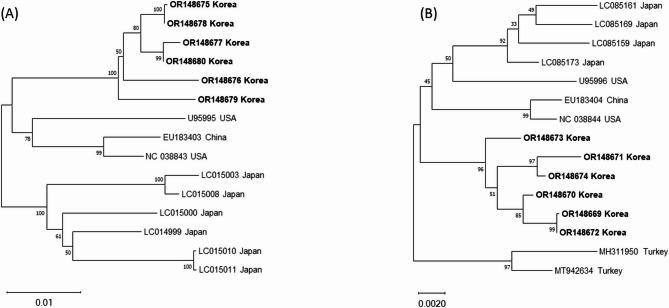
A total of 810 fecal samples from Hanwoo calves () were collected, consisting of 526 normal samples (267 with a fecal score of 0 and 259 with a fecal score of 1) and 284 diarrheic samples (178 with a fecal score of 2 and 106 with a fecal score of 3). All 7 pathogens were detected by PCR in feces and their detection rates and mean fecal scores for each were as follows: BRV (14.0%, 1.41), BCV (3.2%, 1.42), BVDV1 (2.1%, 1.35), BVDV2 (4.9%, 1.33), . (9.8%, 1.66), spp. (1.9%, 1.73), and spp. (0.9%, 0.71). Among these pathogens, BRV ( = 0.004), . ( < 0.001), and spp. ( = 0.027) showed an increase in prevalence with higher fecal scores. Twenty-one fecal samples negative for all pathogens were randomly selected and subjected to high-throughput sequencing to identify RNA viral pathogens associated with calf diarrhea. This approach led to the identification of nearly complete genomic sequences for bovine astrovirus, bovine enterovirus, bovine kobuvirus, bovine nebovirus, bovine norovirus, bovine boosepivirus B, bovine parechovirus, bovine torovirus, . virus 1, and hunnivirus.
This study represents the first investigation of hunnivirus presence and provides a comprehensive description of the nearly complete genomes of 10 viruses associated with calf diarrhea in the ROK. The findings contribute to a better understanding of the epidemiology and molecular characteristics of calf diarrhea-associated pathogens in the ROK, highlighting the potential application of high-throughput sequencing for diagnosing other diseases.
The online version contains supplementary material available at 10.1186/s12917-025-04926-2.
犊牛腹泻仍是全球养牛业的一个重大问题,会导致相当大的经济损失。传染性病原体是该病的主要病因之一。在本研究中,使用聚合酶链反应(PCR)调查了与犊牛腹泻相关的7种病原体——牛轮状病毒(BRV)、牛冠状病毒(BCV)、1型和2型牛病毒性腹泻病毒(BVDV)、 属、 属和 属的流行情况。还采用宏基因组学方法从大韩民国(韩国)腹泻粪便样本的不明病因中鉴定其他RNA病毒病原体。
共收集了810份韩牛犊牛( )的粪便样本,其中包括526份正常样本(267份粪便评分为0,259份粪便评分为1)和284份腹泻样本(178份粪便评分为2,106份粪便评分为3)。通过PCR在粪便中检测到了所有7种病原体,每种病原体的检出率和平均粪便评分如下:BRV(14.0%,1.41)、BCV(3.2%,1.42)、BVDV1(2.1%,1.35)、BVDV2(4.9%,1.33)、 (9.8%,1.66)、 属(1.9%,1.73)和 属(0.9%,0.71)。在这些病原体中,BRV( = 0.004)、 ( < 0.001)和 属( = 0.027)的流行率随粪便评分升高而增加。随机选择21份所有病原体检测均为阴性的粪便样本,进行高通量测序,以鉴定与犊牛腹泻相关的RNA病毒病原体。该方法鉴定出了牛星状病毒、牛肠道病毒、牛杯状病毒、牛内博病毒、牛诺如病毒、牛布塞病毒B、牛帕里病毒、牛环曲病毒、 病毒1和洪尼病毒的近乎完整的基因组序列。
本研究首次调查了洪尼病毒的存在情况,并全面描述了韩国与犊牛腹泻相关的10种病毒的近乎完整基因组。这些发现有助于更好地了解韩国犊牛腹泻相关病原体的流行病学和分子特征,突出了高通量测序在诊断其他疾病方面的潜在应用。
在线版本包含可在10.1186/s12917 - 025 - 04926 - 2获取的补充材料。