Silberman Jordan, Sarlati Siavash, Harris Bronwyn, Lenyoun Hanson, Kaur Manpreet, Wagner Bradley G, Bokhari Warris, Boushey Homer, Chesnutt Asha, Sitts Kelly, Zhu Peter, Willey Vincent J, Fuentes Emmanuel, LeKrey Matthew, Alger Beverly L, Muscioni Guido, Bianchi Matt T, Bota Daniela A, Taylor Thomas H, Evans Michael, Amin Alpesh N, Stark Dylan, Montanari Claudio, Perry James S, Vian Christian, Patel Mithun, Poe Will, Lee Richard A
Office of Medical Policy and Technology Assessment, Elevance Health Inc, Palo Alto, California.
Department of Emergency Medicine, University of California, San Francisco, San Francisco.
JAMA Netw Open. 2025 Jul 1;8(7):e2521438. doi: 10.1001/jamanetworkopen.2025.21438.
Digital health technologies may improve asthma self-management, but evidence is limited in this area.
To investigate the effect of a digital asthma self-management (DASM) program on asthma symptoms in adults.
DESIGN, SETTING, AND PARTICIPANTS: Patient-reported outcome results were reported from a randomized, pragmatic, parallel-arm, open-label, decentralized clinical trial. Adults with asthma were recruited via email, enrolled from October 29, 2020, through November 4, 2021, and were randomized to DASM or usual care (control). Participants completed study activities outside a clinical setting. Data were analyzed between October 13, 2023, and November 29, 2024.
The app-based DASM program provided tailored notifications, symptom logging, wearable device integration, and other tools.
Change in the Asthma Control Test (ACT) was a primary outcome. The ACT is a validated measure of asthma control. Secondary outcomes included engagement and self-reported medication adherence.
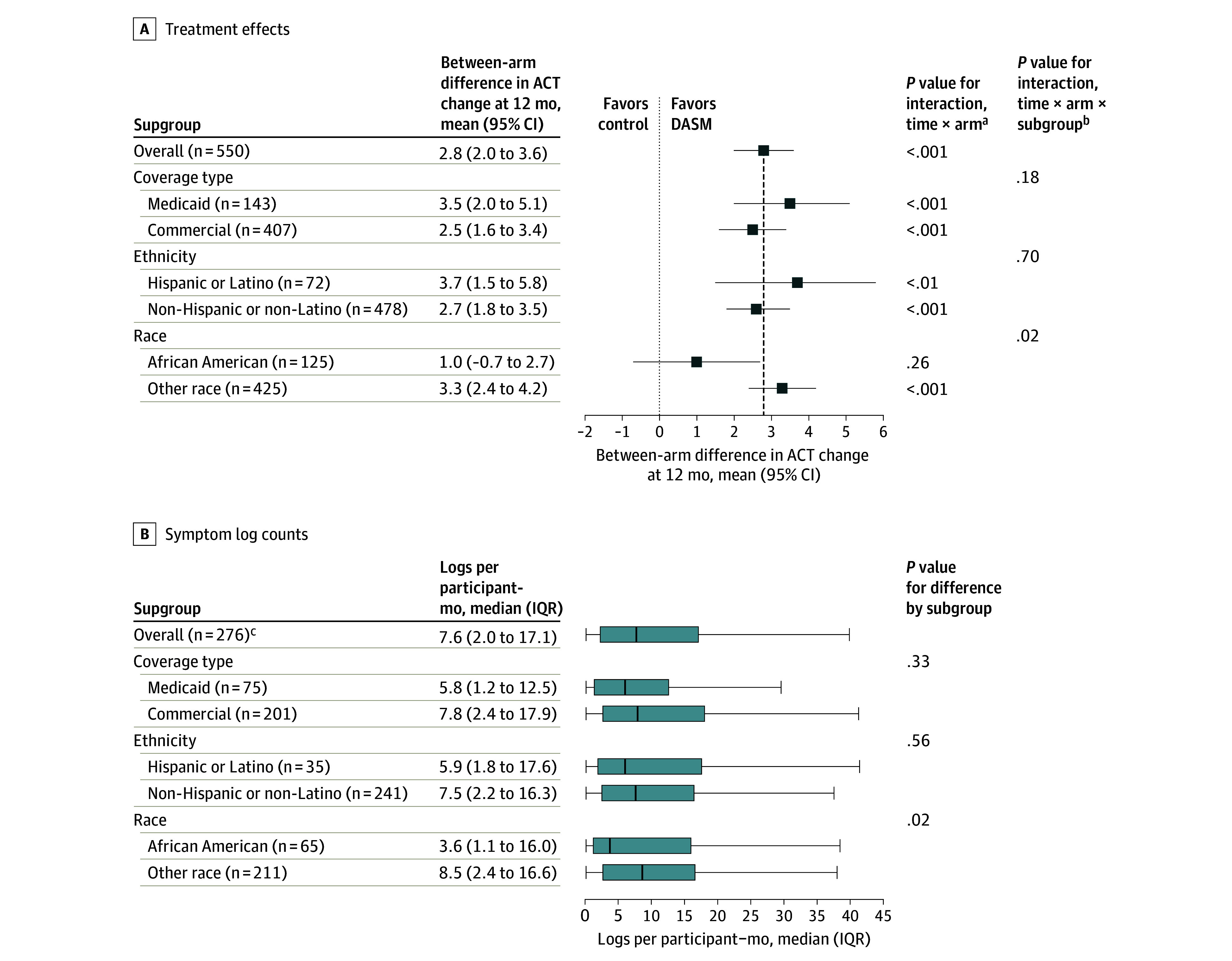
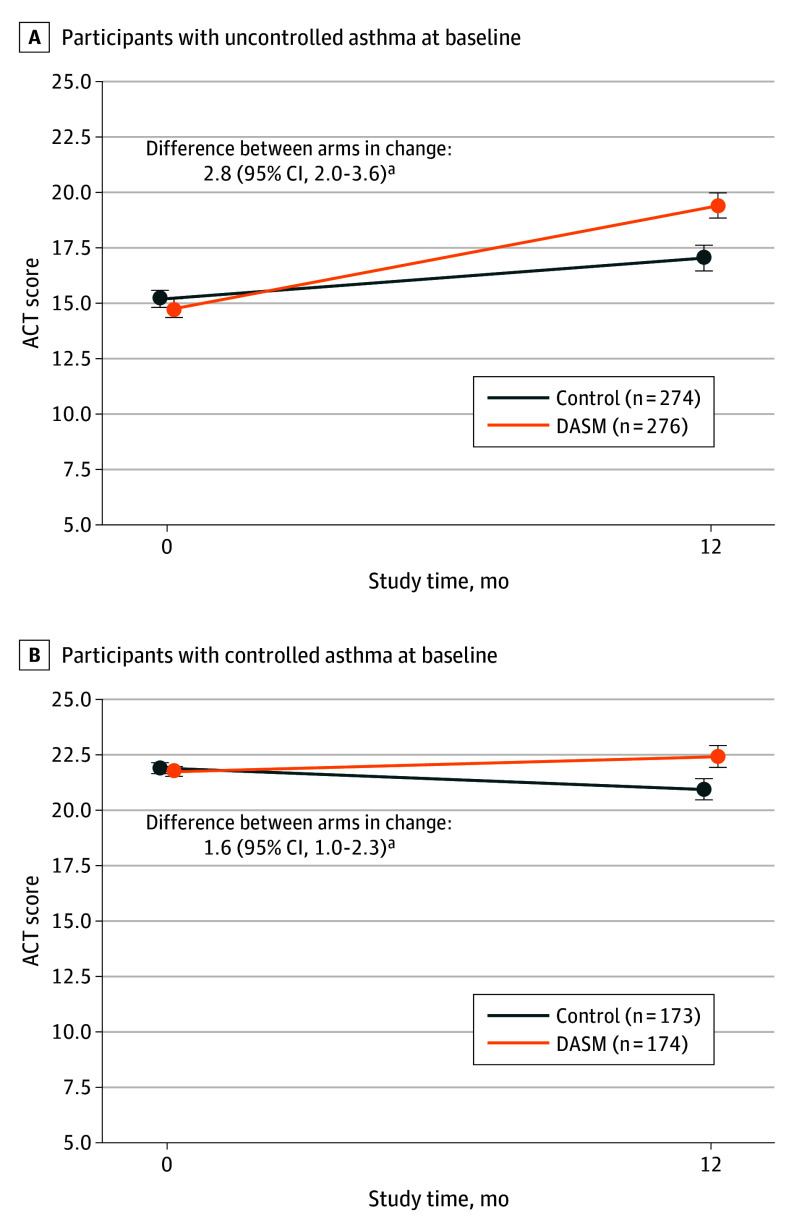
Nine hundred and one participants were enrolled, with data available for 899 (639 [71.1%] female; mean [SD] age, 36.6 [10.5] years). For subgroup analyses, 195 participants (21.7%) were African American; 125 (13.9%), Hispanic or Latino; 680 (75.6%), commercially insured; and 219 (24.4%), Medicaid insured. Prespecified analyses of participants with uncontrolled asthma at baseline (n = 550) showed improvements after 12 months by 4.6 (95% CI, 4.1-5.2) ACT points among DASM participants (P < .001) and 1.8 (95% CI, 1.3-2.4) ACT points among controls (P < .001) (adjusted difference, 2.8 [95% CI, 2.0-3.6] points; P < .001). Race moderated this effect. At 12 months, the difference between arms in ACT change favored DASM over control by 1.0 (95% CI, -0.7 to 2.7) points (P = .26) for African American participants and 3.3 (95% CI, 2.4-4.2) points (P < .001) for participants not endorsing African American race (adjusted difference, -2.3 [95% CI, -4.2 to -0.4] points; P = .02 for interaction). Moderation was not observed by insurance (Medicaid vs commercial; adjusted difference, 1.0 [95% CI, -0.8 to 2.8] points; P = .18 for interaction) or ethnicity (Hispanic or Latino vs non-Hispanic; adjusted difference, 1.0 [95% CI, -1.3 to 3.3] points; P = .70 for interaction).
In this randomized clinical trial of DASM, improved asthma control was observed relative to usual care. Program adaptations may be appropriate to confer benefit throughout diverse populations.
ClinicalTrials.gov Identifier: NCT04609644.
数字健康技术可能会改善哮喘自我管理,但该领域的证据有限。
研究数字哮喘自我管理(DASM)计划对成人哮喘症状的影响。
设计、设置和参与者:患者报告的结局结果来自一项随机、实用、平行组、开放标签、去中心化的临床试验。通过电子邮件招募患有哮喘的成年人,从2020年10月29日至2021年11月4日进行登记,并随机分为DASM组或常规护理(对照组)。参与者在临床环境之外完成研究活动。在2023年10月13日至2024年11月29日期间对数据进行分析。
基于应用程序的DASM计划提供了量身定制的通知、症状记录、可穿戴设备集成和其他工具。
哮喘控制测试(ACT)的变化是主要结局。ACT是一种经过验证的哮喘控制测量指标。次要结局包括参与度和自我报告的药物依从性。
共招募了901名参与者,899名有可用数据(639名[71.1%]为女性;平均[标准差]年龄为36.6[10.5]岁)。对于亚组分析,195名参与者(21.7%)为非裔美国人;125名(13.9%)为西班牙裔或拉丁裔;680名(75.6%)有商业保险;219名(24.4%)有医疗补助保险。对基线时哮喘未得到控制的参与者(n = 550)进行的预先指定分析显示,12个月后,DASM组参与者的ACT得分提高了4.6(95%置信区间,4.1 - 5.2)分(P <.001),对照组提高了1.8(95%置信区间,1.3 - 2.4)分(P <.001)(调整后的差异为2.8[95%置信区间,2.0 - 3.6]分;P <.001)。种族对这种效果有调节作用。在12个月时,ACT变化的组间差异在非裔美国参与者中,DASM组比对照组有利1.0(95%置信区间,-0.7至2.7)分(P = .26),在未认可非裔美国种族的参与者中为3.3(95%置信区间,2.4 - 4.2)分(P <.001)(交互作用的调整差异为-2.3[95%置信区间,-4.2至-0.4]分;P = .02)。在保险类型(医疗补助与商业保险;交互作用的调整差异为1.0[95%置信区间,-0.8至2.8]分;P = .18)或种族(西班牙裔或拉丁裔与非西班牙裔;交互作用的调整差异为1.0[95%置信区间,-1.3至3.3]分;P = .70)方面未观察到调节作用。
在这项关于DASM的随机临床试验中,相对于常规护理,观察到哮喘控制得到改善。可能需要对该计划进行调整,以便为不同人群带来益处。
ClinicalTrials.gov标识符:NCT04609644。