Ji Jiale, Wang Shiliang, Dai Zhaowen, Huo Yinghao, Wang Limin, Zheng Qingshu, Tu Tao
State Key Laboratory of High-efficiency Utilization of Coal and Green Chemical Engineering, School of Chemistry and Chemical Engineering, Ningxia University, Yinchuan, China.
Shanghai Key Laboratory of Molecular Catalysis and Innovative Materials, Department of Chemistry, Fudan University, Shanghai, China.
Nat Commun. 2025 Jul 17;16(1):6583. doi: 10.1038/s41467-025-61989-3.
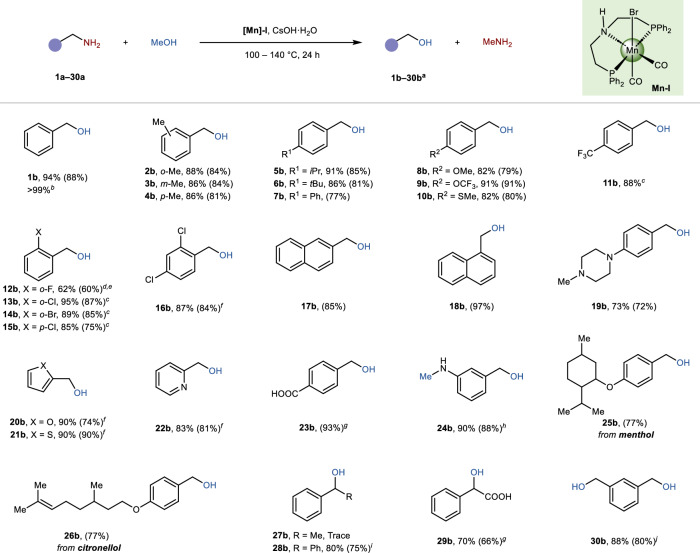
Direct conversion of amines to corresponding alcohols is challenging even under harsh reaction conditions. Inspired by enzymatic transamination, we present a transamination borrowing-hydrogen strategy that enables the direct and selective Mn-catalyzed deaminative hydroxylation of benzylamines, affording a broad scope (>30 examples) of alcohols in good yields at low catalyst loadings (down to 0.05 mol%). Notably, methanol serves a dual role as hydrogen donor and amino acceptor, rather than a conventional role as a methylating agent. Mechanistic investigations reveal base plays a pivotal role in facilitating the 1,3-proton transfer process, thereby effectively suppressing N-methylation pathways and favoring alcohol formation.
即使在苛刻的反应条件下,将胺直接转化为相应的醇也具有挑战性。受酶促转氨作用的启发,我们提出了一种转氨借氢策略,该策略能够实现苄胺的直接、选择性锰催化脱氨基羟基化反应,在低催化剂负载量(低至0.05 mol%)下以良好的产率得到多种醇(>30个实例)。值得注意的是,甲醇作为氢供体和氨基受体发挥双重作用,而不是作为传统的甲基化剂。机理研究表明,碱在促进1,3-质子转移过程中起关键作用,从而有效抑制N-甲基化途径并有利于醇的形成。