Böckmann Hannes, Horstmann Jan Gerrit, Kurtz Felix, Buriks Manuel, Gadge Karun, Manmana Salvatore R, Wippermann Stefan, Ropers Claus
Max Planck Institute for Multidisciplinary Sciences, Göttingen, Germany.
IV. Physical Institute, Solids and Nanostructures, University of Göttingen, Göttingen, Germany.
Nat Phys. 2025;21(7):1106-1111. doi: 10.1038/s41567-025-02899-5. Epub 2025 May 21.
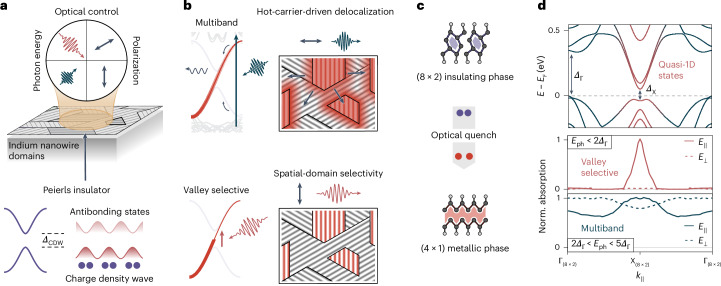
Spatial heterogeneity and phase competition are hallmarks of strongly correlated materials, influencing phenomena such as colossal magnetoresistance and high-temperature superconductivity. Active control over phase textures further promises tunable functionality at the nanoscale. Although light-induced switching of a correlated insulator to a metallic state is well established, optical excitation generally lacks the specificity to select subwavelength domains and determine final textures. Here we drive the domain-specific quench of a textured Peierls insulator using valley-selective photodoping. Polarized excitation exploits the anisotropy of quasi-one-dimensional states at the charge-density-wave gap to initiate an insulator-metal transition with minimal electronic heating. We find that averting dissipation facilitates domain-specific carrier confinement, control over nanotextured phases and reduction in thermal relaxation from the metastable metallic state. This valley-selective photoexcitation approach will enable the activation of electronic phase separation beyond thermodynamic limitations, facilitating optically controlled hidden states, engineered heterostructures and polarization-sensitive percolation networks.
空间异质性和相竞争是强关联材料的标志,影响着诸如巨磁电阻和高温超导等现象。对相纹理的主动控制进一步有望在纳米尺度上实现可调功能。尽管将关联绝缘体光致切换到金属态已得到充分证实,但光激发通常缺乏选择亚波长域和确定最终纹理的特异性。在此,我们利用谷选择性光掺杂驱动纹理化的派尔斯绝缘体进行特定域猝灭。偏振激发利用电荷密度波能隙处准一维态的各向异性,以最小的电子加热引发绝缘体 - 金属转变。我们发现避免耗散有助于特定域载流子限制、对纳米纹理相的控制以及亚稳金属态热弛豫的降低。这种谷选择性光激发方法将能够激活超越热力学限制的电子相分离,促进光控隐藏态、工程异质结构和偏振敏感渗流网络的实现。