Maamar Adel, Faleur Claude, Pedrono Kristell, Adeux Marie-Pierre, Anne Magali, Verdes Adeline, Fillâtre Pierre, Debarre Matthieu, Mercier Nathalie, Revest Matthieu, Massart Nicolas, Poilvet Noémie, Terzi Nicolas, Tadié Jean-Marc, Gacouin Arnaud, Laviolle Bruno
Service des Médecine intensive - Réanimation, Univ Rennes, CHU Rennes, Rennes, F-35000, France.
Service de Réanimation Polyvalente, CH Saint Brieuc, Saint Brieuc, France.
Crit Care. 2025 Jul 18;29(1):312. doi: 10.1186/s13054-025-05563-9.
Pain and anxiety are frequent among critically ill patients undergoing unplanned invasive procedures, and pharmacological pain relief is not always possible. Although hypnosis is widely used in planned painful procedures, studies are lacking in this specific setting. Thus, we aimed to assess whether hypnosis plus standard care reduced pain and anxiety in critically ill patients undergoing an unplanned invasive procedure in comparison to standard care.
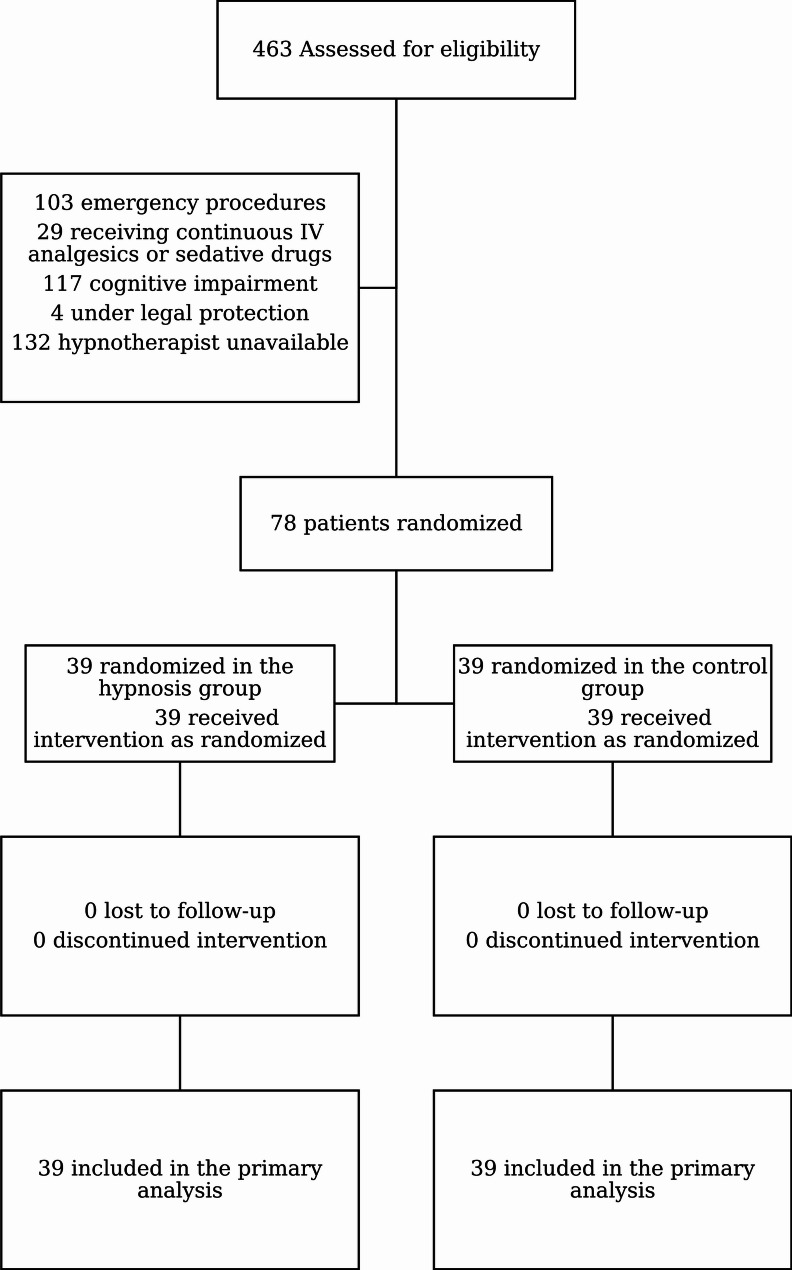
The HYPIC trial was a randomized, single-blind, multicenter clinical trial of hypnosis during unplanned invasive procedures versus standard care for critically ill patients conducted in two French intensive care units (ICUs) from December 27, 2019, to January 25, 2022. Patients were randomly assigned to receive hypnosis plus standard care by trained healthcare providers or standard care. The hypnotherapists were in the room for both arms to maintain blindness. The primary endpoint was the difference in pain level experienced during the invasive procedure assessed immediately after the end of the procedure between the two groups. The secondary outcomes were anxiety level, lidocaine consumption and stress experienced by the ICU nurses in charge of the patients.
We included 78 patients. The pain level, assessed with a numeric pain scale (range, 0-10), was not significantly different between the two groups (2.2 ± 2.9 vs. 2.2 ± 3, difference 0 pts [95% CI -1.3; 1.3], p = 0.89). The level of anxiety was significantly lower in the hypnosis group (2.4 ± 2.8 vs. 4.1 ± 3, difference - 1.7 [-3; -0.4], p = 0.01), as was the level of stress experienced by the ICU nurses (0.1 ± 0.4 vs. 0.9 ± 1.5, difference - 0.8 [-1.3;-0.3], p = 0.003), and the patients were three times less likely to require increased lidocaine consumption (odds ratio: 0.3 [0.13-0.84], p = 0.02) in the hypnosis group.
While hypnosis did not result in a statistically significant reduction in unplanned procedural pain, it seems to reduce anxiety, increase comfort, and reduce the stress level of healthcare providers.
The study was registered on ClinicalTrials.gov (NCT04129333) on 14 October 2019, before the first patient was enrolled.
在接受非计划侵入性操作的重症患者中,疼痛和焦虑很常见,且药物止痛并非总是可行。尽管催眠在计划内的疼痛操作中被广泛应用,但在这种特定情况下的研究却很缺乏。因此,我们旨在评估与标准护理相比,催眠加标准护理是否能减轻接受非计划侵入性操作的重症患者的疼痛和焦虑。
HYPIC试验是一项随机、单盲、多中心临床试验,于2019年12月27日至2022年1月25日在法国的两个重症监护病房(ICU)进行,比较非计划侵入性操作期间催眠与重症患者标准护理的效果。患者被随机分配接受由经过培训的医护人员提供的催眠加标准护理或标准护理。催眠治疗师在两组操作时都在房间内以保持盲法。主要终点是两组在操作结束后立即评估的侵入性操作期间所经历的疼痛水平差异。次要结局包括焦虑水平、利多卡因消耗量以及负责患者的ICU护士所经历的压力。
我们纳入了78名患者。用数字疼痛量表(范围0 - 10)评估的疼痛水平在两组间无显著差异(2.2±2.9对2.2±3,差异0分[95%CI -1.3; 1.3],p = 0.89)。催眠组的焦虑水平显著更低(2.4±2.8对4.1±3,差异 -1.7[-3; -0.4],p = 0.01),负责患者的ICU护士所经历的压力水平也是如此(0.1±0.4对0.9±1.5,差异 -0.8[-1.3; -0.3],p = 0.003),并且催眠组患者需要增加利多卡因消耗量的可能性降低了三倍(比值比:0.3[0.13 - 0.84],p = 0.02)。
虽然催眠并未使非计划操作疼痛在统计学上显著减轻,但它似乎能减轻焦虑、增加舒适度并降低医护人员的压力水平。
该研究于2019年10月14日在ClinicalTrials.gov(NCT04129333)上注册,早于首例患者入组。