Auletta Beatrice, Chiolerio Pietro, Cecconi Giada, Rossi Lucia, Sartore Luigi, Cecchinato Francesca, Barbato Gilda, Lauroja Agnese, Maghin Edoardo, Easler Maria, Raffa Paolo, Angiolillo Silvia, Qin Wei, Frison Roberta, Calabrò Sonia, Villa Chiara, Gagliano Onelia, Laterza Cecilia, Cacchiarelli Davide, Cescon Matilde, Giomo Monica, Torrente Yvan, Luni Camilla, Piccoli Martina, Elvassore Nicola, Urciuolo Anna
Department of Molecular Medicine, University of Padova, Padova, Italy.
Neuromuscular Engineering lab, Istituto di Ricerca Pediatrica, Città della Speranza, Padova, Italy.
Commun Biol. 2025 Jul 19;8(1):1074. doi: 10.1038/s42003-025-08484-z.
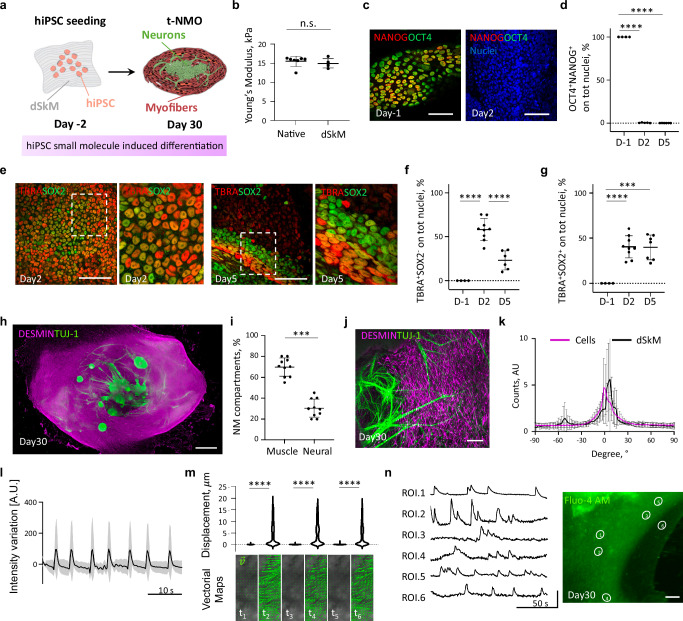
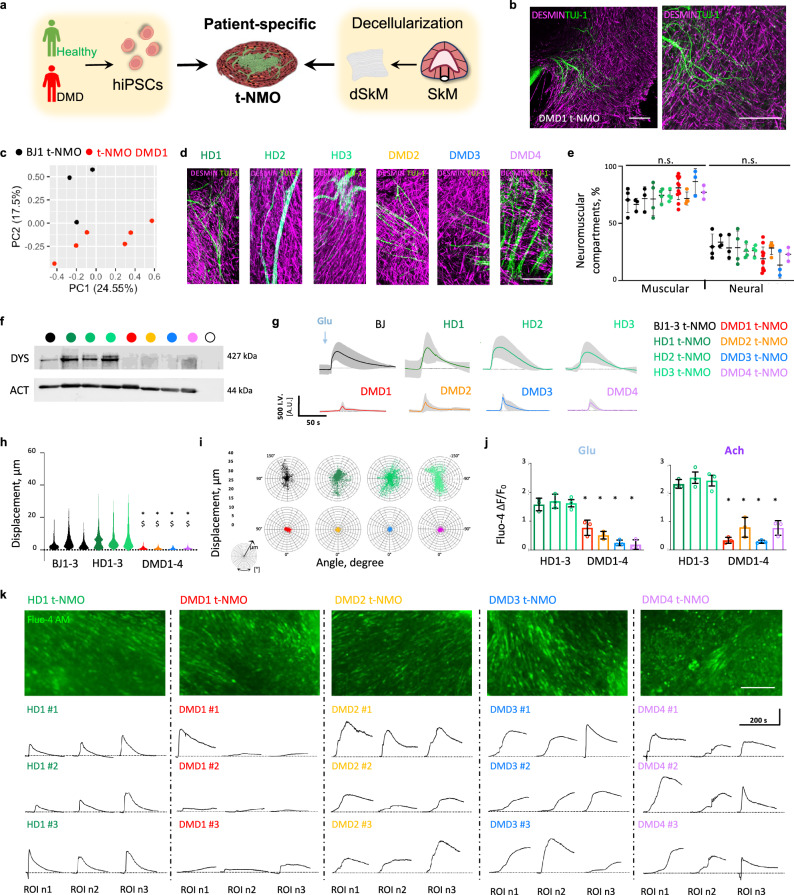
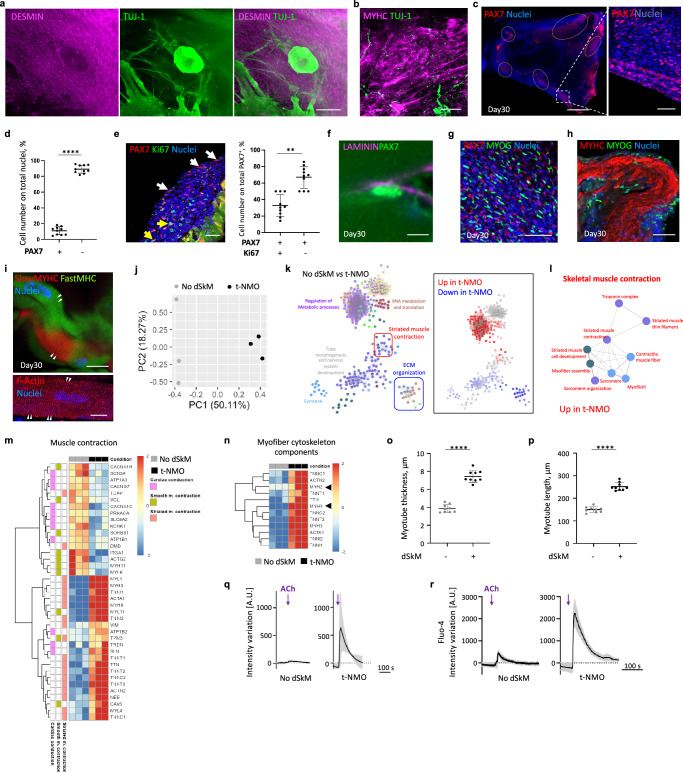
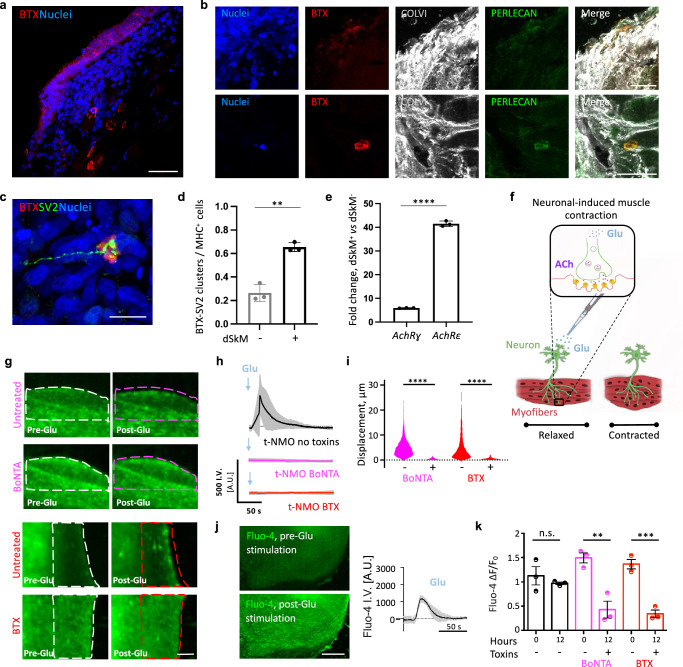
Skeletal muscle development, homeostasis, and function rely on complex interactions among multiple cell types and the extracellular matrix (ECM). Developing in vitro models that recapitulate both intrinsic cellular and extrinsic ECM elements of innervated skeletal muscle is crucial for advancing basic biology and disease modeling studies. Here, we combine tissue engineering approaches with human induced pluripotent stem cell (hiPSC) technology to create tissue-engineered neuromuscular organoids (t-NMOs). Using decellularized muscles as scaffolds, hiPSCs differentiate to form organoids that establish a continuum with the provided biomaterial. After 30 days, t-NMOs exhibit compartmentalized neural and muscular components that establish functional interactions, allowing muscle contraction. We demonstrate the model's potential by creating Duchenne Muscular Dystrophy patient-specific t-NMOs, that recapitulate the reduced skeletal muscle contraction and altered calcium dynamics typical of the disease. Altogether, our study presents a tissue-engineered organoid that model the human neuromuscular system (dys)function, highlighting the potential of applying the ECM in organoid engineering.
骨骼肌的发育、稳态和功能依赖于多种细胞类型与细胞外基质(ECM)之间的复杂相互作用。构建能够重现受神经支配的骨骼肌固有细胞和外在ECM成分的体外模型,对于推进基础生物学和疾病建模研究至关重要。在此,我们将组织工程方法与人类诱导多能干细胞(hiPSC)技术相结合,以创建组织工程化神经肌肉类器官(t-NMO)。利用脱细胞肌肉作为支架,hiPSC分化形成与所提供生物材料建立连续体的类器官。30天后,t-NMO呈现出具有功能相互作用的分隔式神经和肌肉成分,从而实现肌肉收缩。我们通过创建杜兴氏肌肉营养不良症患者特异性t-NMO展示了该模型的潜力,这些t-NMO重现了该疾病典型的骨骼肌收缩减少和钙动力学改变。总之,我们的研究提出了一种模拟人类神经肌肉系统(功能)障碍的组织工程化类器官,突出了在类器官工程中应用ECM的潜力。