Rumi Md Aftabuddin, Hasnine Injamamul, Sayeed Md Abu, Islam Monjurul, Dutta Pronesh, Uddin Md Helal, Rahman Farhana, Samad Mohammed Abdus, Forwood Jade K, Hassan Mohammad Mahmudul, Islam Ariful
Faculty of Veterinary Medicine, Chattogram Veterinary and Animal Sciences University, Chattogram 4225, Bangladesh.
Institute of Epidemiology, Disease Control and Research (IEDCR), Dhaka 1212, Bangladesh.
One Health. 2025 Jul 8;21:101135. doi: 10.1016/j.onehlt.2025.101135. eCollection 2025 Dec.
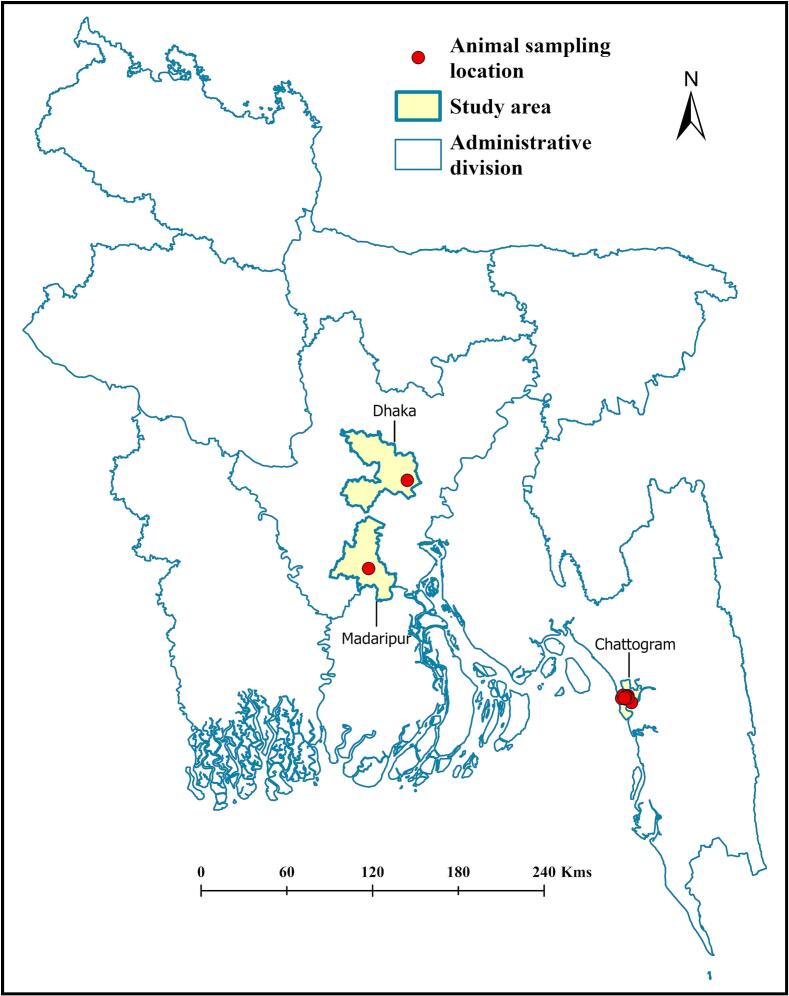
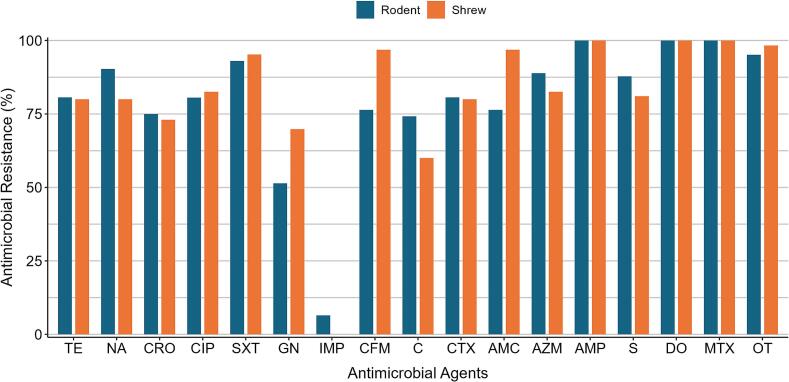
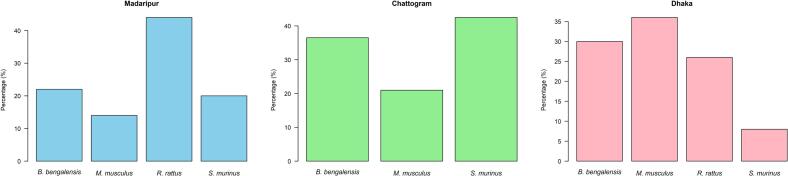
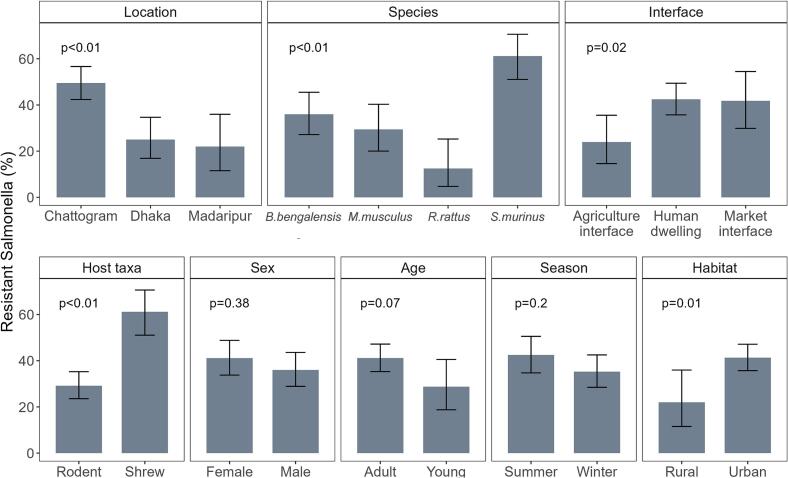
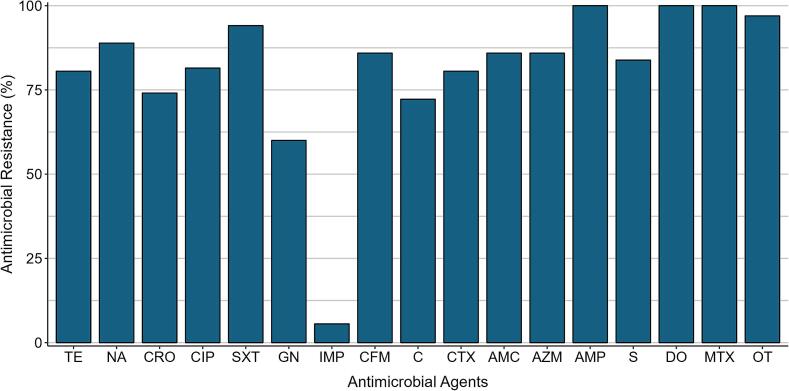
Multidrug resistant (MDR) organisms pose a significant global concern, affecting both human and animal health. Synanthropic small mammals, such as rodents and shrews can serve as environmental reservoirs and vectors for MDR organisms, including spp. Hence, a cross-sectional study was conducted to estimate the prevalence, risk factors, and MDR patterns of spp. in wild rodents and shrews across diverse ecological settings in Bangladesh. Throat and rectal/fecal swab samples were collected from a total of 350 mammals (203 wild rodents and 147 shrews) and tested for spp. using selective culturing, biochemical properties and PCR. All isolates were tested for culture susceptibility using the Kirby-Bauer disc diffusion method for 17 antimicrobials. Our findings revealed the overall prevalence of MDR spp. was 38.6 % (95 % CI: 33.5-44.0). Prevalence was highest in (61.2 %), followed by (35.9 %), (29.4 %) and (29.0 %). The resistance of the isolated Salmonella strains in descending order was: 100 % to ampicillin and oxytetracycline, followed by 94 % to sulfamethoxazole-trimethoprim, 92.0 % to doxycycline, and 89.0 % to ciprofloxacin. Shrews had significantly higher odds of carrying MDR (OR = 3.8, < 0.01) compared to rodents. Moreover, small mammals from human dwellings had greater odds (OR = 2.4, p < 0.01) of carrying MDR than agricultural lands. Resistance to ceftriaxone and azithromycin is particularly concerning, as these are critical for treating human infections with third generation cephalosporin and macrolides. These findings underscore the importance of enhanced reduced environmental contamination and judicious use of antibiotics to prevent spillovers of MDR organisms from wildlife to people and livestock.
多重耐药(MDR)生物体是一个重大的全球问题,影响着人类和动物健康。啮齿动物和鼩鼱等伴人小型哺乳动物可作为包括沙门氏菌属等MDR生物体的环境储存宿主和传播媒介。因此,开展了一项横断面研究,以估计孟加拉国不同生态环境中野生啮齿动物和鼩鼱体内沙门氏菌属的流行率、风险因素和MDR模式。从总共350只哺乳动物(203只野生啮齿动物和147只鼩鼱)采集咽喉和直肠/粪便拭子样本,并使用选择性培养、生化特性和PCR检测沙门氏菌属。使用Kirby-Bauer纸片扩散法对17种抗菌药物对所有分离株进行培养敏感性测试。我们的研究结果显示,MDR沙门氏菌属的总体流行率为38.6%(95%CI:33.5-44.0)。流行率在(某种鼠类,原文未明确)中最高(61.2%),其次是(另一种鼠类,原文未明确)(35.9%)、(某种鼠类,原文未明确)(29.4%)和(某种鼠类,原文未明确)(29.0%)。分离出的沙门氏菌菌株的耐药性从高到低依次为:对氨苄青霉素和土霉素的耐药率为100%,其次是对磺胺甲恶唑-甲氧苄啶的耐药率为94%,对强力霉素的耐药率为92.0%,对环丙沙星的耐药率为89.0%。与啮齿动物相比,鼩鼱携带MDR沙门氏菌的几率显著更高(OR = 3.8,P < 0.01)。此外,来自人类住所的小型哺乳动物携带MDR沙门氏菌的几率(OR = 2.4,P < 0.01)高于农田中的小型哺乳动物。对头孢曲松和阿奇霉素的耐药性尤其令人担忧,因为这些药物对于治疗人类第三代头孢菌素和大环内酯类感染至关重要。这些发现强调了加强减少环境污染和合理使用抗生素以防止MDR生物体从野生动物传播到人类和牲畜的重要性。