Martinez Marie F, Heneghan Jessie, Weatherwax Colleen, Moran Timothy H, Burton-Freeman Britt, Velmurugan Kavya, Ordovás José M, Bartsch Sarah M, Shah Tej D, Lee Jennifer, Booth Sarah L, Kleinberg Samantha, Chin Kevin L, de la Haye Kayla, Dibbs Alexis, Scannell Sheryl A, Lee Bruce Y
Public Health Informatics, Computational, and Operations Research (PHICOR), CUNY Graduate School of Public Health and Health Policy, New York City, NY, United States.
Center for Advanced Technology and Communication in Health (CATCH), CUNY Graduate School of Public Health and Health Policy, New York City, NY, United States.
Curr Dev Nutr. 2025 Jun 19;9(7):107487. doi: 10.1016/j.cdnut.2025.107487. eCollection 2025 Jul.
When it comes to how effectively a diet can help reduce or maintain body weight, a key question is how that diet affects a person's hunger, satiety, and subsequent eating.
This study aimed to analyze modeling, from a physiologic perspective, how varying the ratio of fats to carbohydrates in a diet impacts hunger, satiety, and subsequent eating among metabolically healthy adults.
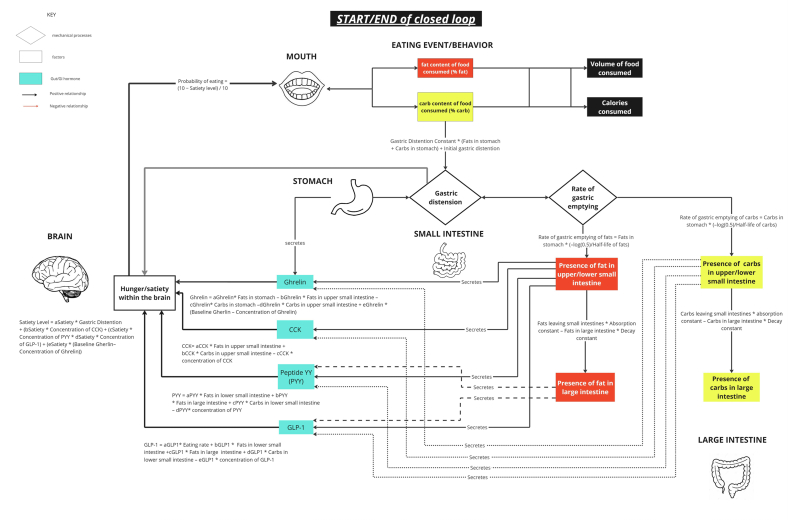
We developed a model representing an adult, their dietary intake, gastrointestinal tract, hunger/satiety levels, and meal consumption. We simulated agents eating fixed ratios of macronutrients and measured their subsequent eating over 24 h driven by physiologic responses.
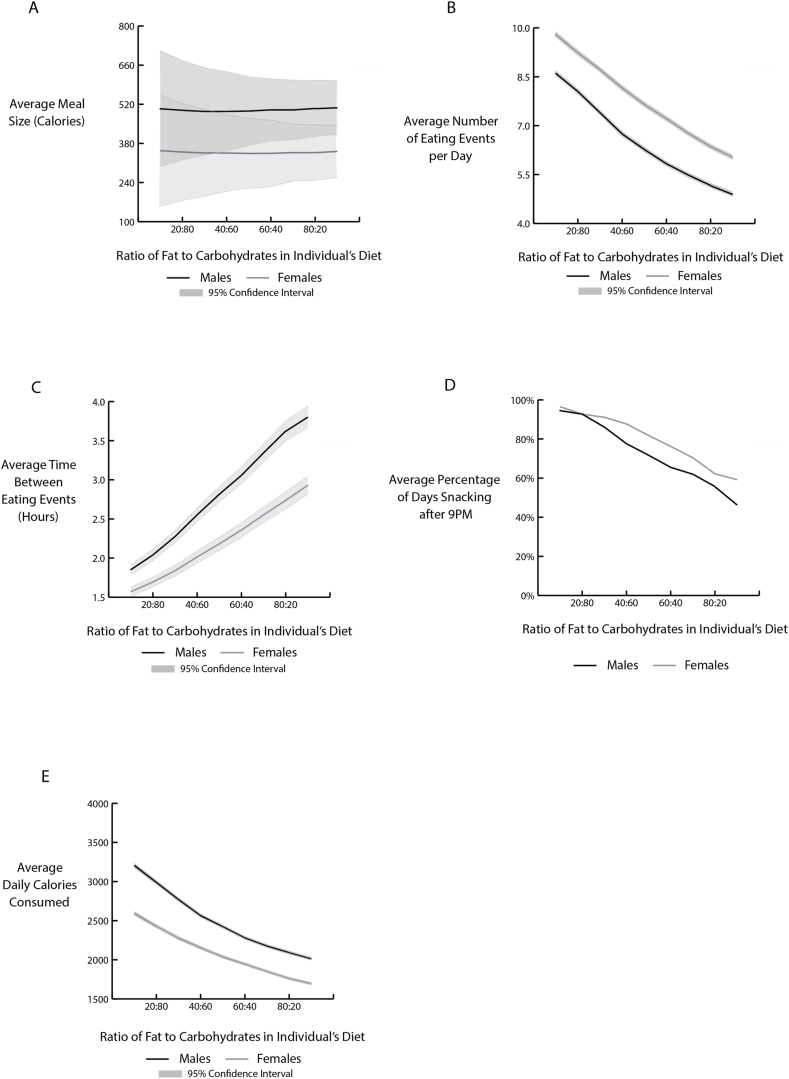
When increasing the proportion of energy from fats relative to carbohydrates, daily calories decrease by on mean 149 and 110 calories per 10% increase in fats for males and females, respectively. Additionally, a simulated diet with a relative ratio of energy from fats:carbohydrates of 20%:80% results in individuals snacking after 21:00 for ∼93% of days in both sexes, whereas a relative fat:carbohydrate ratio of 80%:20% results in late-night snacking ∼55% and ∼60% of days for males and females, respectively. Agents consuming at least a 40%:60% relative ratio of energy from fat:carbohydrate ratio can achieve the largest reductions in total calories consumed and late-night snacking compared with consuming higher relative proportions of carbohydrates.
Eating a diet with ≥40% of its energy from fats relative to carbohydrates can achieve the largest reductions in total calories consumed and late-night snacking each day than consuming higher proportions of carbohydrates, with even further reductions as more fat is added to the diet, when considering the physiologic responses to dietary intake alone. Future research should layer in other strong contributing factors to eating such as stress, social context, palatability, physical activity, and types of macronutrients, and also represent other metabolic profiles and ages.
在讨论饮食能在多大程度上有效帮助减轻或维持体重时,一个关键问题是该饮食如何影响人的饥饿感、饱腹感及后续进食。
本研究旨在从生理学角度分析饮食中脂肪与碳水化合物比例的变化如何影响代谢健康成年人的饥饿感、饱腹感及后续进食。
我们构建了一个模型,该模型涵盖成年人、其饮食摄入、胃肠道、饥饿/饱腹感水平及进餐情况。我们模拟了摄入固定比例常量营养素的个体,并根据生理反应测量他们在24小时内的后续进食情况。
当相对于碳水化合物增加脂肪的能量比例时,男性和女性每将脂肪比例提高10%,每日卡路里摄入量平均分别减少149卡路里和110卡路里。此外,能量来源中脂肪与碳水化合物相对比例为20%:80%的模拟饮食,导致男女在21:00之后吃零食的天数约为93%,而脂肪与碳水化合物相对比例为80%:20%时,男性和女性吃夜宵的天数分别约为55%和60%。与摄入相对较高比例碳水化合物的情况相比,摄入脂肪与碳水化合物能量相对比例至少为40%:60%的个体,在总卡路里摄入量和夜宵摄入量方面能实现最大程度的减少。
仅考虑对饮食摄入的生理反应时,与摄入较高比例碳水化合物相比,摄入能量中脂肪占比≥40%的饮食,能使每日总卡路里摄入量和夜宵摄入量实现最大程度的减少,且随着饮食中脂肪添加量增加,减少幅度更大。未来研究应纳入其他对饮食有重要影响的因素,如压力、社交环境、适口性、身体活动以及常量营养素类型,同时还应涵盖其他代谢特征和年龄段。