Kuroda Daisuke, Moriyama Saya, Sasaki Hiroaki, Takahashi Yoshimasa
Research Center for Vaccine Development, National Institute of Infectious Diseases, Japan Institute for Health Security, Tokyo, Japan.
Department of Biosciences, College of Humanities and Sciences, Nihon University, Tokyo, Japan.
Hum Vaccin Immunother. 2025 Dec;21(1):2526873. doi: 10.1080/21645515.2025.2526873. Epub 2025 Jul 21.
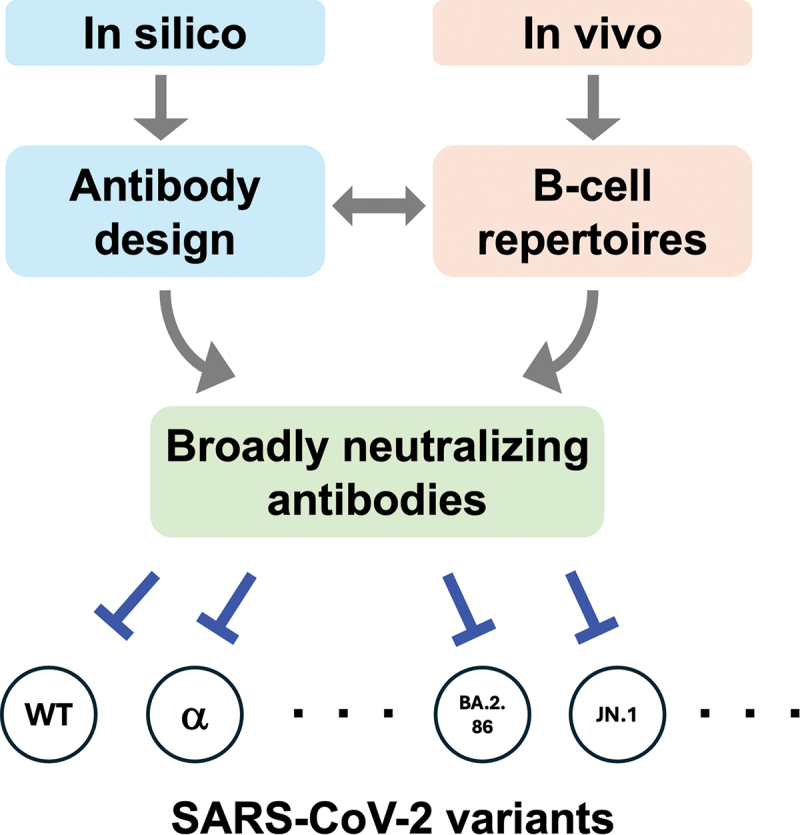
Since the emergence of SARS-CoV-2, the ongoing arms race between mutating viruses and human antibodies has revealed several novel strategies by which antibodies adapt to viral escape. While SARS-CoV-2 viruses exhibit high variability in epitopes targeted by neutralizing antibodies, certain epitopes remain conserved owing to their essential roles on viral fitness. Antibodies can acquire broadly neutralizing activity by targeting these vulnerable sites through affinity-based somatic evolution of immunoglobulin genes. Notably, the specificity encoded in antibody germline genes also plays a fundamental role in acquiring the breadth. In-depth genetic and structural analyses of the antibody repertoires have uncovered multiple strategies for adapting to evolving targets. The integration of large-scale antibody datasets with computational approaches increases the feasibility and efficiency of designing broadly neutralizing antibody therapeutics from ancestral antibody clones with limited initial efficacy. In this review, we discuss strategies to optimize antibody breadth for the development of broadly neutralizing antibody therapeutics and vaccine antigens.
自严重急性呼吸综合征冠状病毒2(SARS-CoV-2)出现以来,不断变异的病毒与人类抗体之间的竞争揭示了抗体适应病毒逃逸的几种新策略。虽然SARS-CoV-2病毒在中和抗体靶向的表位上表现出高度变异性,但某些表位因其对病毒适应性的重要作用而保持保守。抗体可通过基于亲和力的免疫球蛋白基因体细胞进化靶向这些易损位点,从而获得广泛中和活性。值得注意的是,抗体种系基因编码的特异性在获得广度方面也起着基本作用。对抗体库的深入遗传和结构分析揭示了多种适应不断演变的靶点的策略。将大规模抗体数据集与计算方法相结合,提高了从初始疗效有限的祖先抗体克隆设计广泛中和抗体疗法的可行性和效率。在这篇综述中,我们讨论了为开发广泛中和抗体疗法和疫苗抗原而优化抗体广度的策略。