Milenova Maria, Thusini S'thembile, Gronholm Petra C, Salisbury Tatiana Taylor
Health Service and Population Research Department, Institute of Psychiatry, Centre for Global Mental Health, King's College London, Psychology & Neuroscience, London, UK.
Health Service and Population Research Department, Institute of Psychiatry, King's College London, Psychology & Neuroscience, London, UK.
BMC Glob Public Health. 2025 Jul 21;3(1):63. doi: 10.1186/s44263-025-00182-6.
Sustaining the benefits of externally funded interventions in low- and middle-income countries (LMICs) remains a concern in global health. As many initiatives depend on time-limited official development assistance (ODA) or philanthropic funding, exit strategies are increasingly recognised as key to ensuring positive impact. This systematic review examines how exit strategies have been conceptualised and implemented across a range of global health initiatives. We aim to identify, categorise and analyse the components of exit strategies during or after the implementation of health interventions in LMICs and their effectiveness. The results of this review will inform future global health programme design and research, including mental health.
Database searches were conducted in Embase, Scopus, PubMed, PsycINFO (Elsevier), HMIC Health Management Information Consortium, MEDLINE, Social Policy and Practice, Web of Science and Global Health. The latest searches were run in January 2023. Data on study characteristics were descriptively synthesised. Extracted data regarding exit strategy processes and components were analysed using thematic synthesis.
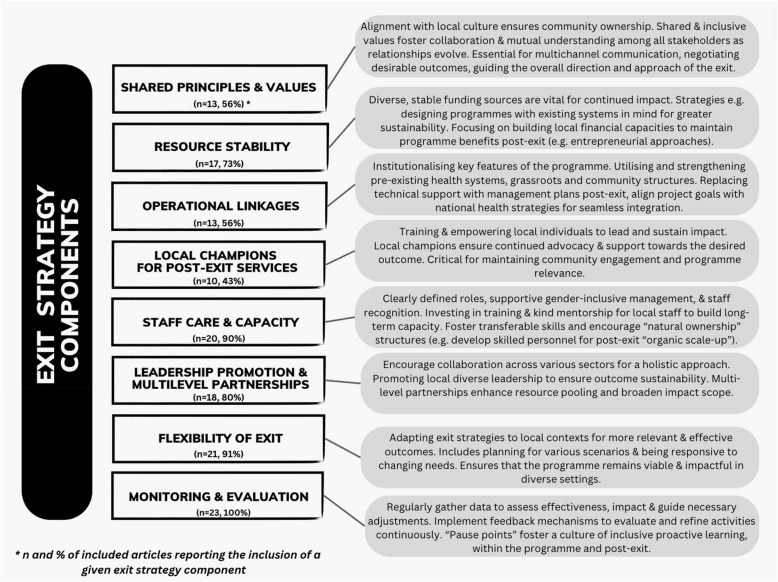
Twenty-three articles (reflecting 22 studies) were identified for inclusion. Within these, eight key components of successful exit strategies were identified: (1) shared principles and values, (2) resource stability, (3) operational linkages, (4) local champions, (5) staff care and capacity, (6) leadership promotion, (7) mentoring and evaluation and (8) context-sensitive flexibility of exit. The studies showcased the complexity and interdependent nature of exit strategies in varied health contexts and provided insights into effective processes for sustained implementation.
This review highlights the importance of planning for sustainability from the outset of health programmes in LMICs. The application of effective, contextually adaptive exit strategies is critical to ensuring the continuity of health gains after external support ends. It emphasises the need for collaborative research focused on long-term impacts and offers concrete recommendations for policy and practice.
PROSPERO Registration: (ref. CRD42021236969).
在低收入和中等收入国家(LMICs)维持外部资助干预措施的效益仍是全球卫生领域关注的问题。由于许多倡议依赖于有时间限制的官方发展援助(ODA)或慈善资金,退出战略越来越被视为确保产生积极影响的关键。本系统评价考察了退出战略在一系列全球卫生倡议中是如何被概念化和实施的。我们旨在识别、分类和分析低收入和中等收入国家卫生干预措施实施期间或之后退出战略的组成部分及其有效性。本评价结果将为未来全球卫生项目设计和研究(包括心理健康)提供参考。
在Embase、Scopus、PubMed、PsycINFO(爱思唯尔)、HMIC卫生管理信息联盟、MEDLINE、社会政策与实践、科学网和全球卫生数据库中进行检索。最新检索于2023年1月进行。对研究特征数据进行描述性综合分析。使用主题综合法分析提取的关于退出战略过程和组成部分的数据。
共纳入23篇文章(反映22项研究)。其中,确定了成功退出战略的八个关键组成部分:(1)共享原则和价值观,(2)资源稳定性,(3)业务联系,(4)当地支持者,(5)员工关怀与能力,(6)领导力提升,(7)指导与评估,(8)因地制宜的退出灵活性。这些研究展示了不同卫生背景下退出战略的复杂性和相互依存性,并提供了关于持续实施有效过程的见解。
本评价强调了在低收入和中等收入国家卫生项目一开始就规划可持续性的重要性。应用有效、因地制宜的退出战略对于确保外部支持结束后健康收益的连续性至关重要。它强调了开展关注长期影响的合作研究的必要性,并为政策和实践提供了具体建议。
PROSPERO注册:(参考文献CRD42021236969)