Selby Joe V, Maas Carolien C H M, Fireman Bruce H, Kent David M
Division of Research, Kaiser Permanente Northern California, Pleasanton.
Tufts Predictive Analytics and Comparative Effectiveness Center, Tufts University School of Medicine, Boston, Massachusetts.
JAMA Netw Open. 2025 Jul 1;8(7):e2522390. doi: 10.1001/jamanetworkopen.2025.22390.
The Predictive Approaches to Treatment Effect Heterogeneity (PATH) Statement of 2020 proposed predictive modeling for identifying heterogeneity in treatment effects (HTE) in randomized clinical trials (RCTs). It described 2 approaches: risk modeling, which develops a multivariable model predicting individual baseline risk of study outcomes and then examines treatment effects across strata of predicted risk, and effect modeling, which develops a model that directly predicts individual treatment effects using a variety of regression and machine learning methods.
To identify, describe, and evaluate findings from reports that cited the PATH Statement and presented predictive modeling of HTE in RCTs.
Reports were identified using PubMed, Google Scholar, Web of Science, and SCOPUS through July 5, 2024. Using double review with adjudication, reports were assessed for consistency with PATH Statement recommendations, credibility of HTE findings (applying criteria adapted from the Instrument to Assess Credibility of Effect Modification Analyses), and clinical importance of credible findings.
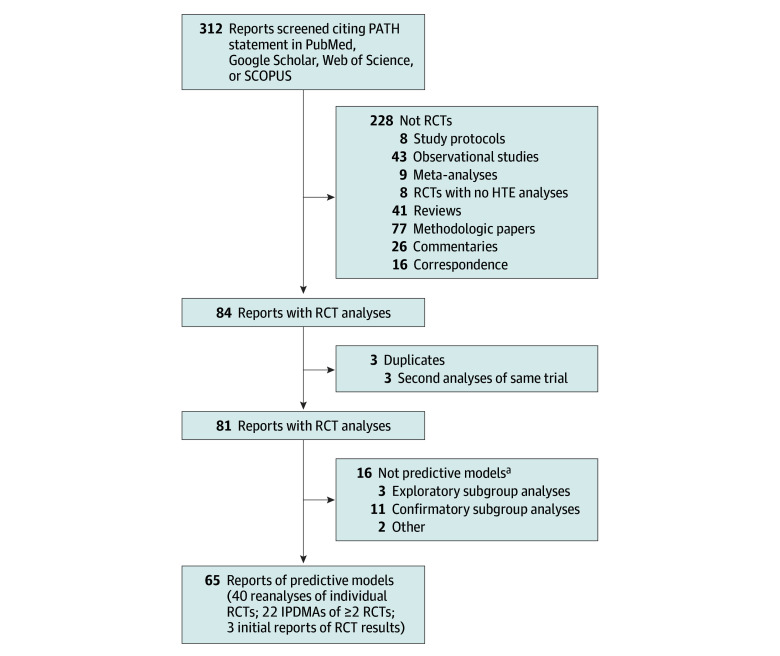
A total of 65 reports (presenting 31 risk models and 41 effect models) analyzing 162 RCTs were identified, with credible, clinically important HTE in 24 reports (37%). Contrary to PATH Statement recommendations, only 25 of 48 studies with positive overall findings included a risk model. Most effect models were exploratory, including multiple predictors with little prior evidence for HTE. Claims of HTE were noted in 23 risk modeling and 31 effect modeling reports but were more likely to meet credibility criteria with risk modeling (20 of 23 reports [87%]) than effect modeling (10 of 31 reports [32%]). For effect modeling, validation of HTE findings in external datasets was critical in establishing credibility. Credible HTE from either approach was usually judged clinically important (24 of 30 reports [80%]). In the 19 reports from RCTs suggesting overall treatment benefits, modeling identified subgroups of 5% to 67% of patients predicted to experience no benefit or net treatment harm. In the 5 reports that found no overall benefit, subgroups of 25% to 60% of patients were nevertheless predicted to benefit.
This scoping review of 65 reports of multivariable predictive modeling of HTE in RCTs identified credible, clinically important HTE in 37%. Risk modeling was more likely than effect modeling to find credible HTE, but external validation of HTE findings served to increase the credibility of findings from exploratory effect models.
2020年的治疗效果异质性预测方法(PATH)声明提出了用于识别随机临床试验(RCT)中治疗效果异质性(HTE)的预测模型。它描述了两种方法:风险建模,即建立一个多变量模型来预测研究结果的个体基线风险,然后检查预测风险分层中的治疗效果;以及效应建模,即使用各种回归和机器学习方法建立一个直接预测个体治疗效果的模型。
识别、描述和评估引用PATH声明并呈现RCT中HTE预测模型的报告中的研究结果。
通过PubMed、谷歌学术、科学网和Scopus检索截至2024年7月5日的报告。通过双人评审和裁决,评估报告与PATH声明建议的一致性、HTE研究结果的可信度(应用改编自效应修饰分析可信度评估工具的标准)以及可信研究结果的临床重要性。
共识别出65篇分析162项RCT的报告(呈现31个风险模型和41个效应模型),其中24篇报告(37%)有可信的、具有临床重要性的HTE。与PATH声明的建议相反,在48项总体结果为阳性的研究中,只有25项纳入了风险模型。大多数效应模型是探索性的,包括多个对HTE几乎没有先验证据的预测因素。在23篇风险建模报告和31篇效应建模报告中提到了HTE的主张,但风险建模(23篇报告中的20篇[87%])比效应建模(31篇报告中的10篇[32%])更有可能符合可信度标准。对于效应建模,在外部数据集中验证HTE研究结果对于确立可信度至关重要。两种方法得出的可信HTE通常被判定具有临床重要性(30篇报告中的24篇[80%])。在19篇表明总体治疗有益的RCT报告中,模型识别出5%至67%的患者亚组预计无益处或有净治疗危害。在5篇未发现总体益处的报告中,仍有25%至60%的患者亚组预计会受益。
这项对65篇RCT中HTE多变量预测模型报告的范围综述发现,37%的报告中有可信的、具有临床重要性的HTE。风险建模比效应建模更有可能发现可信的HTE,但对HTE研究结果进行外部验证有助于提高探索性效应模型研究结果的可信度。